



The length of two parallel chords of a circle are $6\;{\rm{cm}}$ and $8\;{\rm{cm}}$. If the smaller chord is at distance $4\;{\rm{cm}}$ from the center, what is the distance of the other chord from the center?
Answer
 Verified
648.6k+ views
Hint: In the solution we will use Pythagoras theorem to find out the distance of the chord from the center. Pythagoras theorem shows the relation between hypotenuse, base and perpendicular of a right triangle.
Complete Step-by-step Solution
Given:
The length of the first chord of the circle is ${l_1} = 6\;{\rm{cm}}$.
The length of the second chord of the circle is ${l_2} = 8\;{\rm{cm}}$.
The distance of the smaller chord from the center is $d = 4\;{\rm{cm}}$.
The following is the schematic diagram of the circle having two parallel chords.
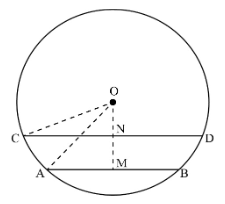
The chord of the circle is divided by the perpendicular line into two parts. The radius of the circle is,
$R = \sqrt {{{\left( {\frac{{{l_1}}}{2}} \right)}^2} + {{\left( {\frac{{{l_2}}}{2}} \right)}^2}} $
Here, $R$ is the radius of the circle.
Substitute the values in the above equation to get the radius of the circle.
$\begin{array}{l}
R = \sqrt {{{\left( {\frac{{6\;{\rm{cm}}}}{2}} \right)}^2} + {{\left( {\frac{{8\;{\rm{cm}}}}{2}} \right)}^2}} \\
R = \sqrt {{{\left( {3\;{\rm{cm}}} \right)}^2} + {{\left( {4\;{\rm{cm}}} \right)}^2}} \\
R = 5\;{\rm{cm}}
\end{array}$
Since, the radius of the circle is $5\;{\rm{cm}}$. Now, the distance of the other chord from the center is,
\[D = \sqrt {{R^2} - {d^2}} \]
Here, \[D\] is the distance of the other chord from the center.
Substitute the values in the above equation.
\[\begin{array}{l}
D = \sqrt {{{\left( {5\;{\rm{cm}}} \right)}^2} - {{\left( {4\;{\rm{cm}}} \right)}^2}} \\
D = 3\;{\rm{cm}}
\end{array}\]
Therefore, the distance of the chord from the center of the circle is \[3\;{\rm{cm}}\].
Note: In such types of problems, the theorem of chords of a circle which states that the chord of the circle is divided by the perpendicular line into two equal parts is used to find the radius of the circle.
Complete Step-by-step Solution
Given:
The length of the first chord of the circle is ${l_1} = 6\;{\rm{cm}}$.
The length of the second chord of the circle is ${l_2} = 8\;{\rm{cm}}$.
The distance of the smaller chord from the center is $d = 4\;{\rm{cm}}$.
The following is the schematic diagram of the circle having two parallel chords.
The chord of the circle is divided by the perpendicular line into two parts. The radius of the circle is,
$R = \sqrt {{{\left( {\frac{{{l_1}}}{2}} \right)}^2} + {{\left( {\frac{{{l_2}}}{2}} \right)}^2}} $
Here, $R$ is the radius of the circle.
Substitute the values in the above equation to get the radius of the circle.
$\begin{array}{l}
R = \sqrt {{{\left( {\frac{{6\;{\rm{cm}}}}{2}} \right)}^2} + {{\left( {\frac{{8\;{\rm{cm}}}}{2}} \right)}^2}} \\
R = \sqrt {{{\left( {3\;{\rm{cm}}} \right)}^2} + {{\left( {4\;{\rm{cm}}} \right)}^2}} \\
R = 5\;{\rm{cm}}
\end{array}$
Since, the radius of the circle is $5\;{\rm{cm}}$. Now, the distance of the other chord from the center is,
\[D = \sqrt {{R^2} - {d^2}} \]
Here, \[D\] is the distance of the other chord from the center.
Substitute the values in the above equation.
\[\begin{array}{l}
D = \sqrt {{{\left( {5\;{\rm{cm}}} \right)}^2} - {{\left( {4\;{\rm{cm}}} \right)}^2}} \\
D = 3\;{\rm{cm}}
\end{array}\]
Therefore, the distance of the chord from the center of the circle is \[3\;{\rm{cm}}\].
Note: In such types of problems, the theorem of chords of a circle which states that the chord of the circle is divided by the perpendicular line into two equal parts is used to find the radius of the circle.
Recently Updated Pages
Master Class 12 Economics: Engaging Questions & Answers for Success

Master Class 12 Social Science: Engaging Questions & Answers for Success
Master Class 12 English: Engaging Questions & Answers for Success
Master Class 12 Maths: Engaging Questions & Answers for Success
Master Class 12 Physics: Engaging Questions & Answers for Success
Master Class 12 Biology: Engaging Questions & Answers for Success
Trending doubts
The common name of Rheo leaf is A Oyster plant B Boat class 9 biology CBSE
Difference Between Plant Cell and Animal Cell
Any five important events between the years 1930 to class 9 social science CBSE
What is the Full Form of ICSE, CBSE and SSC
On an outline map of India show its neighbouring c class 9 social science CBSE
The process by which a solid changes directly into class 9 chemistry CBSE