




The length of the wall is 8m and height is 4m. Wall is 35 cm thick. There is one door of size \[2m\times 1m\] and two windows of size \[1.2m\times 1m\]. Find the expenditure of making the wall at the rate of Rs. 1500 per cubic meter.
Answer
 Verified
630.6k+ views
Hint: Calculate the volume of the wall and subtract this from the space occupied by doors and windows.
\[Volume\text{ }=length\times width\times thickness.\]
Complete step by step answer:
Given, the length of wall is 8m and height of wall is 4m and thickness is 35cm that is 0.35m. Consider the diagram:
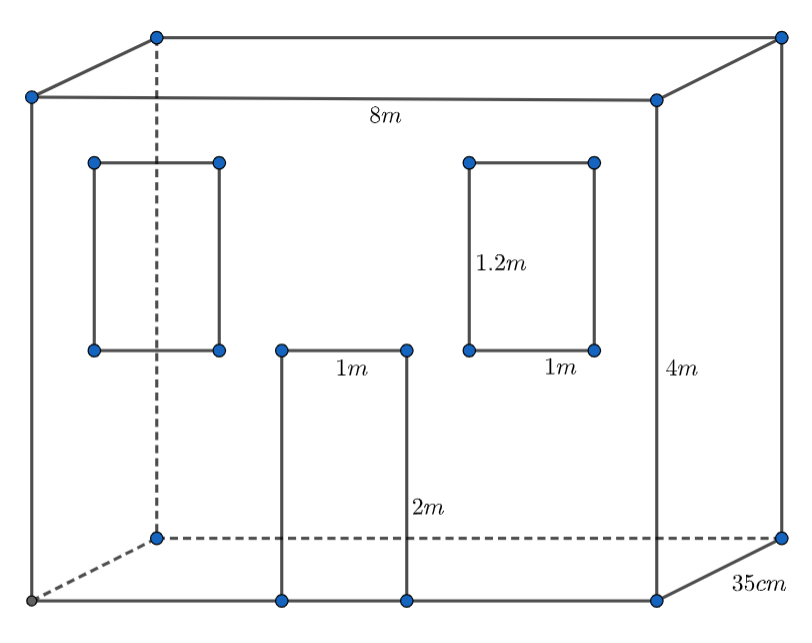
Therefore, the actual volume of the wall is 8×4×0.35=11.2 cubic meters.
Now, the door has dimensions of 2m×1m and it will occupy the thickness that is equal to the thickness of the wall because the door is through the wall. So, the dimensions of the door are 2m×1m×0.35m.
Therefore, door occupies a volume of
\[~2\times 1\times 0.35=0.70\]cubic meters.
The wall has two windows of dimensions \[1.20m\times 1m\]and it will occupy the thickness that is equal to the thickness of the wall because the windows are through the walls. So, the dimensions of windows are \[1.20\times 1m\times 0.35m.\]
Therefore, the volume occupied by windows is \[2\left( 1.20\times 1\times 0.35 \right)=0.84\]cubic meters because there are two windows.
We have expenditure on the volume of \[\left( 11.2-0.70-0.84 \right)=9.66\]cubic meters because the volume occupied by doors and windows is left for their construction.
Given, the expenditure for making the wall is Rs.1500 per cubic meter.
The volume of the wall to be constructed is 9.66 cubic meters.
Therefore, expenditure for constructing the wall is \[\left( \text{ }9.66\times 1500 \right)rupees\text{ }=14,490\]rupees.
Hence, the expenditure for making the wall is 14,490 rupees.
Note: Students must take care while converting m to cubic meters. This may lead to the get wrong answers which may vary with the point. Here, thickness also included, so pay attention while doing the sum.
\[Volume\text{ }=length\times width\times thickness.\]
Complete step by step answer:
Given, the length of wall is 8m and height of wall is 4m and thickness is 35cm that is 0.35m. Consider the diagram:
Therefore, the actual volume of the wall is 8×4×0.35=11.2 cubic meters.
Now, the door has dimensions of 2m×1m and it will occupy the thickness that is equal to the thickness of the wall because the door is through the wall. So, the dimensions of the door are 2m×1m×0.35m.
Therefore, door occupies a volume of
\[~2\times 1\times 0.35=0.70\]cubic meters.
The wall has two windows of dimensions \[1.20m\times 1m\]and it will occupy the thickness that is equal to the thickness of the wall because the windows are through the walls. So, the dimensions of windows are \[1.20\times 1m\times 0.35m.\]
Therefore, the volume occupied by windows is \[2\left( 1.20\times 1\times 0.35 \right)=0.84\]cubic meters because there are two windows.
We have expenditure on the volume of \[\left( 11.2-0.70-0.84 \right)=9.66\]cubic meters because the volume occupied by doors and windows is left for their construction.
Given, the expenditure for making the wall is Rs.1500 per cubic meter.
The volume of the wall to be constructed is 9.66 cubic meters.
Therefore, expenditure for constructing the wall is \[\left( \text{ }9.66\times 1500 \right)rupees\text{ }=14,490\]rupees.
Hence, the expenditure for making the wall is 14,490 rupees.
Note: Students must take care while converting m to cubic meters. This may lead to the get wrong answers which may vary with the point. Here, thickness also included, so pay attention while doing the sum.
Recently Updated Pages
Master Class 11 Social Science: Engaging Questions & Answers for Success

Master Class 11 Chemistry: Engaging Questions & Answers for Success
Master Class 12 Business Studies: Engaging Questions & Answers for Success
Master Class 12 Chemistry: Engaging Questions & Answers for Success
Master Class 12 Biology: Engaging Questions & Answers for Success
Class 12 Question and Answer - Your Ultimate Solutions Guide
Trending doubts
One Metric ton is equal to kg A 10000 B 1000 C 100 class 11 physics CBSE
Difference Between Prokaryotic Cells and Eukaryotic Cells
Two of the body parts which do not appear in MRI are class 11 biology CBSE
Explain zero factorial class 11 maths CBSE
10 examples of friction in our daily life
Name the Largest and the Smallest Cell in the Human Body ?