




The length of the tangent to a circle from a point 17cm from its centre is 8 cm. Find the radius of the circle.
Answer
 Verified
629.1k+ views
Hint: Analyse this question with a Diagram .Consider a circle with radius ‘r’ and draw a tangent on it. Join the tangent with the centre of the circle. Then, a right-angled triangle is formed .Use Pythagoras theorem to find the radius of the circle.
Formula used: Pythagoras Theorem: ${\left( {{\text{Hypotenuse}}} \right)^{\text{2}}}{\text{ = }}{\left( {{\text{Perpendicular}}} \right)^{\text{2}}}{\text{ + }}{\left( {{\text{Base}}} \right)^{\text{2}}}$
i.e. ${{\text{h}}^{\text{2}}}{\text{ = }}{{\text{p}}^{\text{2}}}{\text{ + }}{{\text{b}}^{\text{2}}}$
Complete step-by-step answer:
Given: Length of the tangent = 8 cm
Distance of tangent from centre of circle=17 cm
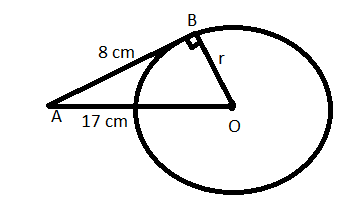
Consider the above diagram of a circle with radius ‘r’ cm.
Here,AB is representing the length of the tangent, OB is representing the radius of the circle and OA is representing the distance of the tangent from the centre of the circle.
As we know from the property of tangent of a circle that ‘at the point of contact, the tangent of the circle is perpendicular to its radius’.
i.e., $OB \bot AB$
So, triangle OBA is a right-angled triangle with OA as hypotenuse.
So, by using Pythagoras Theorem, we have :$O{A^2} = $$O{A^2} = A{B^2} + O{B^2}$………..(i)
From above Diagram, we have: OB= r cm, OA=17 cm, AB =8 cm
Putting these values in equation (i), we have
$\begin{gathered}
{17^2} = {8^2} + {r^2} \\
\Rightarrow 289 = 64 + {r^2} \\
\end{gathered} $
Taking ‘r’ on LHS side ,we have:
$\begin{gathered}
\Rightarrow {r^2} = 289 - 64 \\
\Rightarrow {r^2} = 225 \\
\end{gathered} $
Taking the square root of ‘r’ ,we have:
$\begin{gathered}
\Rightarrow r = \sqrt {225} \\
\therefore r = 15 \\
\end{gathered} $
Thus, the required radius of circle = 15 cm
Note: A tangent to a circle is a straight line that touches the circle at one point, called the point of tangency. At the point of tangency, the tangent of the circle is perpendicular to its radius.
This problem can be solved using Trigonometric ratios. Two sides of a right –angled triangle is known, so we can find one of the acute angle of this triangle .Then, we can find the value of radius ‘r’ using any suitable trigonometric ratio.
Formula used: Pythagoras Theorem: ${\left( {{\text{Hypotenuse}}} \right)^{\text{2}}}{\text{ = }}{\left( {{\text{Perpendicular}}} \right)^{\text{2}}}{\text{ + }}{\left( {{\text{Base}}} \right)^{\text{2}}}$
i.e. ${{\text{h}}^{\text{2}}}{\text{ = }}{{\text{p}}^{\text{2}}}{\text{ + }}{{\text{b}}^{\text{2}}}$
Complete step-by-step answer:
Given: Length of the tangent = 8 cm
Distance of tangent from centre of circle=17 cm
Consider the above diagram of a circle with radius ‘r’ cm.
Here,AB is representing the length of the tangent, OB is representing the radius of the circle and OA is representing the distance of the tangent from the centre of the circle.
As we know from the property of tangent of a circle that ‘at the point of contact, the tangent of the circle is perpendicular to its radius’.
i.e., $OB \bot AB$
So, triangle OBA is a right-angled triangle with OA as hypotenuse.
So, by using Pythagoras Theorem, we have :$O{A^2} = $$O{A^2} = A{B^2} + O{B^2}$………..(i)
From above Diagram, we have: OB= r cm, OA=17 cm, AB =8 cm
Putting these values in equation (i), we have
$\begin{gathered}
{17^2} = {8^2} + {r^2} \\
\Rightarrow 289 = 64 + {r^2} \\
\end{gathered} $
Taking ‘r’ on LHS side ,we have:
$\begin{gathered}
\Rightarrow {r^2} = 289 - 64 \\
\Rightarrow {r^2} = 225 \\
\end{gathered} $
Taking the square root of ‘r’ ,we have:
$\begin{gathered}
\Rightarrow r = \sqrt {225} \\
\therefore r = 15 \\
\end{gathered} $
Thus, the required radius of circle = 15 cm
Note: A tangent to a circle is a straight line that touches the circle at one point, called the point of tangency. At the point of tangency, the tangent of the circle is perpendicular to its radius.
This problem can be solved using Trigonometric ratios. Two sides of a right –angled triangle is known, so we can find one of the acute angle of this triangle .Then, we can find the value of radius ‘r’ using any suitable trigonometric ratio.
Recently Updated Pages
Master Class 11 English: Engaging Questions & Answers for Success

Master Class 11 Social Science: Engaging Questions & Answers for Success
Master Class 11 Maths: Engaging Questions & Answers for Success
Master Class 11 Biology: Engaging Questions & Answers for Success
Master Class 11 Physics: Engaging Questions & Answers for Success
Master Class 11 Chemistry: Engaging Questions & Answers for Success
Trending doubts