



The length of the diagonal of the square is \[\sqrt 2 \left( {6 + 2\sqrt 5 } \right){\rm{cm}}\]. Then find the length of a side of the square.
Answer
 Verified
579.6k+ views
Hint:
Here, we will first draw the diagram of the square and divide it into two right triangles using the diagonal. Then we will apply the Pythagorean Theorem, in one of the triangles and find the required length of the side of the square. Pythagoras theorem states that the square of hypotenuse is equal to the sum of squares of the other two sides. Here, we will consider the diagonal as the hypotenuse.
Formula Used:
We will use the formula of the Pythagoras Theorem, \[{\left( {{\rm{Hypotenuse}}} \right)^2} = {\left( {{\rm{Perpendicular}}} \right)^2} + {\left( {{\rm{Base}}} \right)^2}\]
Complete step by step solution:
Given length of diagonal of square \[ = \sqrt 2 \left( {6 + 2\sqrt 5 } \right){\rm{cm}}\]
Now, let the side of the square be \[a\]
First of all, we will draw a square showing the given diagonal.
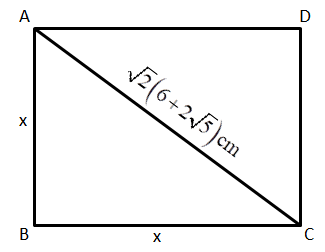
Here, we are having a square \[ABCD\] with sides \[x{\rm{cm}}\] and the length of the diagonal \[AC = \sqrt 2 \left( {6 + 2\sqrt 5 } \right){\rm{cm}}\]
Now, in the right triangle \[ABC\], we will apply the Pythagoras. Therefore, we get
\[{\left( {AC} \right)^2} = {\left( {AB} \right)^2} + {\left( {BC} \right)^2}\]
Substituting the values from the figure, we get
\[ \Rightarrow {\left( {\sqrt 2 \left( {6 + 2\sqrt 5 } \right)} \right)^2} = {\left( x \right)^2} + {\left( x \right)^2}\]
Adding the like terms, we get
\[ \Rightarrow 2{\left( {6 + 2\sqrt 5 } \right)^2} = 2{x^2}\]
Cancelling out 2 from both the sides, we get
\[ \Rightarrow {\left( {6 + 2\sqrt 5 } \right)^2} = {x^2}\]
Taking square root on both sides and neglecting the negative value because the length of side of a square can’t be negative, we get,
\[ \Rightarrow x = 6 + 2\sqrt 5 {\rm{cm}}\]
Therefore, the required length of the side of the square is \[6 + 2\sqrt 5 {\rm{cm}}\]
Hence, this is the required answer.
Note:
An alternate way of solving this question is:
As we know, if the length of the side of a square is \[x\], then using Pythagoras theorem, the length of its diagonal is \[\sqrt 2 x\].
Now, if we compare the length of the side of a square and the length of its diagonal we can notice that, by multiplying the side of a square by \[\sqrt 2 \], we will be able to find the length of the diagonal.
Hence, alternatively, if we divide the length of the diagonal by \[\sqrt 2 \], then, we will be able to find the side of a square.
Using this property, we have the formula,
Side of a square \[ = \] Length of diagonal of the square \[ \div \sqrt 2 \]
Hence, in this question, the diagonal of the square is \[\sqrt 2 \left( {6 + 2\sqrt 5 } \right){\rm{cm}}\].
Therefore, the required side of the square \[ = \dfrac{{\sqrt 2 \left( {6 + 2\sqrt 5 } \right)}}{{\sqrt 2 }} = \left( {6 + 2\sqrt 5 } \right){\rm{cm}}\]
Hence, this is the required answer.
Here, we will first draw the diagram of the square and divide it into two right triangles using the diagonal. Then we will apply the Pythagorean Theorem, in one of the triangles and find the required length of the side of the square. Pythagoras theorem states that the square of hypotenuse is equal to the sum of squares of the other two sides. Here, we will consider the diagonal as the hypotenuse.
Formula Used:
We will use the formula of the Pythagoras Theorem, \[{\left( {{\rm{Hypotenuse}}} \right)^2} = {\left( {{\rm{Perpendicular}}} \right)^2} + {\left( {{\rm{Base}}} \right)^2}\]
Complete step by step solution:
Given length of diagonal of square \[ = \sqrt 2 \left( {6 + 2\sqrt 5 } \right){\rm{cm}}\]
Now, let the side of the square be \[a\]
First of all, we will draw a square showing the given diagonal.
Here, we are having a square \[ABCD\] with sides \[x{\rm{cm}}\] and the length of the diagonal \[AC = \sqrt 2 \left( {6 + 2\sqrt 5 } \right){\rm{cm}}\]
Now, in the right triangle \[ABC\], we will apply the Pythagoras. Therefore, we get
\[{\left( {AC} \right)^2} = {\left( {AB} \right)^2} + {\left( {BC} \right)^2}\]
Substituting the values from the figure, we get
\[ \Rightarrow {\left( {\sqrt 2 \left( {6 + 2\sqrt 5 } \right)} \right)^2} = {\left( x \right)^2} + {\left( x \right)^2}\]
Adding the like terms, we get
\[ \Rightarrow 2{\left( {6 + 2\sqrt 5 } \right)^2} = 2{x^2}\]
Cancelling out 2 from both the sides, we get
\[ \Rightarrow {\left( {6 + 2\sqrt 5 } \right)^2} = {x^2}\]
Taking square root on both sides and neglecting the negative value because the length of side of a square can’t be negative, we get,
\[ \Rightarrow x = 6 + 2\sqrt 5 {\rm{cm}}\]
Therefore, the required length of the side of the square is \[6 + 2\sqrt 5 {\rm{cm}}\]
Hence, this is the required answer.
Note:
An alternate way of solving this question is:
As we know, if the length of the side of a square is \[x\], then using Pythagoras theorem, the length of its diagonal is \[\sqrt 2 x\].
Now, if we compare the length of the side of a square and the length of its diagonal we can notice that, by multiplying the side of a square by \[\sqrt 2 \], we will be able to find the length of the diagonal.
Hence, alternatively, if we divide the length of the diagonal by \[\sqrt 2 \], then, we will be able to find the side of a square.
Using this property, we have the formula,
Side of a square \[ = \] Length of diagonal of the square \[ \div \sqrt 2 \]
Hence, in this question, the diagonal of the square is \[\sqrt 2 \left( {6 + 2\sqrt 5 } \right){\rm{cm}}\].
Therefore, the required side of the square \[ = \dfrac{{\sqrt 2 \left( {6 + 2\sqrt 5 } \right)}}{{\sqrt 2 }} = \left( {6 + 2\sqrt 5 } \right){\rm{cm}}\]
Hence, this is the required answer.

Recently Updated Pages
Master Class 9 Social Science: Engaging Questions & Answers for Success

Master Class 9 Science: Engaging Questions & Answers for Success
Master Class 9 Maths: Engaging Questions & Answers for Success
Master Class 9 General Knowledge: Engaging Questions & Answers for Success
Class 9 Question and Answer - Your Ultimate Solutions Guide
Master Class 8 Social Science: Engaging Questions & Answers for Success
Trending doubts
Find the sum of series 1 + 2 + 3 + 4 + 5 + + 100 class 9 maths CBSE
What is the Full Form of ISI and RAW
Fill the blanks with the suitable prepositions 1 The class 9 english CBSE
Difference Between Plant Cell and Animal Cell
Who is eligible for RTE class 9 social science CBSE
What is pollution? How many types of pollution? Define it