




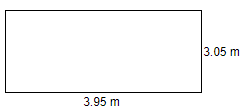
The length and width of a rectangular room are measured to be $3.95\pm 0.05m$ and $3.05\pm 0.05m$ respectively. The area of the floor is
(A) $12.05\pm 0.01{{m}^{2}}$
(B) $12.05\pm 0.005{{m}^{2}}$
(C) $12.05\pm 0.34{{m}^{2}}$
(D) $12.05\pm 0.40{{m}^{2}}$
Answer
 Verified
617.7k+ views
Hint: We solve this question by first considering the given length and breadth and then find the area without error by using the formula for the area of the rectangle $Area=l\times b$. The we consider the formula for area and then applying logarithm to it and then differentiate it using the formulas $\dfrac{d}{dx}\log x=\dfrac{1}{x}$ and $\log a+\log b=\log ab$. Then we substitute the values of length and breadth and their errors and area to find the value of error in the area. Then we combine both the area and its error to find the required value of the area.
Complete step by step answer:
We are given that the length and width of a rectangular room are $3.95\pm 0.05m$ and $3.05\pm 0.05m$ respectively.
We need to find the area of the floor.
Let us assume that length and breadth are $l=3.95\pm 0.05m$ and $b=3.05\pm 0.05m$.
Here errors of length and breadth are $\Delta l=0.05m$ and $\Delta b=0.05m$.
As we are given that the room is rectangular, let us consider the formula for the area of the rectangle with length $l$ and breadth $b$.
$Area=l\times b$
Then we get the area of room without errors using this formula as,
$\begin{align}
& \Rightarrow Area=3.95\times 3.05 \\
& \Rightarrow Area=12.0475...........\left( 1 \right) \\
\end{align}$
Rounding it off to two decimals we get the area as $12.05{{m}^{2}}$.
Now let us find the error in the area.
Let us consider the formula for the area of the room.
$\Rightarrow Area=l\times b$
Now let us apply logarithm to the above equation. Then we get,
$\Rightarrow \log Area=\log \left( l\times b \right)$
Now let us consider the formula,
$\log a+\log b=\log ab$
Using this formula, we can write the above equation as,
$\Rightarrow \log Area=\log l+\log b$
Now let us differentiate the above equation.
Let us also consider the formula for differentiation of $\log x$, $\dfrac{d}{dx}\log x=\dfrac{1}{x}$.
So, we get the above equation as,
$\Rightarrow \dfrac{\Delta Area}{Area}=\dfrac{\Delta l}{l}+\dfrac{\Delta b}{b}$
Now let us substitute the values of $l,b,A,\Delta l,\Delta b$ in the above equation.
$\begin{align}
& \Rightarrow \dfrac{\Delta Area}{12.05}=\dfrac{0.05}{3.95}+\dfrac{0.05}{3.05} \\
& \Rightarrow \Delta Area=12.05\times \left( \dfrac{0.05}{3.95}+\dfrac{0.05}{3.05} \right) \\
& \Rightarrow \Delta Area=12.05\times \left( 0.01265+0.01639 \right) \\
& \Rightarrow \Delta Area=12.05\times \left( 0.02904 \right) \\
& \Rightarrow \Delta Area=0.349932..............\left( 2 \right) \\
\end{align}$
So, rounding it off to two digits we get the error in the area as $0.34{{m}^{2}}$
So, finally we get the area as, $12.05\pm 0.34{{m}^{2}}$.
So, the correct answer is “Option C”.
Note: The common mistake one makes while solving this question is one might find the errors in an area by just multiplying the errors in the length and breadth, that is multiplying the values 0.05 and 0.05 from length and breadth.
Complete step by step answer:
We are given that the length and width of a rectangular room are $3.95\pm 0.05m$ and $3.05\pm 0.05m$ respectively.
We need to find the area of the floor.
Let us assume that length and breadth are $l=3.95\pm 0.05m$ and $b=3.05\pm 0.05m$.
Here errors of length and breadth are $\Delta l=0.05m$ and $\Delta b=0.05m$.
As we are given that the room is rectangular, let us consider the formula for the area of the rectangle with length $l$ and breadth $b$.
$Area=l\times b$
Then we get the area of room without errors using this formula as,
$\begin{align}
& \Rightarrow Area=3.95\times 3.05 \\
& \Rightarrow Area=12.0475...........\left( 1 \right) \\
\end{align}$
Rounding it off to two decimals we get the area as $12.05{{m}^{2}}$.
Now let us find the error in the area.
Let us consider the formula for the area of the room.
$\Rightarrow Area=l\times b$
Now let us apply logarithm to the above equation. Then we get,
$\Rightarrow \log Area=\log \left( l\times b \right)$
Now let us consider the formula,
$\log a+\log b=\log ab$
Using this formula, we can write the above equation as,
$\Rightarrow \log Area=\log l+\log b$
Now let us differentiate the above equation.
Let us also consider the formula for differentiation of $\log x$, $\dfrac{d}{dx}\log x=\dfrac{1}{x}$.
So, we get the above equation as,
$\Rightarrow \dfrac{\Delta Area}{Area}=\dfrac{\Delta l}{l}+\dfrac{\Delta b}{b}$
Now let us substitute the values of $l,b,A,\Delta l,\Delta b$ in the above equation.
$\begin{align}
& \Rightarrow \dfrac{\Delta Area}{12.05}=\dfrac{0.05}{3.95}+\dfrac{0.05}{3.05} \\
& \Rightarrow \Delta Area=12.05\times \left( \dfrac{0.05}{3.95}+\dfrac{0.05}{3.05} \right) \\
& \Rightarrow \Delta Area=12.05\times \left( 0.01265+0.01639 \right) \\
& \Rightarrow \Delta Area=12.05\times \left( 0.02904 \right) \\
& \Rightarrow \Delta Area=0.349932..............\left( 2 \right) \\
\end{align}$
So, rounding it off to two digits we get the error in the area as $0.34{{m}^{2}}$
So, finally we get the area as, $12.05\pm 0.34{{m}^{2}}$.
So, the correct answer is “Option C”.
Note: The common mistake one makes while solving this question is one might find the errors in an area by just multiplying the errors in the length and breadth, that is multiplying the values 0.05 and 0.05 from length and breadth.
Recently Updated Pages
Master Class 11 English: Engaging Questions & Answers for Success

Master Class 11 Social Science: Engaging Questions & Answers for Success
Master Class 11 Maths: Engaging Questions & Answers for Success
Master Class 11 Biology: Engaging Questions & Answers for Success
Master Class 11 Physics: Engaging Questions & Answers for Success
Master Class 11 Chemistry: Engaging Questions & Answers for Success
Trending doubts
Explain the Treaty of Vienna of 1815 class 10 social science CBSE
What is the full form of POSCO class 10 social science CBSE
Define Potential, Developed, Stock and Reserved resources
The diagonals of a rhombus are 10cm and 24cm Find the class 10 maths CBSE
Fill the blanks with proper collective nouns 1 A of class 10 english CBSE
What planets have no moons Which one has only one moon class 10 physics CBSE