



The length and breadth of three rectangles are given below. Find which one has greater perimeter and which one has least area.
(a) 10 m and 6 m
(b) 20 m and 10 m
(c) 15 m and 5 m
Answer
 Verified
483.6k+ views
Hint: We are given the length and breadth of the three rectangles and we need to find which one has greater perimeter and least area. We will use the formula of perimeter i.e. twice the sum of length and breadth. Next, the formula of area is multiplication of length and breadth. Solving this, we will get the final output.
Formula used:
Let, $l$ as the length and $b$ as the breadth of the rectangle. Then, the formula of
Perimeter \[ = 2(l + b)\] and
Area \[ = l \times b\]
Complete step by step answer:
Given, the length and breadth of three rectangles. We will solve all the cases given as below:
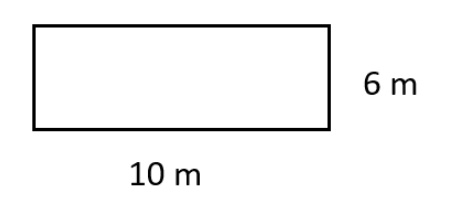
(a) 10 m and 6 m
Here, we are given that,
\[l = 10m\] and \[b = 6m\]
\[\text{Perimeter} = 2(l + b)\]
Substituting the values of both, we will get,
\[\text{Perimeter} = 2(10 + 6)\]
On simplifying this, we will get,
\[ \text{Perimeter} = 2(16)\]
\[ \therefore \text{Perimeter} = 32\,m\]
\[\text{Area} = l \times b\]
Substituting the values of both, we will get,
\[\text{Area} = 10 \times 6\]
On simplifying this, we will get,
\[\therefore \text{Area} = 60{m^2}\]
Thus, the perimeter is 32 m and the area is $60\,{m^2}$.
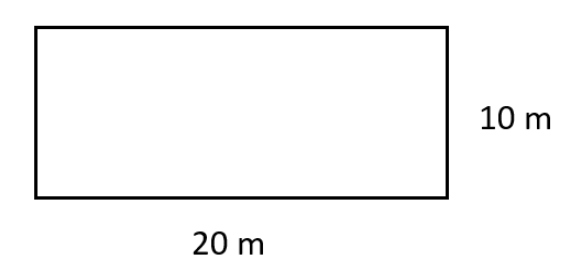
(b) 20m and 10m
Here, we are given that,
\[l = 20m\] and \[b = 10m\]
\[ \text{Perimeter} = 2(l + b)\]
Substituting the values of both, we will get,
\[\text{Perimeter} = 2(20 + 10)\]
On simplifying this, we will get,
\[\text{Perimeter} = 2(30)\]
\[\therefore \text{Perimeter} = 60\,m\]
\[\text{Area} = l \times b\]
Substituting the values of both, we will get,
\[\text{Area} = 20 \times 10\]
On simplifying this, we will get,
\[\therefore \text{Area} = 200{m^2}\]
Thus, the perimeter is 60 m and the area is $200\,{m^2}$.
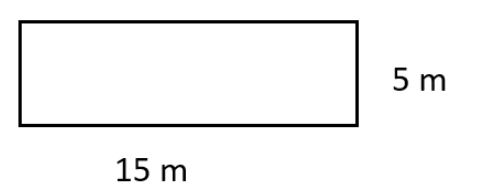
(c) 15m and 5m
Here, we are given that,
\[l = 15m\] and \[b = 5m\]
\[\text{Perimeter} = 2(l + b)\]
Substituting the values of both, we will get,
\[\text{Perimeter} = 2(15 + 5)\]
On simplifying this, we will get,
\[\text{Perimeter} = 2(20)\]
\[\therefore \text{Perimeter} = 40\,m\]
\[\text{Area} = l \times b\]
Substituting the values of both, we will get,
\[\text{Area} = 15 \times 5\]
On simplifying this, we will get,
\[\therefore \text{Area} = 75{m^2}\]
Thus, the perimeter is 40m and the area is $75\,{m^2}$.
Hence, from the above cases, we have:
- The Rectangle with greater perimeter is 60 m having \[l = 20m\] and \[b = 10m\].
- The Rectangle with the least area is $60\,{m^2}$ having \[l = 10m\] and \[b = 6m\] .
Note: We know that square and rectangle have four sides each. But, all the sides of a square are equal and in a rectangle only opposite sides are equal. The length of a rectangle is the longest side, whereas the width is the shortest side. And, the width of a rectangle is also referred to as the breadth. Also, the perimeter of the square is 4 times the length and the area of the square is square of the length.
Formula used:
Let, $l$ as the length and $b$ as the breadth of the rectangle. Then, the formula of
Perimeter \[ = 2(l + b)\] and
Area \[ = l \times b\]
Complete step by step answer:
Given, the length and breadth of three rectangles. We will solve all the cases given as below:
(a) 10 m and 6 m
Here, we are given that,
\[l = 10m\] and \[b = 6m\]
\[\text{Perimeter} = 2(l + b)\]
Substituting the values of both, we will get,
\[\text{Perimeter} = 2(10 + 6)\]
On simplifying this, we will get,
\[ \text{Perimeter} = 2(16)\]
\[ \therefore \text{Perimeter} = 32\,m\]
\[\text{Area} = l \times b\]
Substituting the values of both, we will get,
\[\text{Area} = 10 \times 6\]
On simplifying this, we will get,
\[\therefore \text{Area} = 60{m^2}\]
Thus, the perimeter is 32 m and the area is $60\,{m^2}$.
(b) 20m and 10m
Here, we are given that,
\[l = 20m\] and \[b = 10m\]
\[ \text{Perimeter} = 2(l + b)\]
Substituting the values of both, we will get,
\[\text{Perimeter} = 2(20 + 10)\]
On simplifying this, we will get,
\[\text{Perimeter} = 2(30)\]
\[\therefore \text{Perimeter} = 60\,m\]
\[\text{Area} = l \times b\]
Substituting the values of both, we will get,
\[\text{Area} = 20 \times 10\]
On simplifying this, we will get,
\[\therefore \text{Area} = 200{m^2}\]
Thus, the perimeter is 60 m and the area is $200\,{m^2}$.
(c) 15m and 5m
Here, we are given that,
\[l = 15m\] and \[b = 5m\]
\[\text{Perimeter} = 2(l + b)\]
Substituting the values of both, we will get,
\[\text{Perimeter} = 2(15 + 5)\]
On simplifying this, we will get,
\[\text{Perimeter} = 2(20)\]
\[\therefore \text{Perimeter} = 40\,m\]
\[\text{Area} = l \times b\]
Substituting the values of both, we will get,
\[\text{Area} = 15 \times 5\]
On simplifying this, we will get,
\[\therefore \text{Area} = 75{m^2}\]
Thus, the perimeter is 40m and the area is $75\,{m^2}$.
Hence, from the above cases, we have:
- The Rectangle with greater perimeter is 60 m having \[l = 20m\] and \[b = 10m\].
- The Rectangle with the least area is $60\,{m^2}$ having \[l = 10m\] and \[b = 6m\] .
Note: We know that square and rectangle have four sides each. But, all the sides of a square are equal and in a rectangle only opposite sides are equal. The length of a rectangle is the longest side, whereas the width is the shortest side. And, the width of a rectangle is also referred to as the breadth. Also, the perimeter of the square is 4 times the length and the area of the square is square of the length.
Recently Updated Pages
Master Class 9 Social Science: Engaging Questions & Answers for Success

Master Class 9 Science: Engaging Questions & Answers for Success
Master Class 9 Maths: Engaging Questions & Answers for Success
Master Class 9 General Knowledge: Engaging Questions & Answers for Success
Class 9 Question and Answer - Your Ultimate Solutions Guide
Master Class 8 Social Science: Engaging Questions & Answers for Success
Trending doubts
21st March is celebrated as A World environment day class 9 biology CBSE
Find the sum of series 1 + 2 + 3 + 4 + 5 + + 100 class 9 maths CBSE
What is the Full Form of ISI and RAW
Fill the blanks with the suitable prepositions 1 The class 9 english CBSE
Difference Between Plant Cell and Animal Cell
Here 1 km is equal to how many miles class 9 maths CBSE