




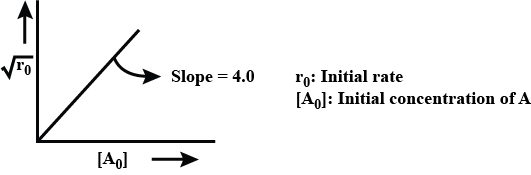
The kinetic study of a reaction like $vA\to P$ at 300K provides the following curve, where concentration is taken in $mo{{l}^{-1}}\ \text{d}{{\text{m}}^{\text{3}}}{{\min }^{-1}}$ and time in minute. Identify the correct order (n) and rate constant (k):
A. n = 0, k = 4.0 $mol\ \text{d}{{\text{m}}^{\text{-3}}}{{\min }^{-1}}$
B. n = 1/2, k = 2.0 $mo{{l}^{1/2}}\ \text{d}{{\text{m}}^{\text{-3}}}^{/2}{{\min }^{-1}}$
C. n = 1, k = 8.0 ${{\min }^{-1}}$
D. n = 2, k = 16 $K=16.0d{{m}^{3}}mo{{l}^{-1}}{{\min }^{-1}}$
Answer
 Verified
599.1k+ views
Hint: There is a special branch of chemistry which deals with the rate of reaction and the order of reaction and order of any reaction can be defined as the power which depends on the rate of concentration of all reactants.
Complete answer:
The order of reaction tells us the relationship between the rate of a chemical reaction and the concentration of the species taking part in it.
The order of reaction can also be depend upon the units given i.e. unit of zero order reaction are $mol{{L}^{-1}}{{\sec }^{-1}}$, first order reaction ${{\sec }^{-1}}$and second order reaction is $mo{{l}^{-1}}L{{\sec }^{-1}}$, now we can see in the question that the unit given is $mo{{l}^{-1}}\ \text{d}{{\text{m}}^{\text{3}}}{{\min }^{-1}}$which is similar to second order reaction. This suggests that n = 2.
Rate constant can be defined as the proportionality constant which explains the relationship between the molar concentration of the reactants and the rate of a chemical reaction.
$\sqrt{{{r}_{0}}}=4[{{A}_{0}}]$, this equation is obtained from the given graph.
By squaring both side
${{r}_{0}}=16{{[{{A}_{0}}]}^{2}}$
Now we know that
$Rate=K{{[{{A}_{0}}]}^{n}}$
Which implies that K = 16 and n = 2.
Thus we can say that option D is the correct answer.
Note:
The rate constant is represented by the symbol k and also known as reaction rate constant or reaction rate coefficient. It is temperature dependent. Rate constant can be determined by using the Arrhenius equation and using the molar concentrations of reactants.
Complete answer:
The order of reaction tells us the relationship between the rate of a chemical reaction and the concentration of the species taking part in it.
The order of reaction can also be depend upon the units given i.e. unit of zero order reaction are $mol{{L}^{-1}}{{\sec }^{-1}}$, first order reaction ${{\sec }^{-1}}$and second order reaction is $mo{{l}^{-1}}L{{\sec }^{-1}}$, now we can see in the question that the unit given is $mo{{l}^{-1}}\ \text{d}{{\text{m}}^{\text{3}}}{{\min }^{-1}}$which is similar to second order reaction. This suggests that n = 2.
Rate constant can be defined as the proportionality constant which explains the relationship between the molar concentration of the reactants and the rate of a chemical reaction.
$\sqrt{{{r}_{0}}}=4[{{A}_{0}}]$, this equation is obtained from the given graph.
By squaring both side
${{r}_{0}}=16{{[{{A}_{0}}]}^{2}}$
Now we know that
$Rate=K{{[{{A}_{0}}]}^{n}}$
Which implies that K = 16 and n = 2.
Thus we can say that option D is the correct answer.
Note:
The rate constant is represented by the symbol k and also known as reaction rate constant or reaction rate coefficient. It is temperature dependent. Rate constant can be determined by using the Arrhenius equation and using the molar concentrations of reactants.
Recently Updated Pages
If x a + bt + ct2 where x is in meters and t is in class 11 physics CBSE

A car covers the first half distance between two places class 11 physics CBSE
The resultant of two vectors overrightarrow P and overrightarrow class 11 physics CBSE
Find the value of cos 135 class 11 maths CBSE
A mass M is held in place by an applied force F and class 11 physics CBSE
A solution of glucose in water is labelled as 10 dfracwv class 11 chemistry CBSE
Trending doubts
One Metric ton is equal to kg A 10000 B 1000 C 100 class 11 physics CBSE
Find the value of the expression given below sin 30circ class 11 maths CBSE
What do you mean by retardation What is its SI uni class 11 physics CBSE
Draw a diagram of nephron and explain its structur class 11 biology CBSE
10 examples of friction in our daily life
Difference between physical and chemical change class 11 chemistry CBSE