




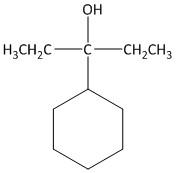
The IUPAC name of the following compound is:
A. \[3\]-cyclohexylpentan-\[3\]-ol
B. \[3\]-cyclohexyl-\[3\]-hydroxypentane
C. \[3\]-hydroxypentyl cyclohexane
D. None of the above
Answer
 Verified
546.3k+ views
Hint: The given compound belongs to an alcohol. It is a secondary alcohol. The parent compound contains the longest chain of five carbon atoms.
Complete step by step answer:
The naming of organic compounds is done following the IUPAC rules of nomenclature. IUPAC stands for International Union of Pure and Applied Chemistry.
According to the IUPAC rules the following points are to be followed for naming of a compound.
i. Identify the longest continuous carbon chain and name it.
ii. Identify the substituents attached to the carbon chain and name them.
iii. Number the carbon chain starting from the end to which the substituent is nearest.
iv. Name and designate the location of the substituents.
v. Write the name of the compound by listing the substituent groups in an alphabetical order.
From the structure analysis it appears that the given compound contains the longest chain in the form of five carbon atoms. Thus, the parent name of the alkane is pentane.
A hydroxyl group and a cyclohexyl ring are attached to the third carbon of the alkane chain. Thus the name of the compound must contain a \[3\]-cyclohexyl and a \[3\]-ol. The suffix –ol is used for naming alcohols which also contains other substituent groups.
Hence the name of the compound is \[3\]-cyclohexylpentan-\[3\]-ol, i.e. option is the correct answer.
So, the correct answer is Option A.
Note: The longest chain should be found correctly. Then identify the substituents and designate their location and name them correctly. If no other substituents are present and only alcohol functional group is present, then the name of the compound starts with a prefix ‘\[3\]-hydroxy-‘.
Complete step by step answer:
The naming of organic compounds is done following the IUPAC rules of nomenclature. IUPAC stands for International Union of Pure and Applied Chemistry.
According to the IUPAC rules the following points are to be followed for naming of a compound.
i. Identify the longest continuous carbon chain and name it.
ii. Identify the substituents attached to the carbon chain and name them.
iii. Number the carbon chain starting from the end to which the substituent is nearest.
iv. Name and designate the location of the substituents.
v. Write the name of the compound by listing the substituent groups in an alphabetical order.
From the structure analysis it appears that the given compound contains the longest chain in the form of five carbon atoms. Thus, the parent name of the alkane is pentane.
A hydroxyl group and a cyclohexyl ring are attached to the third carbon of the alkane chain. Thus the name of the compound must contain a \[3\]-cyclohexyl and a \[3\]-ol. The suffix –ol is used for naming alcohols which also contains other substituent groups.
Hence the name of the compound is \[3\]-cyclohexylpentan-\[3\]-ol, i.e. option is the correct answer.
So, the correct answer is Option A.
Note: The longest chain should be found correctly. Then identify the substituents and designate their location and name them correctly. If no other substituents are present and only alcohol functional group is present, then the name of the compound starts with a prefix ‘\[3\]-hydroxy-‘.
Recently Updated Pages
Master Class 11 Computer Science: Engaging Questions & Answers for Success

Master Class 11 Business Studies: Engaging Questions & Answers for Success
Master Class 11 Economics: Engaging Questions & Answers for Success
Master Class 11 English: Engaging Questions & Answers for Success
Master Class 11 Maths: Engaging Questions & Answers for Success
Master Class 11 Biology: Engaging Questions & Answers for Success
Trending doubts
One Metric ton is equal to kg A 10000 B 1000 C 100 class 11 physics CBSE
There are 720 permutations of the digits 1 2 3 4 5 class 11 maths CBSE
Discuss the various forms of bacteria class 11 biology CBSE
Draw a diagram of a plant cell and label at least eight class 11 biology CBSE
State the laws of reflection of light
Explain zero factorial class 11 maths CBSE