




The IUPAC name of $ C{H_3}C{H_2}COC{H_2}C{H_3} $ is
(A) 2-pentanone
(B) 3-pentanone
(C) Diethyl ketone
(D) All of the above
Answer
 Verified
555.3k+ views
Hint: IUPAC nomenclature is a method of naming the organic compounds recommended by the International Union of Pure and Applied Chemistry. IUPAC names are usually a long and tedious method of naming the compounds and chemists do not always prefer IUPAC naming. Trivial names or common names are used more often.
Complete answer:
The question given above is to find out the IUPAC name of the compound.
IUPAC nomenclature has some rules that one should follow to name any compound. The rules given are as follows:
-At first, the longest continuous carbon chain is chosen as a parent name of the compound
-Next, all the carbon atoms chosen as parent chains are numbered. Numbering will start from terminal carbon. It should be in such a way that the substituent gets the lowest number.
-Then name each of the substituents and indicate each of them by number.
Finally, combine the name and the substituent and the parent chain position and write it as one word.
After knowing the rules apply the rules to name the above compound.
The given compound is $ C{H_3}C{H_2}COC{H_2}C{H_3} $
Here the longest continuous chain has $ 5 $ carbons and so the longest chain is pentane as no double or triple bonds are present. Now the numbering of the chain will be as follows:
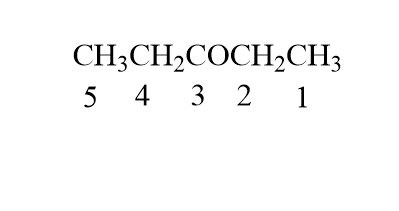
As we can see above the $ {3^{rd}} $ carbon has functional group ketone hence the parent chain will end with the suffix –one.
Therefore the IUPAC name of the compound is $ 3 - pentanone. $
So the correct option is B.
Note:
The name $ 3 - pentanone $ can also be written as $ pentane - 3 - one $ . If a double bond or triple bond is present, the compound’s name will end with ‘ene’ for double bond and ‘yne’ for a triple bond. The parent chain in some cases is a ring also. The groups’ alcohol, -COOH, ketone, etc. always are present in the suffix in IUPAC naming.
Complete answer:
The question given above is to find out the IUPAC name of the compound.
IUPAC nomenclature has some rules that one should follow to name any compound. The rules given are as follows:
-At first, the longest continuous carbon chain is chosen as a parent name of the compound
-Next, all the carbon atoms chosen as parent chains are numbered. Numbering will start from terminal carbon. It should be in such a way that the substituent gets the lowest number.
-Then name each of the substituents and indicate each of them by number.
Finally, combine the name and the substituent and the parent chain position and write it as one word.
After knowing the rules apply the rules to name the above compound.
The given compound is $ C{H_3}C{H_2}COC{H_2}C{H_3} $
Here the longest continuous chain has $ 5 $ carbons and so the longest chain is pentane as no double or triple bonds are present. Now the numbering of the chain will be as follows:
As we can see above the $ {3^{rd}} $ carbon has functional group ketone hence the parent chain will end with the suffix –one.
Therefore the IUPAC name of the compound is $ 3 - pentanone. $
So the correct option is B.
Note:
The name $ 3 - pentanone $ can also be written as $ pentane - 3 - one $ . If a double bond or triple bond is present, the compound’s name will end with ‘ene’ for double bond and ‘yne’ for a triple bond. The parent chain in some cases is a ring also. The groups’ alcohol, -COOH, ketone, etc. always are present in the suffix in IUPAC naming.
Recently Updated Pages
Master Class 11 English: Engaging Questions & Answers for Success

Master Class 11 Social Science: Engaging Questions & Answers for Success
Master Class 11 Maths: Engaging Questions & Answers for Success
Master Class 11 Biology: Engaging Questions & Answers for Success
Master Class 11 Physics: Engaging Questions & Answers for Success
Master Class 11 Chemistry: Engaging Questions & Answers for Success
Trending doubts
Find the value of the expression given below sin 30circ class 11 maths CBSE
Difference between physical and chemical change class 11 chemistry CBSE
Agaragar is obtained from A Chlorella B Spirogyra C class 11 biology CBSE
Agaragar is derived from a A fungi b An algae c Both class 11 biology CBSE
Draw a labelled diagram showing structure of LS of class 11 biology CBSE
Hydrogen bonding is seen in H2O and not in H2S Why class 11 chemistry CBSE