




The IUPAC name of ${{\text{C}}_{6}}{{\text{H}}_{4}}\text{COCl}$is:
A. Benzoyl chloride
B. Benzene chloro ketone
C. Benzene carbonyl chloride
D. Chlorophenyl ketone
Answer
 Verified
597.3k+ views
Hint: Benzene is a six-carbon containing compound. The naming of carbon is done according to the amount of it present in the molecule. Ketone is a -CO functional group whereas while doing the naming of halogens, they are commonly named as chloride, fluoride, bromide, etc.
Complete step by step solution:
- In the given question we have to explain the IUPAC or International Union of Applied and Pure Chemistry of the given compound.
- So, the structure of the compound is:
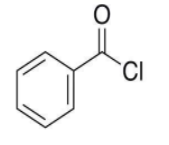
- Here, we can see that a chlorine group is attached at the benzoyl group i.e. ${{\text{C}}_{6}}{{\text{H}}_{5}}\text{CO-}$.
- We know that the IUPAC name of chlorine is chloride.
- So, the IUPAC name of the above compound is Benzoyl chloride.
- In benzene chloro ketone, the chlorine is attached to the other carbon other than carbonyl carbon.
- So, this option (b) is not correct because the benzoyl group is ${{\text{C}}_{6}}{{\text{H}}_{5}}\text{CO-}$.
- In option (c), the carbonyl group is mentioned whose formula is C=O, the particular group is present in the compound, but it cannot be considered as a prior group,
- So, option (c) is also incorrect.
- A phenyl group is similar to the benzene except it has one hydrogen atom less than the benzene.
- In the phenyl group, one hydrogen is absent and other elements can attach to its place.
- So, option (d) is also incorrect.
Therefore, option (a) is the correct answer.
Note: One may get confused with the benzene, benzyl and benzyl group. There is a difference between these three structures. The formula of benzene, benzyl and benzoyl is ${{\text{C}}_{6}}{{\text{H}}_{5}},\ {{\text{C}}_{6}}{{\text{H}}_{5}}\text{CH}_{2}^{-},{{\text{C}}_{6}}{{\text{H}}_{5}}\text{CO}$ respectively.
Complete step by step solution:
- In the given question we have to explain the IUPAC or International Union of Applied and Pure Chemistry of the given compound.
- So, the structure of the compound is:
- Here, we can see that a chlorine group is attached at the benzoyl group i.e. ${{\text{C}}_{6}}{{\text{H}}_{5}}\text{CO-}$.
- We know that the IUPAC name of chlorine is chloride.
- So, the IUPAC name of the above compound is Benzoyl chloride.
- In benzene chloro ketone, the chlorine is attached to the other carbon other than carbonyl carbon.
- So, this option (b) is not correct because the benzoyl group is ${{\text{C}}_{6}}{{\text{H}}_{5}}\text{CO-}$.
- In option (c), the carbonyl group is mentioned whose formula is C=O, the particular group is present in the compound, but it cannot be considered as a prior group,
- So, option (c) is also incorrect.
- A phenyl group is similar to the benzene except it has one hydrogen atom less than the benzene.
- In the phenyl group, one hydrogen is absent and other elements can attach to its place.
- So, option (d) is also incorrect.
Therefore, option (a) is the correct answer.
Note: One may get confused with the benzene, benzyl and benzyl group. There is a difference between these three structures. The formula of benzene, benzyl and benzoyl is ${{\text{C}}_{6}}{{\text{H}}_{5}},\ {{\text{C}}_{6}}{{\text{H}}_{5}}\text{CH}_{2}^{-},{{\text{C}}_{6}}{{\text{H}}_{5}}\text{CO}$ respectively.
Recently Updated Pages
Master Class 11 Economics: Engaging Questions & Answers for Success

Master Class 11 English: Engaging Questions & Answers for Success
Master Class 11 Maths: Engaging Questions & Answers for Success
Class 11 Question and Answer - Your Ultimate Solutions Guide
Master Class 11 Social Science: Engaging Questions & Answers for Success
Master Class 11 Business Studies: Engaging Questions & Answers for Success
Trending doubts
One Metric ton is equal to kg A 10000 B 1000 C 100 class 11 physics CBSE
There are 720 permutations of the digits 1 2 3 4 5 class 11 maths CBSE
Differentiate between an exothermic and an endothermic class 11 chemistry CBSE
In what year Guru Nanak Dev ji was born A15 April 1469 class 11 social science CBSE
Difference Between Prokaryotic Cells and Eukaryotic Cells
State and prove Bernoullis theorem class 11 physics CBSE