




The innermost part of a flower is called the ________.
Answer
 Verified
525.9k+ views
Hint: As flowers help reproduction in plants, the innermost part of it is known as the female reproductive part. It is located centrally and consists of a swollen base, the ovary, a pollen receptive tip and the stigma.
Complete answer:
A flower can be defined as the reproductive part of any angiosperms as they carry out sexual reproduction in them. A flower has four different parts - the calyx, corolla, androecium and gynoecium. It is the androecium and gynoecium which contains the male and female reproductive organs of the plant respectively.
The calyx is the outermost part of the flower mainly containing the sepals. They are a green and leaf-like formation that protects the flower during its early stage also called the bud stage. The Corolla of a flower is found inside the calyx and contains coloured petals. These help in alluring and attracting insects for pollination. The androecium is the next part after the corolla and it typically consists of stamens which are the male reproductive element of the flower and is composed of two parts anther and filament. The gynoecium is the innermost whorl of a flower consisting of pistils, the female reproductive organs of the flower.
Carpel, individually or collectively known as pistils which are the female part of the plants and is composed of three parts stigma, style and ovary. Pistils collectively form the gynoecium, in distinction to the male reproductive parts, androecium. A pistil may have one carpel called the simple pistil or more carpels called the compound pistil joined partially (in mustard) or completely joined (in lily). A flower containing separate pistils is termed apocarpous and if more than two its is syncarpous.
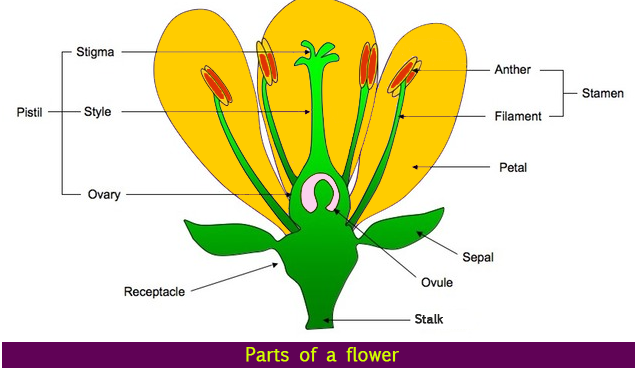
The innermost part of a flower is known as the pistil.
Note: Pistils and the ovary is the basal swollen portion of the pistil and the wall of the ovary after fertilization is known as the pericarp. Carpels are the innermost whorls of flowers. In pollination, pollen grains land on the stigma and then germinate which forms a pollen tube that grows down through the tissue of the style to deposit sperm in the ovary.
Complete answer:
A flower can be defined as the reproductive part of any angiosperms as they carry out sexual reproduction in them. A flower has four different parts - the calyx, corolla, androecium and gynoecium. It is the androecium and gynoecium which contains the male and female reproductive organs of the plant respectively.
The calyx is the outermost part of the flower mainly containing the sepals. They are a green and leaf-like formation that protects the flower during its early stage also called the bud stage. The Corolla of a flower is found inside the calyx and contains coloured petals. These help in alluring and attracting insects for pollination. The androecium is the next part after the corolla and it typically consists of stamens which are the male reproductive element of the flower and is composed of two parts anther and filament. The gynoecium is the innermost whorl of a flower consisting of pistils, the female reproductive organs of the flower.
Carpel, individually or collectively known as pistils which are the female part of the plants and is composed of three parts stigma, style and ovary. Pistils collectively form the gynoecium, in distinction to the male reproductive parts, androecium. A pistil may have one carpel called the simple pistil or more carpels called the compound pistil joined partially (in mustard) or completely joined (in lily). A flower containing separate pistils is termed apocarpous and if more than two its is syncarpous.
The innermost part of a flower is known as the pistil.
Note: Pistils and the ovary is the basal swollen portion of the pistil and the wall of the ovary after fertilization is known as the pericarp. Carpels are the innermost whorls of flowers. In pollination, pollen grains land on the stigma and then germinate which forms a pollen tube that grows down through the tissue of the style to deposit sperm in the ovary.
Recently Updated Pages
Master Class 5 English: Engaging Questions & Answers for Success

Master Class 5 Maths: Engaging Questions & Answers for Success
Master Class 5 Social Science: Engaging Questions & Answers for Success
Master Class 5 Science: Engaging Questions & Answers for Success
Class 5 Question and Answer - Your Ultimate Solutions Guide
Master Class 9 General Knowledge: Engaging Questions & Answers for Success
Trending doubts
One Metric ton is equal to kg A 10000 B 1000 C 100 class 11 physics CBSE
What is cell theory Who formulated it class 11 biology CBSE
Phyllotaxy is the arrangement of ALeaflets BLeaves class 11 biology CBSE
Difference Between Prokaryotic Cells and Eukaryotic Cells
The symbiotic association of fungi and algae is called class 11 biology CBSE
Cell theory was formulated by A Schleiden and Schwann class 11 biology CBSE