




The inner membrane of mitochondria is folded because
a) It has no space
b) It helps in transportation of material
c) It increases the surface area
d) It stores more food
Answer
 Verified
654.6k+ views
Hint:
- Mitochondria are membrane-bound organelles, but with two different membranes.
- The powerhouse of our cell mitochondria has an external film and inward layer. The internal layer known as the cristae is collapsed.
Complete answer:
To answer this question we need the knowledge of basic structure of mitochondria
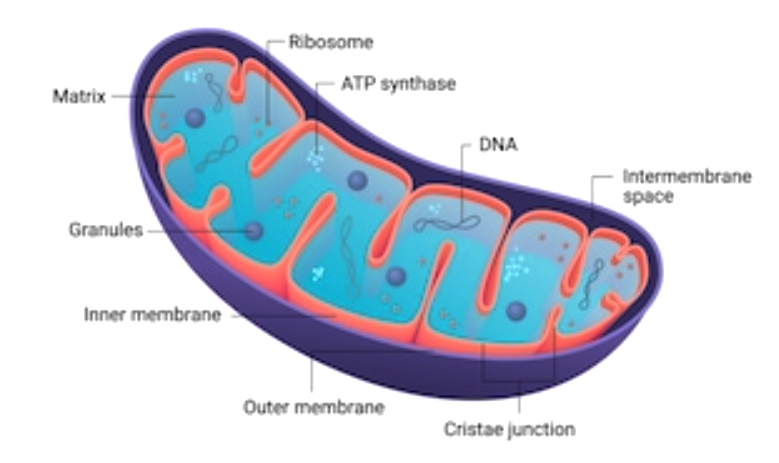
Mitochondrion structure
- The folds of the internal layer or the cristae give an expansion in the surface area which gives the mitochondrion more areas for ATP creation to happen. Actually, without them the mitochondrion would not have the option to stay aware of the cell's ATP needs.
- The folds (cristea) of the mitochondria give a more noteworthy surface territory (more space) for the concoction responses of oxidative phosphorylation (procedure of changing over food sugars into vitality (ATP)) to happen.
- Expanded surface region permits more proteins that make the electron transport anchor during this procedure to work at making more ATP. More space implies more vitality manufacturing plants in every mitochondrion and more vitality to fuel our organs and frameworks to support life.
- The purpose behind them is to expand the surface region of the mitochondrial inside, which makes more space for a bigger number of oxidative chemicals. That gives the mitochondrion an immeasurably more noteworthy limit with respect to ATP generation.
Therefore, the answer is c, it increases the surface area.
Additional information:
- Some cells have different amounts of mitochondria due to their energy needs such as muscles, liver, kidney to name a few.
- Mitochondrial DNA is inherited only from the mother.
Note: Mitochondria are free-floating cell organelles! Chemical energy produced by mitochondria is stored in a small molecule called adenosine triphosphate.
- Mitochondria are membrane-bound organelles, but with two different membranes.
- The powerhouse of our cell mitochondria has an external film and inward layer. The internal layer known as the cristae is collapsed.
Complete answer:
To answer this question we need the knowledge of basic structure of mitochondria
Mitochondrion structure
- The folds of the internal layer or the cristae give an expansion in the surface area which gives the mitochondrion more areas for ATP creation to happen. Actually, without them the mitochondrion would not have the option to stay aware of the cell's ATP needs.
- The folds (cristea) of the mitochondria give a more noteworthy surface territory (more space) for the concoction responses of oxidative phosphorylation (procedure of changing over food sugars into vitality (ATP)) to happen.
- Expanded surface region permits more proteins that make the electron transport anchor during this procedure to work at making more ATP. More space implies more vitality manufacturing plants in every mitochondrion and more vitality to fuel our organs and frameworks to support life.
- The purpose behind them is to expand the surface region of the mitochondrial inside, which makes more space for a bigger number of oxidative chemicals. That gives the mitochondrion an immeasurably more noteworthy limit with respect to ATP generation.
Therefore, the answer is c, it increases the surface area.
Additional information:
- Some cells have different amounts of mitochondria due to their energy needs such as muscles, liver, kidney to name a few.
- Mitochondrial DNA is inherited only from the mother.
Note: Mitochondria are free-floating cell organelles! Chemical energy produced by mitochondria is stored in a small molecule called adenosine triphosphate.
Recently Updated Pages
Which will be the least stable resonating structure class 11 chemistry CBSE

How many 5 digit telephone numbers can be construc-class-11-maths-CBSE
How do you find the angle of the resultant vector class 11 physics CBSE
Draw labelled diagram of the following i Gram seed class 11 biology CBSE
1 Quintal is equal to a 110 kg b 10 kg c 100kg d 1000 class 11 physics CBSE
What is the need and importance of classification class 11 biology CBSE
Trending doubts
One Metric ton is equal to kg A 10000 B 1000 C 100 class 11 physics CBSE
Find the value of the expression given below sin 30circ class 11 maths CBSE
Draw a diagram of nephron and explain its structur class 11 biology CBSE
10 examples of friction in our daily life
Proton was discovered by A Thomson B Rutherford C Chadwick class 11 chemistry CBSE
The teeth used for biting and cutting food are called class 11 biology CBSE