




The information source for making proteins is
(a) Rough endoplasmic reticulum
(b) DNA
(c) Hormones
(d) Enzymes
Answer
 Verified
571.1k+ views
Hint: Central dogma model has three main processes: Replication, Transcription, and Translation used by all cells to maintain their genetic information.
Complete answer:
Francis Crick proposed the Central dogma in molecular biology, which states that the genetic information flows from DNA to RNA to Protein.
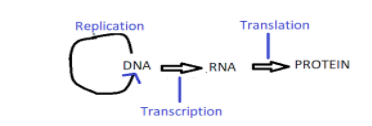
DNA (deoxyribonucleic acid) is the basic source of making proteins in the cells. First DNA replicates itself, then DNA is transcribed into a messenger RNA (mRNA - ribonucleic acid) molecule during transcription, lastly the mRNA must be translated to produce a protein. In translation, mRNA along with transfer RNA (tRNA- adapter molecule) and ribosome’s (also acts as catalyst) work together to produce proteins.
Additional Information:
Let’s see how the other options are connected to protein synthesis. In the eukaryotic cells, rough endoplasmic reticulum (RER) is a series of connected flattened sacs and a part of the continuous membrane organelle. The rough endoplasmic reticulum bears ribosome’s on top and these ribosomes are called 'membrane bound' and are responsible for the assembly of protein.
Chemical substances that affect the activity of another part of the body (target site) are known as hormones. Hormones are useful for messengers, controlling and coordinating activities throughout the body. Anabolic hormones stimulate the human muscle growth mainly by increasing protein synthesis (growth hormone and testosterone) or by reducing protein breakdown (insulin).
Proteins that speed up the rate of a chemical reaction in a living organism are known as enzymes. An enzyme basically acts as a catalyst for specific chemical reactions, converting from a set of reactants (called substrates) into specific products. Enzymes like tRNA help in protein synthesis.
So, the correct answer is “DNA”.
Note: In some viruses the flow of information is in reverse direction; from RNA to DNA. DNA is the genetic material passed from parents to offspring.
Catalyst is a substance used for making the reaction faster.
Complete answer:
Francis Crick proposed the Central dogma in molecular biology, which states that the genetic information flows from DNA to RNA to Protein.
DNA (deoxyribonucleic acid) is the basic source of making proteins in the cells. First DNA replicates itself, then DNA is transcribed into a messenger RNA (mRNA - ribonucleic acid) molecule during transcription, lastly the mRNA must be translated to produce a protein. In translation, mRNA along with transfer RNA (tRNA- adapter molecule) and ribosome’s (also acts as catalyst) work together to produce proteins.
Additional Information:
Let’s see how the other options are connected to protein synthesis. In the eukaryotic cells, rough endoplasmic reticulum (RER) is a series of connected flattened sacs and a part of the continuous membrane organelle. The rough endoplasmic reticulum bears ribosome’s on top and these ribosomes are called 'membrane bound' and are responsible for the assembly of protein.
Chemical substances that affect the activity of another part of the body (target site) are known as hormones. Hormones are useful for messengers, controlling and coordinating activities throughout the body. Anabolic hormones stimulate the human muscle growth mainly by increasing protein synthesis (growth hormone and testosterone) or by reducing protein breakdown (insulin).
Proteins that speed up the rate of a chemical reaction in a living organism are known as enzymes. An enzyme basically acts as a catalyst for specific chemical reactions, converting from a set of reactants (called substrates) into specific products. Enzymes like tRNA help in protein synthesis.
So, the correct answer is “DNA”.
Note: In some viruses the flow of information is in reverse direction; from RNA to DNA. DNA is the genetic material passed from parents to offspring.
Catalyst is a substance used for making the reaction faster.
Recently Updated Pages
Master Class 11 English: Engaging Questions & Answers for Success

Master Class 11 Social Science: Engaging Questions & Answers for Success
Master Class 11 Maths: Engaging Questions & Answers for Success
Master Class 11 Biology: Engaging Questions & Answers for Success
Master Class 11 Physics: Engaging Questions & Answers for Success
Master Class 11 Chemistry: Engaging Questions & Answers for Success
Trending doubts
One Metric ton is equal to kg A 10000 B 1000 C 100 class 11 physics CBSE
Difference Between Prokaryotic Cells and Eukaryotic Cells
Find the value of the expression given below sin 30circ class 11 maths CBSE
Difference between physical and chemical change class 11 chemistry CBSE
Two of the body parts which do not appear in MRI are class 11 biology CBSE
Draw a diagram of a plant cell and label at least eight class 11 biology CBSE