




The image formed by a convex lens is observed to be virtual, erect, and larger than the object. Then the position of the object should be :
Answer
 Verified
531.6k+ views
Hint:When an object is placed in front of a convex lens the image formation depends upon the exact position of the object according to the focus, center of curvature, and the optical center of the lens. The image is generally real for almost all positions of the object except one. The virtual image is always erect and larger than the object. So, this position of the object has to be known, and by drawing the diagram the image formation can be shown.
Complete step-by-step solution:
To get the virtual image from a convex lens that is erect as well and also larger than the object, the object has to be placed near the optical center of the convex lens inside the focus.
The diagram of the formation of the given image is drawn below:
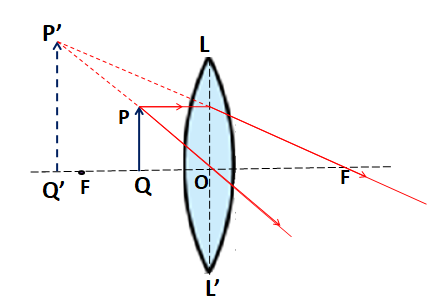
The object PQ is placed at the axis of the convex lens LL’ normally in between the lens and the focus point of the lens. The ray parallel to the principal axis coming from the point P goes through the focus point F after the refraction and another ray goes through the optical center straight. These two refracting rays are divergent. Hence, if the rays are extended to the back side they will intersect at point P '. This P’ is the image of P. If a perpendicular line is drawn from P’ on the axis at point Q’, the image will be P’Q’.
The image seen here is virtual as we have to extend the rays to form, also it is erect as shown in the diagram. The size of the image is larger than the object.
Note:There are many positions of objects like:
The object is placed at a distance more than double of the focal length and hence the image is real, inverted, and shorter than the object.
The object is placed at a distance double of the focal length and hence the image is real, inverted, and of equal size to that of the object.
The object is placed at a distance more than the focal length but less than double of the focal length and hence the image is real, inverted, and of larger size than that of the object.
The object is placed at the focus point and hence the image is real, inverted, and of an excessive larger size than that of the object.
The object is placed at a distance less than the focal length and hence the image is virtual, erect, and larger than the object.
Complete step-by-step solution:
To get the virtual image from a convex lens that is erect as well and also larger than the object, the object has to be placed near the optical center of the convex lens inside the focus.
The diagram of the formation of the given image is drawn below:
The object PQ is placed at the axis of the convex lens LL’ normally in between the lens and the focus point of the lens. The ray parallel to the principal axis coming from the point P goes through the focus point F after the refraction and another ray goes through the optical center straight. These two refracting rays are divergent. Hence, if the rays are extended to the back side they will intersect at point P '. This P’ is the image of P. If a perpendicular line is drawn from P’ on the axis at point Q’, the image will be P’Q’.
The image seen here is virtual as we have to extend the rays to form, also it is erect as shown in the diagram. The size of the image is larger than the object.
Note:There are many positions of objects like:
The object is placed at a distance more than double of the focal length and hence the image is real, inverted, and shorter than the object.
The object is placed at a distance double of the focal length and hence the image is real, inverted, and of equal size to that of the object.
The object is placed at a distance more than the focal length but less than double of the focal length and hence the image is real, inverted, and of larger size than that of the object.
The object is placed at the focus point and hence the image is real, inverted, and of an excessive larger size than that of the object.
The object is placed at a distance less than the focal length and hence the image is virtual, erect, and larger than the object.
Recently Updated Pages
Master Class 12 Business Studies: Engaging Questions & Answers for Success

Master Class 12 Biology: Engaging Questions & Answers for Success
Master Class 12 Chemistry: Engaging Questions & Answers for Success
Class 12 Question and Answer - Your Ultimate Solutions Guide
Master Class 11 Social Science: Engaging Questions & Answers for Success
Master Class 11 English: Engaging Questions & Answers for Success
Trending doubts
Which are the Top 10 Largest Countries of the World?
Draw a labelled sketch of the human eye class 12 physics CBSE
Name the crygenes that control cotton bollworm and class 12 biology CBSE
Differentiate between homogeneous and heterogeneous class 12 chemistry CBSE
Ribosomal RNA is actively synthesised in A Nucleoplasm class 12 biology CBSE
How many molecules of ATP and NADPH are required information class 12 biology CBSE