




The image formed by a concave mirror is:
A.always real.
B.always virtual.
C.certainly real if the object is virtual.
D.certainly virtual if the object is real.
Answer
 Verified
627.3k+ views
Hint: The mirror formula is basically an equation that relates the object distance and the mirror distance with the focal length. It is also known as the mirror equation. Using the mirror equation, we can answer the question.
Step by step answer:
Using the mirror equation we can write the following:
$\begin{align}
& \dfrac{\text{1}}{\text{v}}\text{ + }\dfrac{\text{1}}{\text{u}}\text{ = }\dfrac{\text{1}}{\text{f}} \\
& \dfrac{\text{1}}{\text{v}}\text{ = }\dfrac{\text{1}}{\text{f}}\text{ }-\text{ }\dfrac{\text{1}}{\text{u}} \\
\end{align}$
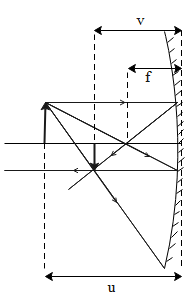
With the given diagram we can see that,
For concave mirrors the focal length is negative. Hence,
$\text{f }<\text{ 0}$
For a virtual object distance is positive. Hence,
${{\text{u}}_{\text{v}}}>\text{ 0}$
From the above equations, it can be observed that image distance v is negative when the object is virtual. Since image distance is negative, it is formed by the real intersection of rays and the image is also real.
For real objects distance is negative. Hence,
${{\text{u}}_{\text{r}}}<\text{ 0}$
In this case, as we can see image distance v can be positive or negative depending upon the location of the object.
Therefore, we can see that the image formed by a concave mirror is certainly real if the object is virtual. So the correct option among the mentioned for this following question is Option C.
Note: Therefore, we can see that concave mirrors can produce both real as well as virtual images. The image can be upright if the image is virtual or inverted if the image is real.
If the image is behind the mirror it is virtual, and if it is in front of the mirror, it is real. The image can also be enlarged, reduced, or the same size as the object.
Step by step answer:
Using the mirror equation we can write the following:
$\begin{align}
& \dfrac{\text{1}}{\text{v}}\text{ + }\dfrac{\text{1}}{\text{u}}\text{ = }\dfrac{\text{1}}{\text{f}} \\
& \dfrac{\text{1}}{\text{v}}\text{ = }\dfrac{\text{1}}{\text{f}}\text{ }-\text{ }\dfrac{\text{1}}{\text{u}} \\
\end{align}$
With the given diagram we can see that,
For concave mirrors the focal length is negative. Hence,
$\text{f }<\text{ 0}$
For a virtual object distance is positive. Hence,
${{\text{u}}_{\text{v}}}>\text{ 0}$
From the above equations, it can be observed that image distance v is negative when the object is virtual. Since image distance is negative, it is formed by the real intersection of rays and the image is also real.
For real objects distance is negative. Hence,
${{\text{u}}_{\text{r}}}<\text{ 0}$
In this case, as we can see image distance v can be positive or negative depending upon the location of the object.
Therefore, we can see that the image formed by a concave mirror is certainly real if the object is virtual. So the correct option among the mentioned for this following question is Option C.
Note: Therefore, we can see that concave mirrors can produce both real as well as virtual images. The image can be upright if the image is virtual or inverted if the image is real.
If the image is behind the mirror it is virtual, and if it is in front of the mirror, it is real. The image can also be enlarged, reduced, or the same size as the object.
Recently Updated Pages
Master Class 12 Business Studies: Engaging Questions & Answers for Success

Master Class 12 Biology: Engaging Questions & Answers for Success
Master Class 12 Chemistry: Engaging Questions & Answers for Success
Class 12 Question and Answer - Your Ultimate Solutions Guide
Master Class 11 Social Science: Engaging Questions & Answers for Success
Master Class 11 English: Engaging Questions & Answers for Success
Trending doubts
Explain the Treaty of Vienna of 1815 class 10 social science CBSE
Who Won 36 Oscar Awards? Record Holder Revealed
What is the median of the first 10 natural numbers class 10 maths CBSE
Why is it 530 pm in india when it is 1200 afternoon class 10 social science CBSE
The highest temperature in Karnataka is recorded in class 10 social science CBSE
Define Potential, Developed, Stock and Reserved resources