




The image formed by a concave lens is seen to be virtual, erect and highly diminished than the object. What is the position of the object?
Answer
 Verified
560.7k+ views
Hint: We can use the knowledge that a concave lens is a lens that possesses at least one surface that curves inwards. It is a diverging lens, meaning that it spreads out light rays that have been refracted through it. A concave lens is thinner at its centre than at its edges, and is used to correct short-sightedness (myopia). Concave Lenses Are for the Near-sighted, Convex for the Farsighted. Concave lenses are used in eyeglasses that correct near-sightedness. Because the distance between the eye's lens and retina in near-sighted people is longer than it should be, such people are unable to make out distant objects clearly.
Complete step-by-step solution:
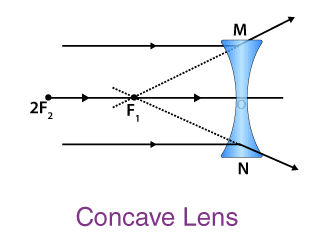
A concave lens always gives a virtual, erect and diminished image whatever may be the position of the object. If the object is placed at infinity, the position of the image at the focus F behind the mirror will be virtual, erect and highly-diminished. If the object placed between infinity and the pole P of the mirror, the position of the image between P and F behind the mirror will be virtual, erect and diminished.
Hence, if the object is placed between the pole and focus, then the image formed will be virtual, erect and enlarged.
Note: It is required to be sure that in actuality, there are two focal points for every lens, the same distance from the lens, on opposite sides. The distance from the lens to the focal point is called the focal length. For converging lenses, the focal length is always positive, while diverging lenses always have negative focal lengths. Plano-concave - A lens in which one side is concave and the other is Plano. Plano-concave lenses are diverging lenses.
Thus, a positive meniscus is a converging lens where one side is concave and the other convex. Negative meniscus - A diverging lens where one side is concave and the other convex.
Complete step-by-step solution:
A concave lens always gives a virtual, erect and diminished image whatever may be the position of the object. If the object is placed at infinity, the position of the image at the focus F behind the mirror will be virtual, erect and highly-diminished. If the object placed between infinity and the pole P of the mirror, the position of the image between P and F behind the mirror will be virtual, erect and diminished.
Hence, if the object is placed between the pole and focus, then the image formed will be virtual, erect and enlarged.
Note: It is required to be sure that in actuality, there are two focal points for every lens, the same distance from the lens, on opposite sides. The distance from the lens to the focal point is called the focal length. For converging lenses, the focal length is always positive, while diverging lenses always have negative focal lengths. Plano-concave - A lens in which one side is concave and the other is Plano. Plano-concave lenses are diverging lenses.
Thus, a positive meniscus is a converging lens where one side is concave and the other convex. Negative meniscus - A diverging lens where one side is concave and the other convex.
Recently Updated Pages
Master Class 12 Business Studies: Engaging Questions & Answers for Success

Master Class 12 Chemistry: Engaging Questions & Answers for Success
Master Class 12 Biology: Engaging Questions & Answers for Success
Class 12 Question and Answer - Your Ultimate Solutions Guide
Master Class 11 English: Engaging Questions & Answers for Success
Master Class 11 Social Science: Engaging Questions & Answers for Success
Trending doubts
Which are the Top 10 Largest Countries of the World?
Draw a labelled sketch of the human eye class 12 physics CBSE
The end of compass needle which points towards north class 12 physics CBSE
Differentiate between homogeneous and heterogeneous class 12 chemistry CBSE
Why is the cell called the structural and functional class 12 biology CBSE
When was the first election held in India a 194748 class 12 sst CBSE