




The hypotenuse of a right triangle is 25 cm, and the shorter leg is 15 cm. What is length of the other leg?
Answer
 Verified
475.2k+ views
Hint: In a right- angled triangle the longest side is called hypotenuse, the side at the bottom is called base and the third side of the triangle is called the perpendicular.
The relation between these sides of the right- angled triangle is given by
${\text{Hypotenus}}{{\text{e}}^{\text{2}}}{\text{ = Perpendicula}}{{\text{r}}^{\text{2}}}{\text{ + Bas}}{{\text{e}}^{\text{2}}}$
We’ll use this relation to find the length of other side.
Complete answer:
Given a right- angled triangle with length of hypotenuse $ = 25cm$ ,
Length of shorter side (say base of the triangle) $ = 15cm$ .
To find the length of the third side i.e., the perpendicular of the triangle.
The triangle becomes
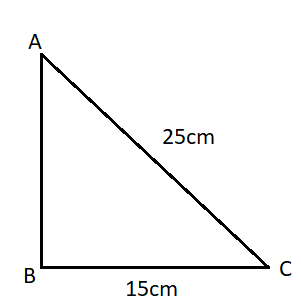
For that we will use the relation ${\text{Hypotenus}}{{\text{e}}^{\text{2}}}{\text{ = Perpendicula}}{{\text{r}}^{\text{2}}}{\text{ + Bas}}{{\text{e}}^{\text{2}}}$ .
Putting the given lengths of the sides of the triangle, we get,
${\left( {25} \right)^2} = {\left( {{\text{Perpendicular}}} \right)^2} + {\left( {15} \right)^2}$ ,
Now, taking ${\left( {15} \right)^2}$ on the left- hand side, we get,
${\left( {25} \right)^2} - {\left( {15} \right)^2} = {\left( {{\text{Perpendicular}}} \right)^2}$ ,
We know, ${\left( {25} \right)^2} = 625$ and ${\left( {15} \right)^2} = 225$ . Putting these values in above equation, we get,
\[625 - 225 = {\left( {{\text{Perpendicular}}} \right)^2}\] ,
On subtracting, we get, $400 = {\left( {{\text{Perpendicular}}} \right)^2}$ or ${\left( {{\text{Perpendicular}}} \right)^2} = 400$ .
Take square root on both sides, we get,
$\sqrt[2]{{{{\left( {{\text{Perpendicular}}} \right)}^2}}} = \sqrt[2]{{400}}$ i.e., Perpendicular ${\text{ = }}\sqrt[2]{{400}}$ .
Now, we’ll do prime factorisation of $400$ , which gives,
$400 = 2 \times 2 \times 2 \times 2 \times 5 \times 5$ .
Making pairs gives $400 = \underline {2 \times 2} \times \underline {2 \times 2} \times \underline {5 \times 5} $ .
So, $\sqrt {400} $ can be written as $\sqrt {400} = \sqrt {\underline {2 \times 2} \times \underline {2 \times 2} \times \underline {5 \times 5} } $ and these pairs will come out of the square root as one.
i.e., $\sqrt {400} = 2 \times 2 \times 5$ ,
so, $\sqrt {400} = 20$ .
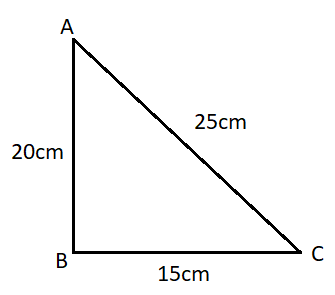
Hence, Perpendicular $ = 20cm$ i.e., the length of the other leg is $20cm$.
Note:
The relation used in this question between the hypotenuse, the perpendicular and the base is known as “Pythagoras Theorem”.
The Pythagoras Theorem is only valid for right- angled triangles.
While taking square roots, first do prime factorisation of the number then take the factors outside the root in pairs, as one and then multiply them.
The relation between these sides of the right- angled triangle is given by
${\text{Hypotenus}}{{\text{e}}^{\text{2}}}{\text{ = Perpendicula}}{{\text{r}}^{\text{2}}}{\text{ + Bas}}{{\text{e}}^{\text{2}}}$
We’ll use this relation to find the length of other side.
Complete answer:
Given a right- angled triangle with length of hypotenuse $ = 25cm$ ,
Length of shorter side (say base of the triangle) $ = 15cm$ .
To find the length of the third side i.e., the perpendicular of the triangle.
The triangle becomes
For that we will use the relation ${\text{Hypotenus}}{{\text{e}}^{\text{2}}}{\text{ = Perpendicula}}{{\text{r}}^{\text{2}}}{\text{ + Bas}}{{\text{e}}^{\text{2}}}$ .
Putting the given lengths of the sides of the triangle, we get,
${\left( {25} \right)^2} = {\left( {{\text{Perpendicular}}} \right)^2} + {\left( {15} \right)^2}$ ,
Now, taking ${\left( {15} \right)^2}$ on the left- hand side, we get,
${\left( {25} \right)^2} - {\left( {15} \right)^2} = {\left( {{\text{Perpendicular}}} \right)^2}$ ,
We know, ${\left( {25} \right)^2} = 625$ and ${\left( {15} \right)^2} = 225$ . Putting these values in above equation, we get,
\[625 - 225 = {\left( {{\text{Perpendicular}}} \right)^2}\] ,
On subtracting, we get, $400 = {\left( {{\text{Perpendicular}}} \right)^2}$ or ${\left( {{\text{Perpendicular}}} \right)^2} = 400$ .
Take square root on both sides, we get,
$\sqrt[2]{{{{\left( {{\text{Perpendicular}}} \right)}^2}}} = \sqrt[2]{{400}}$ i.e., Perpendicular ${\text{ = }}\sqrt[2]{{400}}$ .
Now, we’ll do prime factorisation of $400$ , which gives,
$400 = 2 \times 2 \times 2 \times 2 \times 5 \times 5$ .
Making pairs gives $400 = \underline {2 \times 2} \times \underline {2 \times 2} \times \underline {5 \times 5} $ .
So, $\sqrt {400} $ can be written as $\sqrt {400} = \sqrt {\underline {2 \times 2} \times \underline {2 \times 2} \times \underline {5 \times 5} } $ and these pairs will come out of the square root as one.
i.e., $\sqrt {400} = 2 \times 2 \times 5$ ,
so, $\sqrt {400} = 20$ .
Hence, Perpendicular $ = 20cm$ i.e., the length of the other leg is $20cm$.
Note:
The relation used in this question between the hypotenuse, the perpendicular and the base is known as “Pythagoras Theorem”.
The Pythagoras Theorem is only valid for right- angled triangles.
While taking square roots, first do prime factorisation of the number then take the factors outside the root in pairs, as one and then multiply them.
Recently Updated Pages
Master Class 10 Computer Science: Engaging Questions & Answers for Success

Master Class 10 General Knowledge: Engaging Questions & Answers for Success
Master Class 10 English: Engaging Questions & Answers for Success
Master Class 10 Social Science: Engaging Questions & Answers for Success
Master Class 10 Maths: Engaging Questions & Answers for Success
Master Class 10 Science: Engaging Questions & Answers for Success
Trending doubts
What is the median of the first 10 natural numbers class 10 maths CBSE
Which women's tennis player has 24 Grand Slam singles titles?
Who is the Brand Ambassador of Incredible India?
Why is there a time difference of about 5 hours between class 10 social science CBSE
Write a letter to the principal requesting him to grant class 10 english CBSE
A moving boat is observed from the top of a 150 m high class 10 maths CBSE