




The hormones of the neurohypophysis are formed in
A. Pars nervosa
B. Pars distalis
C. Supraoptic and paraventricular center
D. None of the above
Answer
 Verified
641.4k+ views
Hint: The pituitary gland, a part of the endocrine system is divided into two parts adenohypophysis and neurohypophysis.
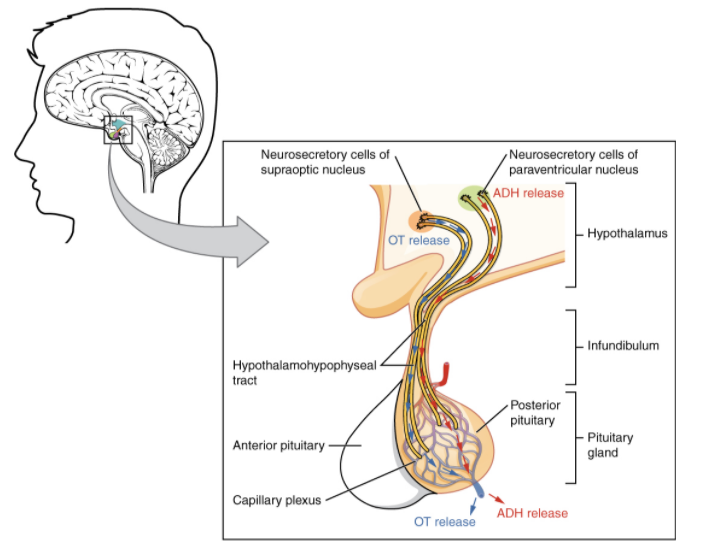
Complete answer: Anterior pituitary gland is called adenohypophysis.
1. It consists of pars distalis and pars intermedia.
2. Posterior pituitary and the infundibulum is called neurohypophysis.
3. It consists of pars nervosa. The infundibulum is also called the pituitary stalk.
4. It creates a junction between the hypothalamic and hypophyseal systems.
5. The pituitary gland secretes various types of hormones.
The anterior pituitary gland (pars distalis) secrets growth hormone (GH), prolactin (PRL), thyroid-stimulating hormone (TSH), adrenocorticotropic hormone (ACTH), luteinizing hormone (LH), and follicle-stimulating hormone (FSH).
6. Pars intermedia secretes melanocyte-stimulating hormone (MSH).
7. Pars nervosa (neurohypophysis) stores two hormones called oxytocin and vasopressin.
8. These two hormones are secreted indirectly, they are synthesized by the hypothalamus and are transported axonally to the neurohypophysis.
9. Abnormal secretions of these hormones can lead to various abnormalities in our body, like a decrease in the secretion of vasopressin will lead to diabetes insipidus, and an increase in secretion cause SIADH.
So the correct answer is option C.
Note: Supraoptic and paraventricular center are nuclei of the hypothalamus which secrete oxytocin and vasopressin. These hormones are then stored and released into the bloodstream via neurohypophysis or Posterior pituitary.
The blood circulation of the posterior pituitary gland is, arterial- inferior hypophyseal artery and venous drainage are through the hypophyseal vein.
Complete answer: Anterior pituitary gland is called adenohypophysis.
1. It consists of pars distalis and pars intermedia.
2. Posterior pituitary and the infundibulum is called neurohypophysis.
3. It consists of pars nervosa. The infundibulum is also called the pituitary stalk.
4. It creates a junction between the hypothalamic and hypophyseal systems.
5. The pituitary gland secretes various types of hormones.
The anterior pituitary gland (pars distalis) secrets growth hormone (GH), prolactin (PRL), thyroid-stimulating hormone (TSH), adrenocorticotropic hormone (ACTH), luteinizing hormone (LH), and follicle-stimulating hormone (FSH).
6. Pars intermedia secretes melanocyte-stimulating hormone (MSH).
7. Pars nervosa (neurohypophysis) stores two hormones called oxytocin and vasopressin.
8. These two hormones are secreted indirectly, they are synthesized by the hypothalamus and are transported axonally to the neurohypophysis.
9. Abnormal secretions of these hormones can lead to various abnormalities in our body, like a decrease in the secretion of vasopressin will lead to diabetes insipidus, and an increase in secretion cause SIADH.
So the correct answer is option C.
Note: Supraoptic and paraventricular center are nuclei of the hypothalamus which secrete oxytocin and vasopressin. These hormones are then stored and released into the bloodstream via neurohypophysis or Posterior pituitary.
The blood circulation of the posterior pituitary gland is, arterial- inferior hypophyseal artery and venous drainage are through the hypophyseal vein.
Recently Updated Pages
Basicity of sulphurous acid and sulphuric acid are

Master Class 12 Economics: Engaging Questions & Answers for Success
Master Class 12 Biology: Engaging Questions & Answers for Success
Master Class 11 English: Engaging Questions & Answers for Success
Master Class 11 Physics: Engaging Questions & Answers for Success
Master Class 11 Computer Science: Engaging Questions & Answers for Success
Trending doubts
Draw a labelled sketch of the human eye class 12 physics CBSE
The chemical formula of tear gas is A CO Cl 2 B C 10 class 12 chemistry CBSE
Draw ray diagrams each showing i myopic eye and ii class 12 physics CBSE
Which are the Top 10 Largest Countries of the World?
Differentiate between homogeneous and heterogeneous class 12 chemistry CBSE
Which is the correct genotypic ratio of mendel dihybrid class 12 biology CBSE