




The horizontal and vertical lines in a line graph are usually called
Answer
 Verified
552.6k+ views
Hint: First, we will see what the graph is.
A graph is a pictorial representation of the given data and that will help in easily analyzing the data.
The line graphs (graphs with lines only) are mostly used to represent the mutual variation of the given two quantities and that quantities will be either directly or inversely proportional to each other.
Complete step-by-step solution:
Horizon is the line along with the earth's surface, which is a straight line and that line maps from the left to the right and also parallel to the x-axis in the given plane coordinate system.

Which is the horizontal line.
Vertical lines that are one goes straight up and down, also parallel to the y-axis in the given coordinate systems. Vertical lines do not have to slope, where the slope is the ratio of changing the given vertical to horizon changes between the distinct two points.
Vertical lines can be represented as
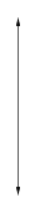
Thus, horizontal lines in the line graph are called the x-axis. The vertical lines in the line graphs are called the y-axis.
Hence the two-dimensional graph with x and y axes can be represented as
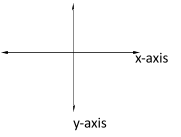
Where the right-hand side of the x-axis are positive numbers and the left-hand side are negative numbers.
In the y-axis, the top lines are positive numbers and the bottom are negative numbers.
Thus, the horizontal and vertical lines in a line graph are usually called the x-axis and y-axis respectively.
Note: In the line graph, there are three types.
> A single line graph consists of only one line that will represent the variation of the given two quantities.
> Double line graph, consists of two lines that will be representing the same data.
> Compound line graph, variation of the given any two quantities in the many different ways also it consists of more than three lines.
A graph is a pictorial representation of the given data and that will help in easily analyzing the data.
The line graphs (graphs with lines only) are mostly used to represent the mutual variation of the given two quantities and that quantities will be either directly or inversely proportional to each other.
Complete step-by-step solution:
Horizon is the line along with the earth's surface, which is a straight line and that line maps from the left to the right and also parallel to the x-axis in the given plane coordinate system.
Which is the horizontal line.
Vertical lines that are one goes straight up and down, also parallel to the y-axis in the given coordinate systems. Vertical lines do not have to slope, where the slope is the ratio of changing the given vertical to horizon changes between the distinct two points.
Vertical lines can be represented as
Thus, horizontal lines in the line graph are called the x-axis. The vertical lines in the line graphs are called the y-axis.
Hence the two-dimensional graph with x and y axes can be represented as
Where the right-hand side of the x-axis are positive numbers and the left-hand side are negative numbers.
In the y-axis, the top lines are positive numbers and the bottom are negative numbers.
Thus, the horizontal and vertical lines in a line graph are usually called the x-axis and y-axis respectively.
Note: In the line graph, there are three types.
> A single line graph consists of only one line that will represent the variation of the given two quantities.
> Double line graph, consists of two lines that will be representing the same data.
> Compound line graph, variation of the given any two quantities in the many different ways also it consists of more than three lines.
Recently Updated Pages
Master Class 11 English: Engaging Questions & Answers for Success

Master Class 11 Social Science: Engaging Questions & Answers for Success
Master Class 11 Maths: Engaging Questions & Answers for Success
Master Class 11 Biology: Engaging Questions & Answers for Success
Master Class 11 Physics: Engaging Questions & Answers for Success
Master Class 11 Chemistry: Engaging Questions & Answers for Success
Trending doubts
Explain the Treaty of Vienna of 1815 class 10 social science CBSE
What is the full form of POSCO class 10 social science CBSE
Define Potential, Developed, Stock and Reserved resources
The diagonals of a rhombus are 10cm and 24cm Find the class 10 maths CBSE
Fill the blanks with proper collective nouns 1 A of class 10 english CBSE
What planets have no moons Which one has only one moon class 10 physics CBSE