




The Hereditary vehicle is
(a) Chromosome
(b) Centromere
(c) Nucleus
(d) Nucleolus
Answer
 Verified
645.6k+ views
Hint: These are made up of protein and a single molecule of deoxyribonucleic acid (DNA). They are passed from parents to offspring, DNA contains the specific instructions that make each type of living creature unique.
Complete Step by Step Answer:
Chromosomes are the threadlike structure that is present within the nucleus of a cell (plant cell and animal cell). They are made up of deoxyribonucleic acid or DNA and basic proteins called histones.
Chromosomes enclose genes (sequence of DNA) which carries the hereditary characteristic or information from the parents to the offsprings. Therefore, they are called hereditary vehicles.
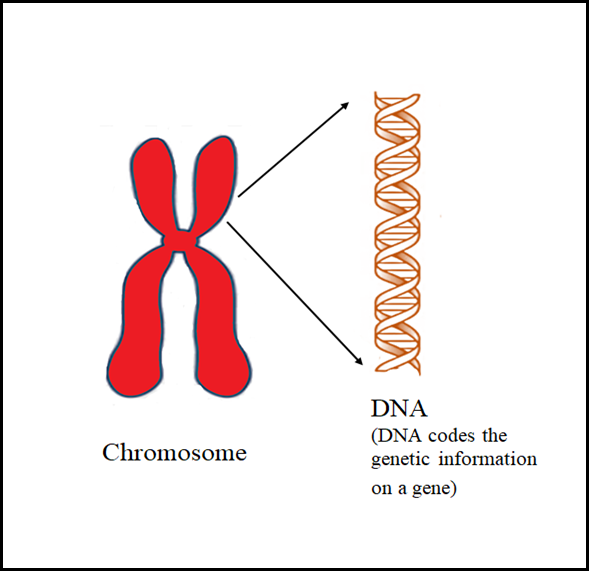
Chromosomes are formed of DNA and proteins. They are not visible in the cell nucleus even under a microscope when the cell is not dividing. During cell division, the DNA found tightly coiled many times around a protein called histones. Before the initiation of cell division, they undergo further condensation and form chromatids. The chromatids undergo replication and form copies of each chromatid, and they remain attached with the help of centromere. Each chromosome has a constriction point known as centromere which divides the chromosome into two parts or arms-a q arm and a p arm. The terminal end of the arm is known as telomeres. Telomeres are significant in that they form the termini of chromosomes, protect chromosomes from nuclease activity, and maintain the stability of chromosomes.
So, the correct answer is, ‘(a) Chromosomes.’
Note:
- Chromosomes contain genes that carry hereditary characteristics of a specific person i.e shortness, tallness, brown eye color, etc. Chromosomes are called hereditary vehicles because they're inherited to the offspring from their parents and to their offspring from them.
- A chromosome contains hundreds to thousands of genes. Every normal human cell contains 23 pairs of chromosomes, for a complete 46 chromosomes. A trait is any gene- determined characteristic and is usually determined by quite one gene.
Complete Step by Step Answer:
Chromosomes are the threadlike structure that is present within the nucleus of a cell (plant cell and animal cell). They are made up of deoxyribonucleic acid or DNA and basic proteins called histones.
Chromosomes enclose genes (sequence of DNA) which carries the hereditary characteristic or information from the parents to the offsprings. Therefore, they are called hereditary vehicles.
Chromosomes are formed of DNA and proteins. They are not visible in the cell nucleus even under a microscope when the cell is not dividing. During cell division, the DNA found tightly coiled many times around a protein called histones. Before the initiation of cell division, they undergo further condensation and form chromatids. The chromatids undergo replication and form copies of each chromatid, and they remain attached with the help of centromere. Each chromosome has a constriction point known as centromere which divides the chromosome into two parts or arms-a q arm and a p arm. The terminal end of the arm is known as telomeres. Telomeres are significant in that they form the termini of chromosomes, protect chromosomes from nuclease activity, and maintain the stability of chromosomes.
So, the correct answer is, ‘(a) Chromosomes.’
Note:
- Chromosomes contain genes that carry hereditary characteristics of a specific person i.e shortness, tallness, brown eye color, etc. Chromosomes are called hereditary vehicles because they're inherited to the offspring from their parents and to their offspring from them.
- A chromosome contains hundreds to thousands of genes. Every normal human cell contains 23 pairs of chromosomes, for a complete 46 chromosomes. A trait is any gene- determined characteristic and is usually determined by quite one gene.
Recently Updated Pages
Master Class 12 Economics: Engaging Questions & Answers for Success

Master Class 12 Social Science: Engaging Questions & Answers for Success
Master Class 12 English: Engaging Questions & Answers for Success
Master Class 12 Maths: Engaging Questions & Answers for Success
Master Class 12 Physics: Engaging Questions & Answers for Success
Master Class 12 Biology: Engaging Questions & Answers for Success
Trending doubts
Draw a labelled sketch of the human eye class 12 physics CBSE
Which are the Top 10 Largest Countries of the World?
Draw ray diagrams each showing i myopic eye and ii class 12 physics CBSE
Which is the correct genotypic ratio of mendel dihybrid class 12 biology CBSE
Differentiate between homogeneous and heterogeneous class 12 chemistry CBSE
Which animal never drinks water in its entire life class 12 biology CBSE