




The height of the right circular cylinder is 5 and the diameter of its base is 4. What is the distance from the centre of one base to a point on the circumference of the other base?
A) 3
B) 5
C) $\sqrt{29}$
D) $\sqrt{33.}$
Answer
 Verified
624.6k+ views
Hint: In order to solve this question, where we have been asked for the distance from the centre of one base to a point on the circumference of other bases, we need to follow the Pythagoras theorem to get to our result.
Complete step by step solution: It is given that;
The height of the right circular cylinder is $\left( h \right)=5;$
And, the diameter of its base $=4.$
radius of its base $\left( r \right)=\dfrac{1}{2}\times $ diameter of its base $=\dfrac{1}{2}\times 4=2$.
Let the distance from the centre of one base to the point on the circumference of other base be ‘l’ we observe that;
(height of the cylinder), (radius of the cylinder) and (the line joining the centre of one base to the point on the circumference of another base) from a right-angled triangle with a hypotenuse of length ‘l’.
To find the value of ‘l’, we need to follow the Pythagoras theorem:-
By Pythagoras theorem :
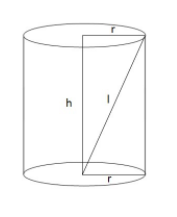
${{l}^{2}}={{h}^{2}}+{{r}^{2}}$
$\Rightarrow {{l}^{2}}={{\left( 5 \right)}^{2}}+{{\left( 2 \right)}^{2}}$
$\Rightarrow {{l}^{2}}=25+4$
$\Rightarrow {{l}^{2}}=29$
$\Rightarrow l=\sqrt{29}$
$\Rightarrow $
Therefore, distance from the centre of one base to a point on the circumference of the other base is $ \sqrt{29}.$
Hence, Option (C) is the correct answer to this question.
Note: Note :
In a right circular cylinder, the axis of the cylinder is perpendicular to the base of the cylinder while in a normal cylinder, it is a parallelogram.
The cross-section of a right circular cylinder is a circle, and the axis of the cylinder is perpendicular to the base.
Pythagoras theorem : ${{\left( \text{hypotenuse} \right)}^{\text{2}}}\text{=}{{\left( \text{height} \right)}^{\text{2}}}\text{+}{{\left( \text{base} \right)}^{\text{2}}}$
Complete step by step solution: It is given that;
The height of the right circular cylinder is $\left( h \right)=5;$
And, the diameter of its base $=4.$
radius of its base $\left( r \right)=\dfrac{1}{2}\times $ diameter of its base $=\dfrac{1}{2}\times 4=2$.
Let the distance from the centre of one base to the point on the circumference of other base be ‘l’ we observe that;
(height of the cylinder), (radius of the cylinder) and (the line joining the centre of one base to the point on the circumference of another base) from a right-angled triangle with a hypotenuse of length ‘l’.
To find the value of ‘l’, we need to follow the Pythagoras theorem:-
By Pythagoras theorem :
${{l}^{2}}={{h}^{2}}+{{r}^{2}}$
$\Rightarrow {{l}^{2}}={{\left( 5 \right)}^{2}}+{{\left( 2 \right)}^{2}}$
$\Rightarrow {{l}^{2}}=25+4$
$\Rightarrow {{l}^{2}}=29$
$\Rightarrow l=\sqrt{29}$
$\Rightarrow $
Therefore, distance from the centre of one base to a point on the circumference of the other base is $ \sqrt{29}.$
Hence, Option (C) is the correct answer to this question.
Note: Note :
In a right circular cylinder, the axis of the cylinder is perpendicular to the base of the cylinder while in a normal cylinder, it is a parallelogram.
The cross-section of a right circular cylinder is a circle, and the axis of the cylinder is perpendicular to the base.
Pythagoras theorem : ${{\left( \text{hypotenuse} \right)}^{\text{2}}}\text{=}{{\left( \text{height} \right)}^{\text{2}}}\text{+}{{\left( \text{base} \right)}^{\text{2}}}$
Recently Updated Pages
Master Class 12 Economics: Engaging Questions & Answers for Success

Master Class 12 English: Engaging Questions & Answers for Success
Master Class 12 Social Science: Engaging Questions & Answers for Success
Master Class 12 Maths: Engaging Questions & Answers for Success
Master Class 12 Physics: Engaging Questions & Answers for Success
Master Class 9 General Knowledge: Engaging Questions & Answers for Success
Trending doubts
Explain the Treaty of Vienna of 1815 class 10 social science CBSE
Why is it 530 pm in india when it is 1200 afternoon class 10 social science CBSE
What is the full form of POSCO class 10 social science CBSE
Define Potential, Developed, Stock and Reserved resources
Which Country Has the Largest Border with India?
Complete the sentence with the most appropriate word class 10 english CBSE