




What will be the height of the image when an object of 2 mm is placed at a distance 20 cm in front of the axis of a convex mirror of radius of curvature 40 cm?
A. 20 mm
B. 10 mm
C. 6 mm
D. 1 mm
Answer
 Verified
623.1k+ views
Hint: Magnification is the increase in size of image as compared to the object when placed in front of an optical system.
First determine the distance of the image from the pole using the mirror formula and then use the magnification formula to determine the height of the image.
Formula used: Magnification, $m=-\dfrac{v}{u}$ and mirror formula, $\dfrac{1}{f}=\dfrac{1}{v}+\dfrac{1}{u}$
Complete step by step answer:
The object is placed at a distance 20 cm from the pole of the mirror. The distance of object is always taken negative i.e. $u=20\,cm$
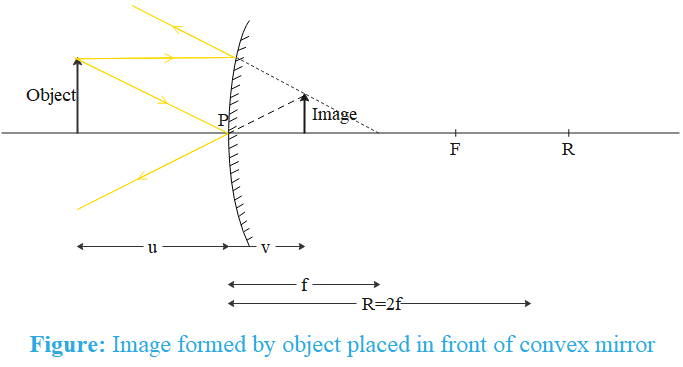
The focus of the convex mirror lies in the direction of incident light from the pole therefore, the focal length of the convex mirror is positive. Also focal length of a mirror is half of its radius of curvature i.e. $f=\dfrac{R}{2}=-20\,cm$
Now, we use mirror formula
$\dfrac{1}{20}=\dfrac{1}{v}+\dfrac{1}{-20}\Rightarrow \dfrac{1}{v}=\dfrac{1}{20}+\dfrac{1}{20}=\dfrac{1}{10}$
$\Rightarrow v=10cm$
Since the image distance is positive, the image is behind the mirror, so the image is virtual and upright.
Magnification is the ratio of height of image (h’) to height of object (h).
$m=\dfrac{-v}{u}=\dfrac{h'}{h}$
Height of the object is $h=2mm$
Substituting the values, we get
$-\dfrac{10cm}{-20cm}=0.5=\dfrac{h'}{2mm}$
$\Rightarrow h'=0.5\times 2mm=1mm$
So, the correct answer is “Option D”.
Additional Information: By sign convention, the object is always placed towards the left from the pole. Therefore, its distance from the pole is always negative.
All distances are measured from the pole of the mirror. Distances measured in the direction of the incident light are positive and the distances measured in the direction opposite to that are negative.
Note: In mirror as well as optical lens problems, the most important thing to consider is sign conventions. Therefore, students should understand the sign conventions properly and then proceed with the solution. Diagrams are very helpful in understanding the sign conventions.
The distances in the direction of incident light from the pole are taken positively.
First determine the distance of the image from the pole using the mirror formula and then use the magnification formula to determine the height of the image.
Formula used: Magnification, $m=-\dfrac{v}{u}$ and mirror formula, $\dfrac{1}{f}=\dfrac{1}{v}+\dfrac{1}{u}$
Complete step by step answer:
The object is placed at a distance 20 cm from the pole of the mirror. The distance of object is always taken negative i.e. $u=20\,cm$
The focus of the convex mirror lies in the direction of incident light from the pole therefore, the focal length of the convex mirror is positive. Also focal length of a mirror is half of its radius of curvature i.e. $f=\dfrac{R}{2}=-20\,cm$
Now, we use mirror formula
$\dfrac{1}{20}=\dfrac{1}{v}+\dfrac{1}{-20}\Rightarrow \dfrac{1}{v}=\dfrac{1}{20}+\dfrac{1}{20}=\dfrac{1}{10}$
$\Rightarrow v=10cm$
Since the image distance is positive, the image is behind the mirror, so the image is virtual and upright.
Magnification is the ratio of height of image (h’) to height of object (h).
$m=\dfrac{-v}{u}=\dfrac{h'}{h}$
Height of the object is $h=2mm$
Substituting the values, we get
$-\dfrac{10cm}{-20cm}=0.5=\dfrac{h'}{2mm}$
$\Rightarrow h'=0.5\times 2mm=1mm$
So, the correct answer is “Option D”.
Additional Information: By sign convention, the object is always placed towards the left from the pole. Therefore, its distance from the pole is always negative.
All distances are measured from the pole of the mirror. Distances measured in the direction of the incident light are positive and the distances measured in the direction opposite to that are negative.
Note: In mirror as well as optical lens problems, the most important thing to consider is sign conventions. Therefore, students should understand the sign conventions properly and then proceed with the solution. Diagrams are very helpful in understanding the sign conventions.
The distances in the direction of incident light from the pole are taken positively.
Recently Updated Pages
Master Class 12 Business Studies: Engaging Questions & Answers for Success

Master Class 12 Chemistry: Engaging Questions & Answers for Success
Master Class 12 Biology: Engaging Questions & Answers for Success
Class 12 Question and Answer - Your Ultimate Solutions Guide
Master Class 11 English: Engaging Questions & Answers for Success
Master Class 11 Social Science: Engaging Questions & Answers for Success
Trending doubts
Which are the Top 10 Largest Countries of the World?
Draw a labelled sketch of the human eye class 12 physics CBSE
Differentiate between homogeneous and heterogeneous class 12 chemistry CBSE
Differentiate between Pyramid of energy and pyramid class 12 biology CBSE
Why is the cell called the structural and functional class 12 biology CBSE
Draw the diagram of the pyramid of energy Explain In class 12 biology CBSE