



The height of a conical vessel is \[3.5cm\]. If its capacity is \[3.3\] litres of milk. Find the diameter of its base.
Answer
 Verified
597k+ views
Hint: Here, we have to find the diameter of the base of the conical vessel. We will use the volume of a cone formula to find the radius of the base. Then by using the radius of the base, we will find the diameter of the conical vessel. Volume is defined as the quantity of substance that can be contained in an enclosed curve or a container.
Formula Used:
Volume of a conical vessel is given by the formula \[V = \dfrac{1}{3}\pi {r^2}h\] where \[r\] is the radius of the cone and \[h\] is the height of the cone.
Complete step-by-step answer:
We are given that the height of a conical vessel is \[3.5cm\].
We are given that the capacity of a conical vessel is \[3.3\] litres of milk.
Volume of a conical vessel \[ = 3.3\]
Now, we will convert the SI units from liters to cubic centimeters.
We know that \[1\] litre \[ = 1000{\rm{ }}c{m^3}\]
Now, to find for \[3.3\] liters, we will be multiplying the given liters by 1000.
So, we have \[3.3{\rm{litre}} = 3.3 \times 1000{\rm{ }}c{m^3}\]
So \[3.3{\rm{litres}} = 3300{\rm{ }}c{m^3}\]
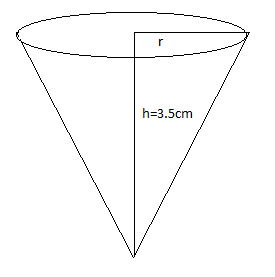
Let \[r\] be the radius of the conical vessel.
\[ \Rightarrow \] Volume of a conical vessel \[ = 3300{\rm{ }}c{m^3}\]
Now using the formula \[V = \dfrac{1}{3}\pi {r^2}h\], we get
\[ \Rightarrow \dfrac{1}{3}\pi {r^2}h = 3300\]
By substituting the height of the cone \[h = 3.5cm\] and \[\pi = \dfrac{{22}}{7}\] in the above equation, we get
\[ \Rightarrow \dfrac{1}{3} \times \dfrac{{22}}{7} \times {r^2} \times 3.5 = 3300\]
\[ \Rightarrow \dfrac{1}{3} \times \dfrac{{22}}{7} \times {r^2} \times \dfrac{{35}}{{10}} = 3300\]
By simplifying the equation, we get
\[ \Rightarrow \dfrac{1}{3} \times 22 \times {r^2} \times \dfrac{1}{2} = 3300\]
\[ \Rightarrow \dfrac{1}{3} \times 11 \times {r^2} = 3300\]
On cross-multiplication, we get
\[ \Rightarrow {r^2} = \dfrac{{3300 \times 3}}{{11}}\]
Dividing the terms, we get
\[ \Rightarrow {r^2} = 300 \times 3\]
\[ \Rightarrow {r^2} = 3 \times 100 \times 3\]
By taking square root on both sides, we get
\[ \Rightarrow r = \sqrt {3 \times 100 \times 3} \]
\[ \Rightarrow r = 3 \times 10\]
\[ \Rightarrow r = 30cm\]
We know that the diameter is two times its radius of the base.
\[d = 2r\]
\[ \Rightarrow d = 2\left( {30} \right)\]
Multiplying the terms, we get
\[ \Rightarrow d = 60cm\]
Therefore, the diameter of the base of a conical vessel is 60cm.
Note: We should know that the capacity of a conical vessel is equal to the volume of a conical vessel. We should convert the given dimensions of liters to the cubic centimeters, otherwise, we will get the wrong answer. In order to mathematically operate an equation, we need to have all the dimensions in the same unit or else we will get the wrong answer. We might make a mistake by finding only the radius, and forget to find the diameter from the radius of the base.
Formula Used:
Volume of a conical vessel is given by the formula \[V = \dfrac{1}{3}\pi {r^2}h\] where \[r\] is the radius of the cone and \[h\] is the height of the cone.
Complete step-by-step answer:
We are given that the height of a conical vessel is \[3.5cm\].
We are given that the capacity of a conical vessel is \[3.3\] litres of milk.
Volume of a conical vessel \[ = 3.3\]
Now, we will convert the SI units from liters to cubic centimeters.
We know that \[1\] litre \[ = 1000{\rm{ }}c{m^3}\]
Now, to find for \[3.3\] liters, we will be multiplying the given liters by 1000.
So, we have \[3.3{\rm{litre}} = 3.3 \times 1000{\rm{ }}c{m^3}\]
So \[3.3{\rm{litres}} = 3300{\rm{ }}c{m^3}\]
Let \[r\] be the radius of the conical vessel.
\[ \Rightarrow \] Volume of a conical vessel \[ = 3300{\rm{ }}c{m^3}\]
Now using the formula \[V = \dfrac{1}{3}\pi {r^2}h\], we get
\[ \Rightarrow \dfrac{1}{3}\pi {r^2}h = 3300\]
By substituting the height of the cone \[h = 3.5cm\] and \[\pi = \dfrac{{22}}{7}\] in the above equation, we get
\[ \Rightarrow \dfrac{1}{3} \times \dfrac{{22}}{7} \times {r^2} \times 3.5 = 3300\]
\[ \Rightarrow \dfrac{1}{3} \times \dfrac{{22}}{7} \times {r^2} \times \dfrac{{35}}{{10}} = 3300\]
By simplifying the equation, we get
\[ \Rightarrow \dfrac{1}{3} \times 22 \times {r^2} \times \dfrac{1}{2} = 3300\]
\[ \Rightarrow \dfrac{1}{3} \times 11 \times {r^2} = 3300\]
On cross-multiplication, we get
\[ \Rightarrow {r^2} = \dfrac{{3300 \times 3}}{{11}}\]
Dividing the terms, we get
\[ \Rightarrow {r^2} = 300 \times 3\]
\[ \Rightarrow {r^2} = 3 \times 100 \times 3\]
By taking square root on both sides, we get
\[ \Rightarrow r = \sqrt {3 \times 100 \times 3} \]
\[ \Rightarrow r = 3 \times 10\]
\[ \Rightarrow r = 30cm\]
We know that the diameter is two times its radius of the base.
\[d = 2r\]
\[ \Rightarrow d = 2\left( {30} \right)\]
Multiplying the terms, we get
\[ \Rightarrow d = 60cm\]
Therefore, the diameter of the base of a conical vessel is 60cm.
Note: We should know that the capacity of a conical vessel is equal to the volume of a conical vessel. We should convert the given dimensions of liters to the cubic centimeters, otherwise, we will get the wrong answer. In order to mathematically operate an equation, we need to have all the dimensions in the same unit or else we will get the wrong answer. We might make a mistake by finding only the radius, and forget to find the diameter from the radius of the base.
Recently Updated Pages
Master Class 9 General Knowledge: Engaging Questions & Answers for Success

Master Class 9 Maths: Engaging Questions & Answers for Success
Master Class 9 Science: Engaging Questions & Answers for Success
Master Class 9 English: Engaging Questions & Answers for Success
Master Class 9 Social Science: Engaging Questions & Answers for Success
Class 9 Question and Answer - Your Ultimate Solutions Guide
Trending doubts
Find the sum of series 1 + 2 + 3 + 4 + 5 + + 100 class 9 maths CBSE
Difference Between Plant Cell and Animal Cell
Fill the blanks with the suitable prepositions 1 The class 9 english CBSE
What is pollution? How many types of pollution? Define it
Name 10 Living and Non living things class 9 biology CBSE
What is the full form of pH?