




The height of a cone is 30 cm. A small cone is cut off at the top by a plane parallel to the base. If its volume is \[\dfrac{1}{27}\] of the volume of the given cone, at what height above the base is the section mode.
Answer
 Verified
658.5k+ views
Hint: At first, we need to find the volume of both small and large cones. Then compare with the relation that the volume of the smaller cone is \[\dfrac{1}{27}\] of the larger one. Then use the property of similarity to write \[\dfrac{{{r}_{1}}}{r}=\dfrac{{{h}_{1}}}{h+{{h}_{1}}}\], then substitute to find the values of \[{{h}_{1}}\] and h respectively.
Complete step-by-step answer:
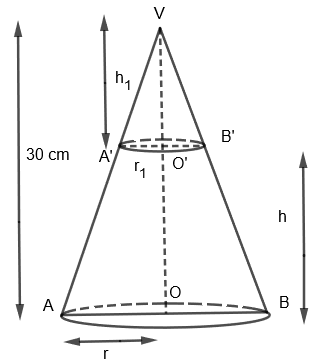
In the question, the height of the cone is given 30 cm. Now it is further said that a small cone is cut off at the top by a plane parallel to the surface of the base. The cone which was cut off is \[\left( \dfrac{1}{27} \right)\] of the larger original cone. Now, we have to find at which height above the base it should be cut so that the conditions are satisfied. In the given figure,
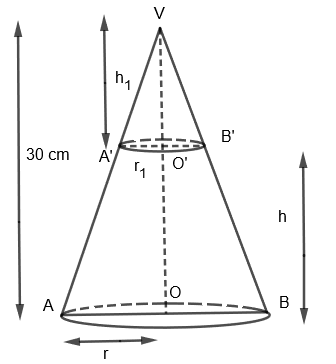
The height of the bigger cone is 30 cm. So, we can say,
\[{{h}_{1}}+h=30\]
\[\Rightarrow {{h}_{1}}=30-h\]
We are given in the figure, r is the radius of the larger cone, and \[{{r}_{1}}\] is the radius of the smaller cone. So we will find the volume of the smaller and larger cone by using the formula \[\dfrac{\pi {{r}^{2}}h}{3}\] where r is radius and h is the height.
So, the volume of the smaller cone is
\[\dfrac{1}{3}\times \pi \times {{\left( {{r}_{1}} \right)}^{2}}\times {{h}_{1}}\]
\[\Rightarrow \dfrac{\pi r_{1}^{2}{{h}_{1}}}{3}\]
And the volume of the larger cone of height 30 cm is
\[\dfrac{1}{3}\times \pi \times {{\left( r \right)}^{2}}\times 30=10\pi {{r}^{2}}\]
We know that the volume of the smaller cone is \[\left( \dfrac{1}{27} \right)\] of the larger cone.
So, we get,
\[\dfrac{\pi r_{1}^{2}{{h}_{1}}}{3}=\dfrac{1}{27}\left( 10\pi {{r}^{2}} \right)\]
On simplifying further, we get,
\[r_{1}^{2}{{h}_{1}}=\dfrac{10}{9}{{r}^{2}}\]
It can be further written as,
\[\dfrac{9{{h}_{1}}}{10}=\dfrac{{{r}^{2}}}{r_{1}^{2}}\]
As the base of the smaller cone whose base was cut parallel to that of the larger cone, then we can say that they are similar to each other. Then we can say,
\[\dfrac{{{r}_{1}}}{r}=\dfrac{h_{1}}{h+{{h}_{1}}}\]
So, we can write,
\[\dfrac{r}{{{r}_{1}}}=\dfrac{h+{{h}_{1}}}{h_{1}}\]
Now, as we know that \[h+{{h}_{1}}=30\]. So,
\[\dfrac{r}{{{r}_{1}}}=\dfrac{30}{h_1}\]
As we know that
\[\dfrac{9{{h}_{1}}}{10}=\dfrac{{{r}^{2}}}{r_{1}^{2}}\]
So, we can substitute \[\dfrac{r}{{{r}_{1}}}=\dfrac{30}{{{h}_{1}}}\]
So, we get,
\[\dfrac{9{{h}_{1}}}{10}=\dfrac{900}{h_{1}^{2}}\]
On further cross-multiplication, we get,
\[9h_{1}^{3}=9000\]
\[\Rightarrow h_{1}^{3}=1000\]
Here, \[{{h}_{1}}=10cm\]
So, h is equal to 30 – $h_1$ which is (30 – 10) cm = 20 cm.
Hence, the height is 20 cm.
Note: Students should be well versed with the formulas of the volume of the cone. They should also know the properties of similar figures, i.e. if two figures are similar to each other, then their dimensions are in ratio to each other.
Complete step-by-step answer:
In the question, the height of the cone is given 30 cm. Now it is further said that a small cone is cut off at the top by a plane parallel to the surface of the base. The cone which was cut off is \[\left( \dfrac{1}{27} \right)\] of the larger original cone. Now, we have to find at which height above the base it should be cut so that the conditions are satisfied. In the given figure,
The height of the bigger cone is 30 cm. So, we can say,
\[{{h}_{1}}+h=30\]
\[\Rightarrow {{h}_{1}}=30-h\]
We are given in the figure, r is the radius of the larger cone, and \[{{r}_{1}}\] is the radius of the smaller cone. So we will find the volume of the smaller and larger cone by using the formula \[\dfrac{\pi {{r}^{2}}h}{3}\] where r is radius and h is the height.
So, the volume of the smaller cone is
\[\dfrac{1}{3}\times \pi \times {{\left( {{r}_{1}} \right)}^{2}}\times {{h}_{1}}\]
\[\Rightarrow \dfrac{\pi r_{1}^{2}{{h}_{1}}}{3}\]
And the volume of the larger cone of height 30 cm is
\[\dfrac{1}{3}\times \pi \times {{\left( r \right)}^{2}}\times 30=10\pi {{r}^{2}}\]
We know that the volume of the smaller cone is \[\left( \dfrac{1}{27} \right)\] of the larger cone.
So, we get,
\[\dfrac{\pi r_{1}^{2}{{h}_{1}}}{3}=\dfrac{1}{27}\left( 10\pi {{r}^{2}} \right)\]
On simplifying further, we get,
\[r_{1}^{2}{{h}_{1}}=\dfrac{10}{9}{{r}^{2}}\]
It can be further written as,
\[\dfrac{9{{h}_{1}}}{10}=\dfrac{{{r}^{2}}}{r_{1}^{2}}\]
As the base of the smaller cone whose base was cut parallel to that of the larger cone, then we can say that they are similar to each other. Then we can say,
\[\dfrac{{{r}_{1}}}{r}=\dfrac{h_{1}}{h+{{h}_{1}}}\]
So, we can write,
\[\dfrac{r}{{{r}_{1}}}=\dfrac{h+{{h}_{1}}}{h_{1}}\]
Now, as we know that \[h+{{h}_{1}}=30\]. So,
\[\dfrac{r}{{{r}_{1}}}=\dfrac{30}{h_1}\]
As we know that
\[\dfrac{9{{h}_{1}}}{10}=\dfrac{{{r}^{2}}}{r_{1}^{2}}\]
So, we can substitute \[\dfrac{r}{{{r}_{1}}}=\dfrac{30}{{{h}_{1}}}\]
So, we get,
\[\dfrac{9{{h}_{1}}}{10}=\dfrac{900}{h_{1}^{2}}\]
On further cross-multiplication, we get,
\[9h_{1}^{3}=9000\]
\[\Rightarrow h_{1}^{3}=1000\]
Here, \[{{h}_{1}}=10cm\]
So, h is equal to 30 – $h_1$ which is (30 – 10) cm = 20 cm.
Hence, the height is 20 cm.
Note: Students should be well versed with the formulas of the volume of the cone. They should also know the properties of similar figures, i.e. if two figures are similar to each other, then their dimensions are in ratio to each other.
Recently Updated Pages
Master Class 11 English: Engaging Questions & Answers for Success

Master Class 11 Social Science: Engaging Questions & Answers for Success
Master Class 11 Maths: Engaging Questions & Answers for Success
Master Class 11 Biology: Engaging Questions & Answers for Success
Master Class 11 Physics: Engaging Questions & Answers for Success
Master Class 11 Chemistry: Engaging Questions & Answers for Success
Trending doubts
Explain the Treaty of Vienna of 1815 class 10 social science CBSE
What is the Total Duration of Football Match?
The shortest day of the year in India
In which year voting age was reduced from 21 to 18?
10 examples of evaporation in daily life with explanations
What planets have no moons Which one has only one moon class 10 physics CBSE