




The heart of mammals and birds is four-chambered while that of the other three groups shown in the diagram have three-chambered hearts. Birds and mammals’ hearts are
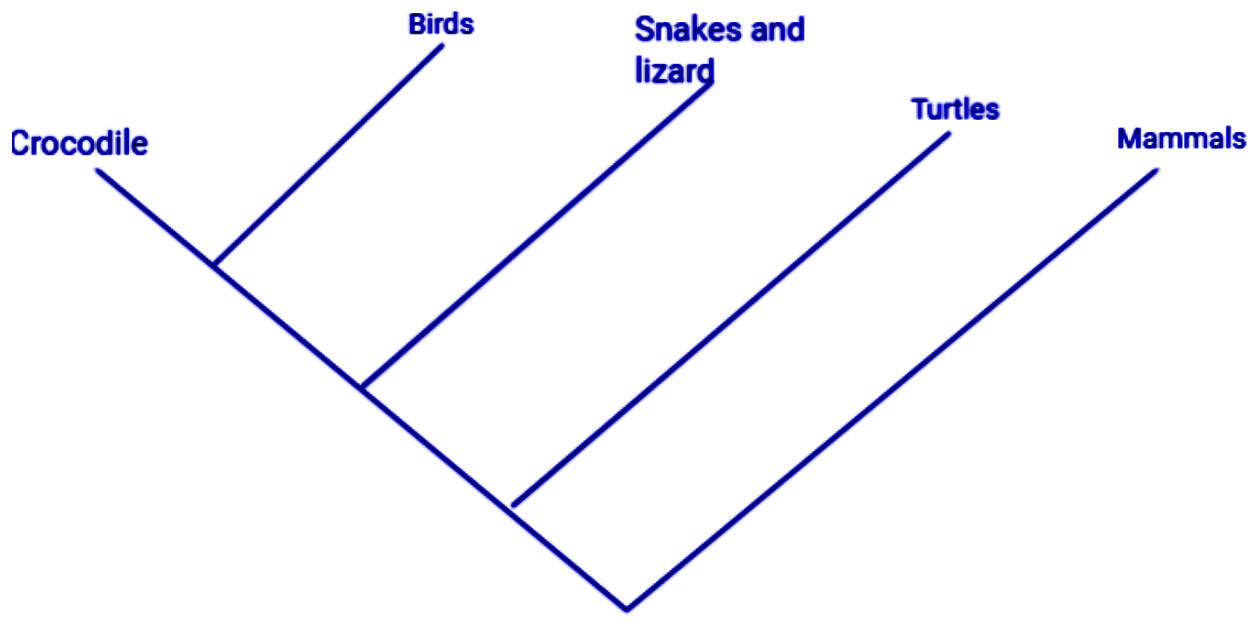
A. Analogous
B. Homologous
C. Parallel
D. Transitional
E. Vestigial
Answer
 Verified
619.8k+ views
Hint: The heart is the primary organ of man and animals in the circulatory system. The blood is pushed into the arteries and blood supply in the body is preserved. A well-developed organ is a heart that is found inside the vertebrate. There is a muscular sac with valves and a dense muscle layer called the myocardium.
Complete answer:
Birds and rodents are creatures with warm blood. In a cooler climate, they maintain a steady body temperature. For this reason, they warm their bodies. In order to make it more effective, the animals need more oxygen, they need to separate oxygenated and deoxygenated blood so that their circulatory system is more efficient and can sustain their constant body temperature.
-Analogous organs are called organs that are structurally dissimilar and functionally identical. They contribute to convergent evolution, i.e., Birds and mammals are distinct from each other but all have four-chambered cores, which may be different structurally, but serve similar functions.
-Homologous structures are organs or skeletal components of animals and organisms that indicate their relation to a common ancestor by virtue of their resemblance. Such systems do not need to look exactly the same or have the same feature.
-There is redundancy built into a parallel organ, such as the liver or kidney, and a certain fraction of the parenchyma (or functional subunits) of the organ can be sacrificed and the organ will retain function. -Vestigial organs in a body are organs, tissues or cells that are no longer functional in the way they were in their ancestral trait form.
Thus, the correct answer is option A-Analogous.
Note: The heart is the circulatory system's primary organ and can be found in almost any animal. The heart of vertebrates is similarly formed to the heart of invertebrates. Different organisms belong to another class, with a different structure. They possess a heart that has three chambers, like amphibia and Ophidia, while the heart found in birds and crocodiles and reptiles has a four-chambered heart.
Complete answer:
Birds and rodents are creatures with warm blood. In a cooler climate, they maintain a steady body temperature. For this reason, they warm their bodies. In order to make it more effective, the animals need more oxygen, they need to separate oxygenated and deoxygenated blood so that their circulatory system is more efficient and can sustain their constant body temperature.
-Analogous organs are called organs that are structurally dissimilar and functionally identical. They contribute to convergent evolution, i.e., Birds and mammals are distinct from each other but all have four-chambered cores, which may be different structurally, but serve similar functions.
-Homologous structures are organs or skeletal components of animals and organisms that indicate their relation to a common ancestor by virtue of their resemblance. Such systems do not need to look exactly the same or have the same feature.
-There is redundancy built into a parallel organ, such as the liver or kidney, and a certain fraction of the parenchyma (or functional subunits) of the organ can be sacrificed and the organ will retain function. -Vestigial organs in a body are organs, tissues or cells that are no longer functional in the way they were in their ancestral trait form.
Thus, the correct answer is option A-Analogous.
Note: The heart is the circulatory system's primary organ and can be found in almost any animal. The heart of vertebrates is similarly formed to the heart of invertebrates. Different organisms belong to another class, with a different structure. They possess a heart that has three chambers, like amphibia and Ophidia, while the heart found in birds and crocodiles and reptiles has a four-chambered heart.
Recently Updated Pages
Basicity of sulphurous acid and sulphuric acid are

Master Class 12 Economics: Engaging Questions & Answers for Success
Master Class 12 Biology: Engaging Questions & Answers for Success
Master Class 11 English: Engaging Questions & Answers for Success
Master Class 11 Physics: Engaging Questions & Answers for Success
Master Class 11 Computer Science: Engaging Questions & Answers for Success
Trending doubts
Draw a labelled sketch of the human eye class 12 physics CBSE
The chemical formula of tear gas is A CO Cl 2 B C 10 class 12 chemistry CBSE
Draw ray diagrams each showing i myopic eye and ii class 12 physics CBSE
Which are the Top 10 Largest Countries of the World?
Differentiate between homogeneous and heterogeneous class 12 chemistry CBSE
Which is the correct genotypic ratio of mendel dihybrid class 12 biology CBSE