




The $H-C-H$ bond angle in $C{{H}_{4}}$ is ${{109.5}^{\circ }}$, due to the presence lone pair, the $H-O-H$ angle in ${{H}_{2}}O$ will:
(a)- Remain same
(b)- Increases
(c)- Decreases
(d)- Becomes ${{180}^{\circ }}$
Answer
 Verified
619.8k+ views
Hint: If the molecule does not have any lone pair then the structure of the molecule is symmetric. Due to the symmetric structure, the bond angle remains the same. If the molecule has lone pairs, the bond pairs will experience repulsion hence the bonds will come closer.
Complete step by step answer:
The bond angle of a molecule tells the direction of the bonds.
When the molecule has a symmetric structure, i.e., they have only bond pairs. The bond angle can easily be determined. According to the hybridization of the molecule, the bond angle of the molecule can be predicted. If the molecule has $sp$ hybridization the bond angle is ${{180}^{\circ }}$, if the molecule has $s{{p}^{2}}$ hybridization, the bond angle is ${{120}^{\circ }}$, if the molecule has $s{{p}^{3}}$ hybridization the bond angle is ${{109.5}^{\circ }}$, etc.
The $C{{H}_{4}}$ molecule has a symmetric structure because it has four bond pairs. The hybridization of carbon in $C{{H}_{4}}$ is $s{{p}^{3}}$. The bond angle between the atoms is ${{109.5}^{\circ }}$. The structure of $C{{H}_{4}}$ is given below:

The ${{H}_{2}}O$ molecule has 2 bond pairs and 2 lone pairs. Due to the presence of lone pairs, the bond pairs will experience repulsion due to the bond pairs will come closer to each other. Due to this repulsion of lone pairs, the bond between bond angles becomes ${{104.5}^{\circ }}$. The structure of ${{H}_{2}}O$ is given below:
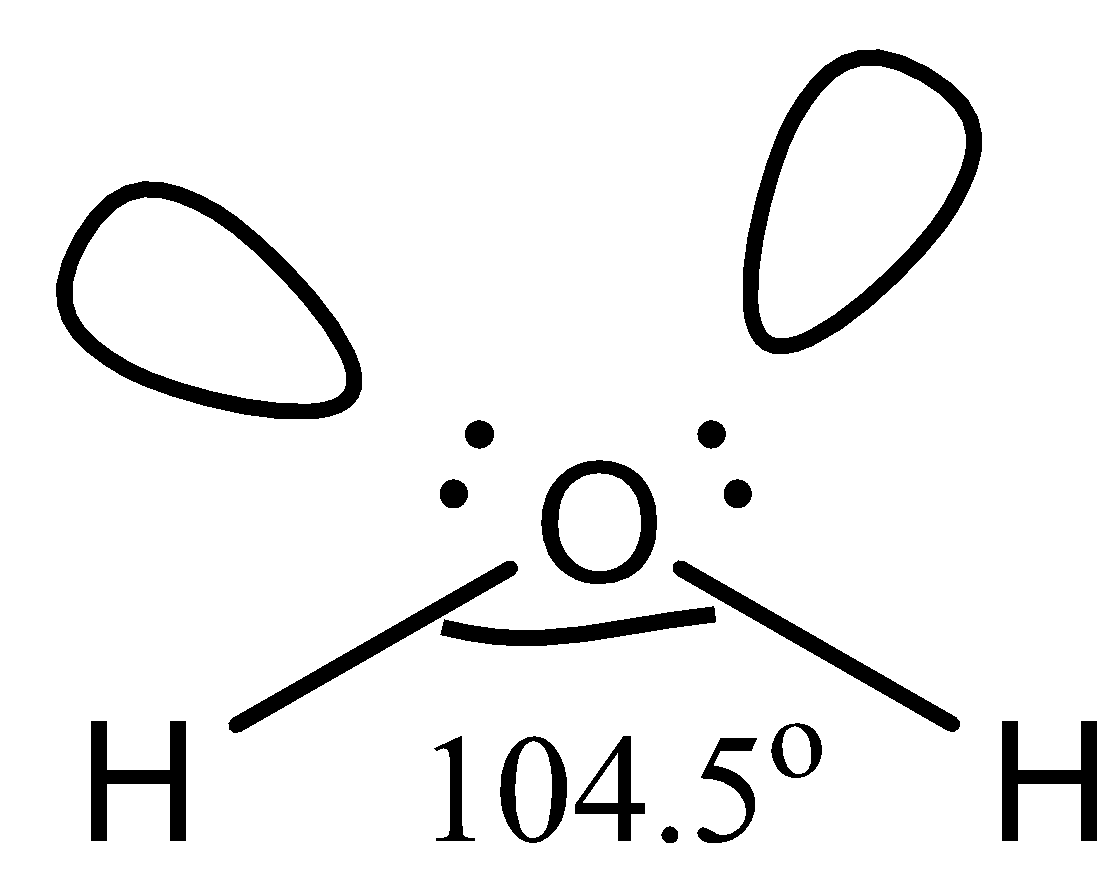
So, the bond angle of ${{H}_{2}}O$ decreases.
So, the correct answer is “Option C”.
Note: Since the hybridization of carbon and oxygen in $C{{H}_{4}}$ and ${{H}_{2}}O$ respectively same, i.e. $s{{p}^{3}}$. The structure of $C{{H}_{4}}$is tetrahedral. But the structure of ${{H}_{2}}O$ is bent or V-shaped due to the presence of 2 lone pairs.
Complete step by step answer:
The bond angle of a molecule tells the direction of the bonds.
When the molecule has a symmetric structure, i.e., they have only bond pairs. The bond angle can easily be determined. According to the hybridization of the molecule, the bond angle of the molecule can be predicted. If the molecule has $sp$ hybridization the bond angle is ${{180}^{\circ }}$, if the molecule has $s{{p}^{2}}$ hybridization, the bond angle is ${{120}^{\circ }}$, if the molecule has $s{{p}^{3}}$ hybridization the bond angle is ${{109.5}^{\circ }}$, etc.
The $C{{H}_{4}}$ molecule has a symmetric structure because it has four bond pairs. The hybridization of carbon in $C{{H}_{4}}$ is $s{{p}^{3}}$. The bond angle between the atoms is ${{109.5}^{\circ }}$. The structure of $C{{H}_{4}}$ is given below:
The ${{H}_{2}}O$ molecule has 2 bond pairs and 2 lone pairs. Due to the presence of lone pairs, the bond pairs will experience repulsion due to the bond pairs will come closer to each other. Due to this repulsion of lone pairs, the bond between bond angles becomes ${{104.5}^{\circ }}$. The structure of ${{H}_{2}}O$ is given below:
So, the bond angle of ${{H}_{2}}O$ decreases.
So, the correct answer is “Option C”.
Note: Since the hybridization of carbon and oxygen in $C{{H}_{4}}$ and ${{H}_{2}}O$ respectively same, i.e. $s{{p}^{3}}$. The structure of $C{{H}_{4}}$is tetrahedral. But the structure of ${{H}_{2}}O$ is bent or V-shaped due to the presence of 2 lone pairs.
Recently Updated Pages
Master Class 12 Economics: Engaging Questions & Answers for Success

Master Class 12 English: Engaging Questions & Answers for Success
Master Class 12 Social Science: Engaging Questions & Answers for Success
Master Class 12 Maths: Engaging Questions & Answers for Success
Master Class 12 Physics: Engaging Questions & Answers for Success
Master Class 11 Social Science: Engaging Questions & Answers for Success
Trending doubts
One Metric ton is equal to kg A 10000 B 1000 C 100 class 11 physics CBSE
Difference Between Prokaryotic Cells and Eukaryotic Cells
Two of the body parts which do not appear in MRI are class 11 biology CBSE
1 ton equals to A 100 kg B 1000 kg C 10 kg D 10000 class 11 physics CBSE
Draw a diagram of nephron and explain its structur class 11 biology CBSE
10 examples of friction in our daily life