




The gravitational force between two bodies is $6.67 \times {10^{ - 7}}N$ when the distance between their centres is 10m. if the mass of first body is 800kg, then the mass of second body is:
A. 1000kg.
B. 1250kg.
C. 1500kg.
D. 2000kg.
Answer
 Verified
609.6k+ views
Hint: To solve this question, we will use Newton's law of gravitation. With a force which is directly proportional to the product of their masses and inversely proportional to the square of the distance between them, each particle in the universe attracts every other particle. This force works along the two points connecting by the line.
Complete answer:
Let us consider two bodies of masses ${m_1}$ and ${m_2}$ and separated by distance r.
According to the law of gravitation, the force of attraction F between them will be,
$F \propto {m_1}{m_2}$ and $F \propto \dfrac{1}{{{r^2}}}$
$ \Rightarrow F \propto \dfrac{{{m_1}{m_2}}}{{{r^2}}}$
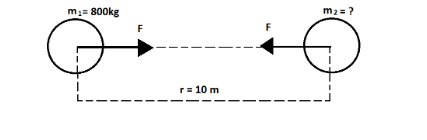
We can write this as:
$ \Rightarrow F = G\dfrac{{{m_1}{m_2}}}{{{r^2}}}$ ……… (i)
Where G = universal gravitational constant = $6.67 \times {10^{ - 11}}N{m^2}k{g^{ - 2}}$.
Now, given that
Force of attraction, F = $6.67 \times {10^{ - 7}}N$
Distance between two bodies, r = 10m.
Mass of one body, ${m_1}$ = 800kg.
We have to find the mass of the second body (${m_2}$).
Putting these values in equation (i), we will get
\[ \Rightarrow 6.67 \times {10^{ - 7}}N = \dfrac{{6.67 \times {{10}^{ - 11}}N{m^2}k{g^{ - 2}} \times 800kg \times {m_2}}}{{{{10}^2}}}\]
\[ \Rightarrow 6.67 \times {10^{ - 7}}N = \dfrac{{6.67 \times {{10}^{ - 11}}N{m^2}k{g^{ - 2}} \times 800kg \times {m_2}}}{{100}}\]
\[ \Rightarrow 6.67 \times {10^{ - 7}}N \times 100 = 6.67 \times {10^{ - 11}}N{m^2}k{g^{ - 2}} \times 800kg \times {m_2}\]
\[ \Rightarrow \dfrac{{6.67 \times {{10}^{ - 7}}N \times 100}}{{6.67 \times {{10}^{ - 11}}N{m^2}k{g^{ - 2}} \times 800kg}} = {m_2}\]
\[ \Rightarrow {m_2} = 1250kg\]
Hence, we get the mass of the second body, \[{m_2} = 1250kg\]
So, the correct answer is “Option B”.
Note:
Newton's law of gravitation also follows the law of superposition, which states that the gravitational between two masses act independently and uninfluenced by the presence of other bodies. Hence the resultant gravitational force acting on a particle due to a number of masses is the vector sum of the gravitational forces exerted by the individual masses on the given particle. Mathematically, $\overrightarrow {{F_R}} = \overrightarrow {{F_1}} + \overrightarrow {{F_2}} + \overrightarrow {{F_3}} + ...... + \overrightarrow {{F_n}} = \sum\limits_{i = 1}^n {\overrightarrow {{F_i}} } $
Complete answer:
Let us consider two bodies of masses ${m_1}$ and ${m_2}$ and separated by distance r.
According to the law of gravitation, the force of attraction F between them will be,
$F \propto {m_1}{m_2}$ and $F \propto \dfrac{1}{{{r^2}}}$
$ \Rightarrow F \propto \dfrac{{{m_1}{m_2}}}{{{r^2}}}$
We can write this as:
$ \Rightarrow F = G\dfrac{{{m_1}{m_2}}}{{{r^2}}}$ ……… (i)
Where G = universal gravitational constant = $6.67 \times {10^{ - 11}}N{m^2}k{g^{ - 2}}$.
Now, given that
Force of attraction, F = $6.67 \times {10^{ - 7}}N$
Distance between two bodies, r = 10m.
Mass of one body, ${m_1}$ = 800kg.
We have to find the mass of the second body (${m_2}$).
Putting these values in equation (i), we will get
\[ \Rightarrow 6.67 \times {10^{ - 7}}N = \dfrac{{6.67 \times {{10}^{ - 11}}N{m^2}k{g^{ - 2}} \times 800kg \times {m_2}}}{{{{10}^2}}}\]
\[ \Rightarrow 6.67 \times {10^{ - 7}}N = \dfrac{{6.67 \times {{10}^{ - 11}}N{m^2}k{g^{ - 2}} \times 800kg \times {m_2}}}{{100}}\]
\[ \Rightarrow 6.67 \times {10^{ - 7}}N \times 100 = 6.67 \times {10^{ - 11}}N{m^2}k{g^{ - 2}} \times 800kg \times {m_2}\]
\[ \Rightarrow \dfrac{{6.67 \times {{10}^{ - 7}}N \times 100}}{{6.67 \times {{10}^{ - 11}}N{m^2}k{g^{ - 2}} \times 800kg}} = {m_2}\]
\[ \Rightarrow {m_2} = 1250kg\]
Hence, we get the mass of the second body, \[{m_2} = 1250kg\]
So, the correct answer is “Option B”.
Note:
Newton's law of gravitation also follows the law of superposition, which states that the gravitational between two masses act independently and uninfluenced by the presence of other bodies. Hence the resultant gravitational force acting on a particle due to a number of masses is the vector sum of the gravitational forces exerted by the individual masses on the given particle. Mathematically, $\overrightarrow {{F_R}} = \overrightarrow {{F_1}} + \overrightarrow {{F_2}} + \overrightarrow {{F_3}} + ...... + \overrightarrow {{F_n}} = \sum\limits_{i = 1}^n {\overrightarrow {{F_i}} } $
Recently Updated Pages
Master Class 11 English: Engaging Questions & Answers for Success

Master Class 11 Maths: Engaging Questions & Answers for Success
Class 11 Question and Answer - Your Ultimate Solutions Guide
Master Class 11 Biology: Engaging Questions & Answers for Success
Master Class 11 Physics: Engaging Questions & Answers for Success
Master Class 11 Accountancy: Engaging Questions & Answers for Success
Trending doubts
Differentiate between an exothermic and an endothermic class 11 chemistry CBSE
One Metric ton is equal to kg A 10000 B 1000 C 100 class 11 physics CBSE
In what year Guru Nanak Dev ji was born A15 April 1469 class 11 social science CBSE
Difference Between Prokaryotic Cells and Eukaryotic Cells
There are 720 permutations of the digits 1 2 3 4 5 class 11 maths CBSE
Draw a diagram of a plant cell and label at least eight class 11 biology CBSE