




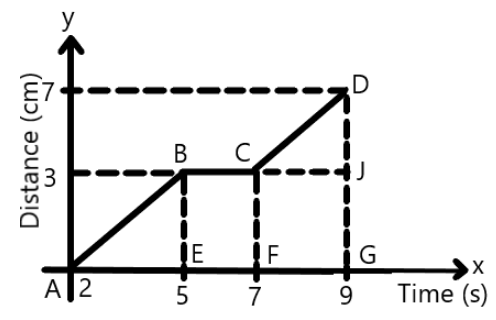
The graph shows the position of a body at different times. Calculate the speed of the body as it moves from:
A. A to B
B. B to C
C. C to D
Answer
 Verified
621.6k+ views
Hint: the graph above shows the variations in position of the body at different values of time. Here, x-axis represents the time taken by the body to cover distance whereas y-axis represents the distance covered by the body. Here, the distance will be in $cm$ and the time taken will be in $\sec $. Here, we will use the formula of speed to calculate the time taken by the body which is given below.
Formula used:
The formula used for calculating the time taken by the body is given below
$v = \dfrac{s}{t}$
Here, $v$ is the speed of the body, $s$ is the distance travelled by the body and $t$ is taken by the body.
Complete step by step answer:
Consider a body which is travelling. The graph below shows the position of a particle at different times.
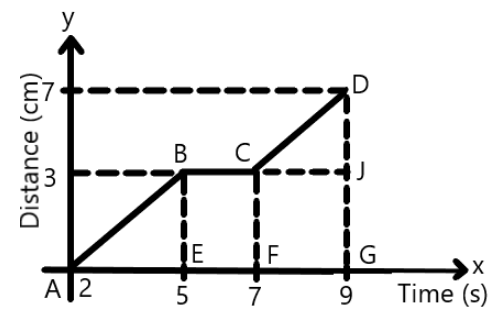
A. Now, the body will cover a distance of $3\,cm$ in $3\,\sec $ while travelling from A to B. Now, for calculating the speed attained by the body, we will use the formula of speed as shown below
$v = \dfrac{s}{t}$
$ \Rightarrow \,v = \dfrac{{3\,cm}}{{3\,\sec }}$
$ \therefore \,v = 1\,cm\,{s^{ - 1}}$
Therefore, the speed of the body as it travels from A to B is $1\,cm\,{s^{ - 1}}$.
B. Now, the distance travelled by the body while travelling from B to C is zero. We know that the speed is directly proportional to the distance covered by the body. As the distance covered by the body is zero, therefore, the speed of the body is zero. Now, the distance covered by the body from C to D is from $3\,cm$ to $7\,cm$.
Therefore, the distance from C to D $ = 7 - 3 = 4\,cm$
C. Time taken to cover this distance is $9 - 7 = 2\,cm$
Now the speed of the body is calculated below
$v = \dfrac{s}{t}$
$ \Rightarrow \,v = \dfrac{4}{2}$
$ \therefore \,v = 2\,cm$
Therefore, the speed of the body while travelling from C to D is $2\,cm$.
Note:Here, the body starts travelling from the origin and then attains different positions at different times. Also, the distance is given in smaller units that is $cm$. Here, the speed of the body is changing because it is travelling different distances.
Formula used:
The formula used for calculating the time taken by the body is given below
$v = \dfrac{s}{t}$
Here, $v$ is the speed of the body, $s$ is the distance travelled by the body and $t$ is taken by the body.
Complete step by step answer:
Consider a body which is travelling. The graph below shows the position of a particle at different times.
A. Now, the body will cover a distance of $3\,cm$ in $3\,\sec $ while travelling from A to B. Now, for calculating the speed attained by the body, we will use the formula of speed as shown below
$v = \dfrac{s}{t}$
$ \Rightarrow \,v = \dfrac{{3\,cm}}{{3\,\sec }}$
$ \therefore \,v = 1\,cm\,{s^{ - 1}}$
Therefore, the speed of the body as it travels from A to B is $1\,cm\,{s^{ - 1}}$.
B. Now, the distance travelled by the body while travelling from B to C is zero. We know that the speed is directly proportional to the distance covered by the body. As the distance covered by the body is zero, therefore, the speed of the body is zero. Now, the distance covered by the body from C to D is from $3\,cm$ to $7\,cm$.
Therefore, the distance from C to D $ = 7 - 3 = 4\,cm$
C. Time taken to cover this distance is $9 - 7 = 2\,cm$
Now the speed of the body is calculated below
$v = \dfrac{s}{t}$
$ \Rightarrow \,v = \dfrac{4}{2}$
$ \therefore \,v = 2\,cm$
Therefore, the speed of the body while travelling from C to D is $2\,cm$.
Note:Here, the body starts travelling from the origin and then attains different positions at different times. Also, the distance is given in smaller units that is $cm$. Here, the speed of the body is changing because it is travelling different distances.
Recently Updated Pages
Master Class 11 Social Science: Engaging Questions & Answers for Success

Master Class 11 English: Engaging Questions & Answers for Success
Master Class 11 Accountancy: Engaging Questions & Answers for Success
Master Class 11 Physics: Engaging Questions & Answers for Success
Master Class 11 Computer Science: Engaging Questions & Answers for Success
Master Class 11 Business Studies: Engaging Questions & Answers for Success
Trending doubts
Find the value of the expression given below sin 30circ class 11 maths CBSE
One Metric ton is equal to kg A 10000 B 1000 C 100 class 11 physics CBSE
Draw a diagram of nephron and explain its structur class 11 biology CBSE
10 examples of friction in our daily life
Proton was discovered by A Thomson B Rutherford C Chadwick class 11 chemistry CBSE
The teeth used for biting and cutting food are called class 11 biology CBSE