




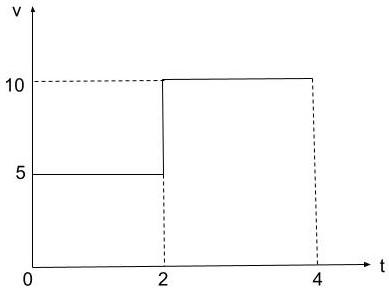
The graph represents the velocity time or the first $4$ second of the motion. Find the distance covered.
Answer
 Verified
557.1k+ views
Hint: An area covered, often known as an area graph, is a graphical representation of quantitative data. A velocity-time graph depicts the speed and direction of an object over a certain time period. Speed-time graphs are sometimes known as velocity-time graphs. The velocity of the item is the vertical axis of a velocity-time graph. The time from the beginning is represented on the horizontal axis.
Complete step by step solution:
We can solve this problem by using Area under the graph.
So, from the graph we can see that the graph is divided into two parts. The first part is from $0$ to $2$ and the second part is $2$ to $4$.
So let us first calculate the area under the graph from $0$ to $2$.
Area under the rectangle $ = $ length $ \times $breadth.
$ = 2 \times 5 = 10$
Now, Let us calculate the area under the graph from $2$ to $4$.
Area under the rectangle $ = $ length $ \times $breadth.
$ = 10 \times (4 - 2) = 20$
Now, by adding both the area we can calculate the distance covered $ = 10 + 20 = 30\,m$
So, the total distance covered is $30\,m$.
Note:
The velocity is changing linearly, showing that the velocity is changing at a constant rate or there is constant acceleration, as seen in the graph above for a uniformly accelerated motion. In uniformly accelerating motion, however, the velocity time graph would be a straight line since velocity varies at a consistent rate with respect to time with acceleration.
Complete step by step solution:
We can solve this problem by using Area under the graph.
So, from the graph we can see that the graph is divided into two parts. The first part is from $0$ to $2$ and the second part is $2$ to $4$.
So let us first calculate the area under the graph from $0$ to $2$.
Area under the rectangle $ = $ length $ \times $breadth.
$ = 2 \times 5 = 10$
Now, Let us calculate the area under the graph from $2$ to $4$.
Area under the rectangle $ = $ length $ \times $breadth.
$ = 10 \times (4 - 2) = 20$
Now, by adding both the area we can calculate the distance covered $ = 10 + 20 = 30\,m$
So, the total distance covered is $30\,m$.
Note:
The velocity is changing linearly, showing that the velocity is changing at a constant rate or there is constant acceleration, as seen in the graph above for a uniformly accelerated motion. In uniformly accelerating motion, however, the velocity time graph would be a straight line since velocity varies at a consistent rate with respect to time with acceleration.
Recently Updated Pages
Master Class 11 Social Science: Engaging Questions & Answers for Success

Master Class 11 English: Engaging Questions & Answers for Success
Master Class 11 Accountancy: Engaging Questions & Answers for Success
Master Class 11 Physics: Engaging Questions & Answers for Success
Master Class 11 Computer Science: Engaging Questions & Answers for Success
Master Class 11 Business Studies: Engaging Questions & Answers for Success
Trending doubts
One Metric ton is equal to kg A 10000 B 1000 C 100 class 11 physics CBSE
Find the value of the expression given below sin 30circ class 11 maths CBSE
Draw a diagram of nephron and explain its structur class 11 biology CBSE
10 examples of friction in our daily life
Proton was discovered by A Thomson B Rutherford C Chadwick class 11 chemistry CBSE
The teeth used for biting and cutting food are called class 11 biology CBSE