




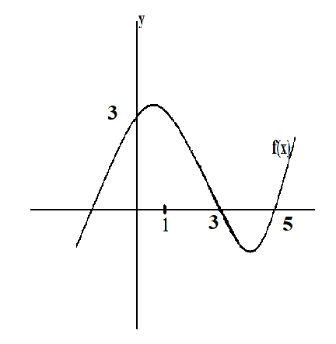
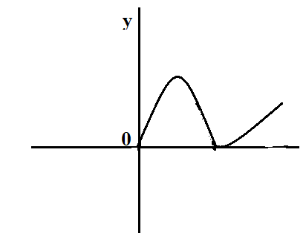
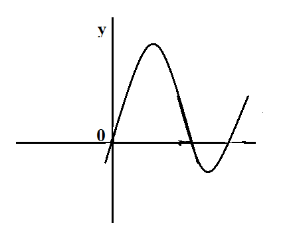
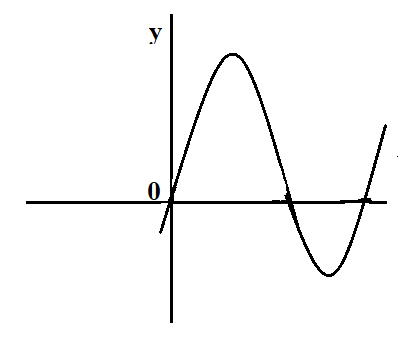
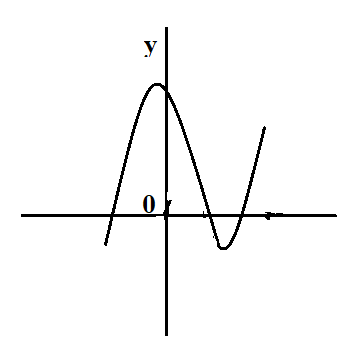
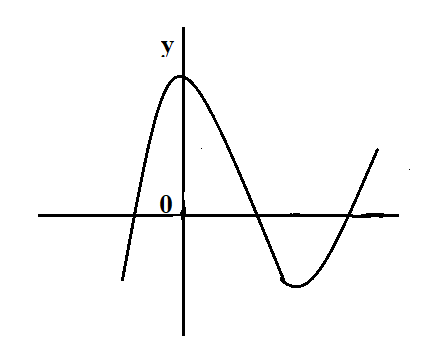
The graph of $y = f\left( x \right)$ is shown. Which is the graph of $g\left( x \right) = 2f\left( {x - 2} \right) + 1$?
A.
B.
C.
D.
E.
Answer
 Verified
586.2k+ views
Hint: We are given the graph of the function $y = f\left( x \right)$. Then, we can apply rules of transformations of graphs to find the graph of $g\left( x \right) = 2f\left( {x - 2} \right) + 1$. We will also find how the coordinate changes for the same value in both the functions. Next, we will match from the given options, and select the graph which will satisfy all the transformations.
Complete step-by-step answer:
From the graph, we can see that the graph intersects the $y$ axis at $\left( {0,3} \right)$ and the graph also intersects the $x$ axis at $\left( {3,0} \right)$ and $\left( {5,0} \right)$
We can also find the value of $g\left( x \right)$ by substituting the values 5 in the $g\left( x \right) = 2f\left( {x - 2} \right) + 1$
Then,
$
g\left( 5 \right) = 2f\left( {5 - 3} \right) + 1 \\
\Rightarrow g\left( 5 \right) = 2f\left( 2 \right) + 1 \\
\Rightarrow g\left( 5 \right) = 2\left( 0 \right) + 1 \\
\Rightarrow g\left( 5 \right) = 1 \\
$
That is the point $\left( {5,0} \right)$ shifted to $\left( {5,1} \right)$
Since, we have $f\left( {x - 2} \right)$, then its graph will shift to the right by 2.
And also the graph of $2f\left( {x - 2} \right)$ will be stretched by 2.
Now, 1 is also added, then the graph will be moved upwards by 1 unit.
The function $g\left( x \right) = 2f\left( {x - 2} \right) + 1$ can be obtained by moving the graph of $y = f\left( x \right)$ to the right by 2 and also multiply the graph of $y = f\left( x \right)$ by 2. Also, the graph will move upwards by 1 unit.
Hence, option B is the correct answer.
Note: If we have the graph of $y = f\left( x \right)$, then the graph of $f\left( {x - k} \right)$ shifts $f\left( x \right)$ to the right by $k$ units, the graph of $kf\left( x \right)$ stretches vertically by $k$ units if $k > 1$ and shrinks by $k$ units if $0 < k < 1$. But if we have $f\left( {kx} \right)$, then the graph of $f\left( x \right)$ stretches horizontally by $k$ units if $k > 1$ and shrinks by $k$ units if $0 < k < 1$. The graph of $f\left( x \right) + k$ can be obtained by shifting the graph of $f\left( x \right)$ upwards by $k$ units.
Complete step-by-step answer:
From the graph, we can see that the graph intersects the $y$ axis at $\left( {0,3} \right)$ and the graph also intersects the $x$ axis at $\left( {3,0} \right)$ and $\left( {5,0} \right)$
We can also find the value of $g\left( x \right)$ by substituting the values 5 in the $g\left( x \right) = 2f\left( {x - 2} \right) + 1$
Then,
$
g\left( 5 \right) = 2f\left( {5 - 3} \right) + 1 \\
\Rightarrow g\left( 5 \right) = 2f\left( 2 \right) + 1 \\
\Rightarrow g\left( 5 \right) = 2\left( 0 \right) + 1 \\
\Rightarrow g\left( 5 \right) = 1 \\
$
That is the point $\left( {5,0} \right)$ shifted to $\left( {5,1} \right)$
Since, we have $f\left( {x - 2} \right)$, then its graph will shift to the right by 2.
And also the graph of $2f\left( {x - 2} \right)$ will be stretched by 2.
Now, 1 is also added, then the graph will be moved upwards by 1 unit.
The function $g\left( x \right) = 2f\left( {x - 2} \right) + 1$ can be obtained by moving the graph of $y = f\left( x \right)$ to the right by 2 and also multiply the graph of $y = f\left( x \right)$ by 2. Also, the graph will move upwards by 1 unit.
Hence, option B is the correct answer.
Note: If we have the graph of $y = f\left( x \right)$, then the graph of $f\left( {x - k} \right)$ shifts $f\left( x \right)$ to the right by $k$ units, the graph of $kf\left( x \right)$ stretches vertically by $k$ units if $k > 1$ and shrinks by $k$ units if $0 < k < 1$. But if we have $f\left( {kx} \right)$, then the graph of $f\left( x \right)$ stretches horizontally by $k$ units if $k > 1$ and shrinks by $k$ units if $0 < k < 1$. The graph of $f\left( x \right) + k$ can be obtained by shifting the graph of $f\left( x \right)$ upwards by $k$ units.
Recently Updated Pages
Master Class 12 English: Engaging Questions & Answers for Success

Master Class 12 Social Science: Engaging Questions & Answers for Success
Master Class 12 Maths: Engaging Questions & Answers for Success
Master Class 12 Economics: Engaging Questions & Answers for Success
Master Class 12 Physics: Engaging Questions & Answers for Success
Master Class 12 Business Studies: Engaging Questions & Answers for Success
Trending doubts
Which are the Top 10 Largest Countries of the World?
What are the major means of transport Explain each class 12 social science CBSE
Draw a labelled sketch of the human eye class 12 physics CBSE
Differentiate between insitu conservation and exsitu class 12 biology CBSE
Draw a neat and well labeled diagram of TS of ovary class 12 biology CBSE
RNA and DNA are chiral molecules their chirality is class 12 chemistry CBSE