




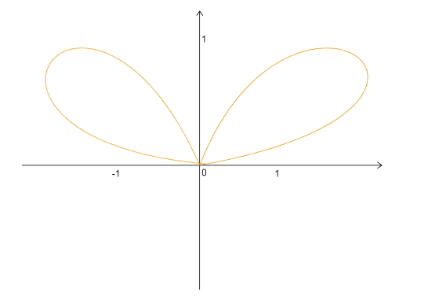
The graph of the function ${({x^2} + {y^2})^2} = 4{x^2}y$ is a double folium as shown below. (a) Find, algebraically, all points on the curve with $y = 1$? (b) Verify that the slopes of tangent lines to both points with $y = 1$ is equal to $0$?
Answer
 Verified
527.4k+ views
Hint: Start by using the formula $\int\limits_a^b {2\pi rhdx} $ where $a,b$ are the x-bounds. Substitute the values in place of the terms to make the equation easier to solve. Then we will differentiate the term. Now we will substitute these terms in the original expression and integrate.
Complete step by step solution:
We have the given expression of function as ${({x^2} + {y^2})^2} = 4{x^2}y$.
Now we need to evaluate the values of the co-ordinates that is values of $x,y$.
So, we first substitute the value $y = 1$ in the expression ${({x^2} + {y^2})^2} = 4{x^2}y$ and solve for the value of $x$.
$
{({x^2} + {y^2})^2} = 4{x^2}y \\
\Rightarrow {({x^2} + {1^2})^2} = 4{x^2}(1) \\
On\,expanding \\
\Rightarrow {x^4} + 2{x^2} + 1 = 4{x^2} \\
\Rightarrow {x^4} - 2{x^2} + 1 = 0 \\
\Rightarrow {({x^2} - 1)^2} = 0 \\
Hence, \\
\Rightarrow {x^2} - 1 = 0 \\
\Rightarrow {x^2} = 1 \\
\Rightarrow x = \pm 1 \;
$
Hence, the coordinates are $(1,1)$ and $( - 1,1)$.
Part b)
Start by using the formula $\int\limits_a^b {2\pi rhdx} $ where $a,b$ are the x-bounds. Substitute the values in place of the terms to make the equation easier to solve. Then we will differentiate the term. Now we will substitute these terms in the original expression and integrate.
If we differentiate implicitly using the chain rule and product rule we will get:
\[2({x^2} + {y^2})\left( {2x + 2y\dfrac{{dy}}{{dx}}} \right) = 4{x^2}\left( {\dfrac{{dy}}{{dx}}} \right) + 8xy\]
But here, we do not need to find an explicit expression for $\dfrac{{dy}}{{dx}}$, just its value when $x = \pm 1$ and $y = 1$. Now we will substitute ${x^2} = 1$ and $y = 1$.
\[
2(1 + 1)\left( {2x + 2\dfrac{{dy}}{{dx}}} \right) = 4\left( {\dfrac{{dy}}{{dx}}} \right) + 8x \\
4\left( {2x + 2\dfrac{{dy}}{{dx}}} \right) = 4\left( {\dfrac{{dy}}{{dx}}} \right) + 8x \\
2x + 2\dfrac{{dy}}{{dx}} = \dfrac{{dy}}{{dx}} + 2x \\
2\dfrac{{dy}}{{dx}} = \dfrac{{dy}}{{dx}} \\
\therefore \dfrac{{dy}}{{dx}} = 0 \;
\]
Hence slopes of tangent lines to both points with $y = 1$ is equal to $0$.
Note: A derivative is the rate of change of a function with respect to a variable. Derivatives are fundamental to the solution of problems in calculus and differential equations. In general, scientists observe changing systems to obtain rate of change of some variable of interest, incorporate this information into some differential equation, and use integration techniques to obtain a function that can be used to predict the behaviour of the original system under diverse conditions. The power rule allows us to find the indefinite integrals of a variety of functions like polynomials, functions involving roots, and even some rational functions.
Complete step by step solution:
We have the given expression of function as ${({x^2} + {y^2})^2} = 4{x^2}y$.
Now we need to evaluate the values of the co-ordinates that is values of $x,y$.
So, we first substitute the value $y = 1$ in the expression ${({x^2} + {y^2})^2} = 4{x^2}y$ and solve for the value of $x$.
$
{({x^2} + {y^2})^2} = 4{x^2}y \\
\Rightarrow {({x^2} + {1^2})^2} = 4{x^2}(1) \\
On\,expanding \\
\Rightarrow {x^4} + 2{x^2} + 1 = 4{x^2} \\
\Rightarrow {x^4} - 2{x^2} + 1 = 0 \\
\Rightarrow {({x^2} - 1)^2} = 0 \\
Hence, \\
\Rightarrow {x^2} - 1 = 0 \\
\Rightarrow {x^2} = 1 \\
\Rightarrow x = \pm 1 \;
$
Hence, the coordinates are $(1,1)$ and $( - 1,1)$.
Part b)
Start by using the formula $\int\limits_a^b {2\pi rhdx} $ where $a,b$ are the x-bounds. Substitute the values in place of the terms to make the equation easier to solve. Then we will differentiate the term. Now we will substitute these terms in the original expression and integrate.
If we differentiate implicitly using the chain rule and product rule we will get:
\[2({x^2} + {y^2})\left( {2x + 2y\dfrac{{dy}}{{dx}}} \right) = 4{x^2}\left( {\dfrac{{dy}}{{dx}}} \right) + 8xy\]
But here, we do not need to find an explicit expression for $\dfrac{{dy}}{{dx}}$, just its value when $x = \pm 1$ and $y = 1$. Now we will substitute ${x^2} = 1$ and $y = 1$.
\[
2(1 + 1)\left( {2x + 2\dfrac{{dy}}{{dx}}} \right) = 4\left( {\dfrac{{dy}}{{dx}}} \right) + 8x \\
4\left( {2x + 2\dfrac{{dy}}{{dx}}} \right) = 4\left( {\dfrac{{dy}}{{dx}}} \right) + 8x \\
2x + 2\dfrac{{dy}}{{dx}} = \dfrac{{dy}}{{dx}} + 2x \\
2\dfrac{{dy}}{{dx}} = \dfrac{{dy}}{{dx}} \\
\therefore \dfrac{{dy}}{{dx}} = 0 \;
\]
Hence slopes of tangent lines to both points with $y = 1$ is equal to $0$.
Note: A derivative is the rate of change of a function with respect to a variable. Derivatives are fundamental to the solution of problems in calculus and differential equations. In general, scientists observe changing systems to obtain rate of change of some variable of interest, incorporate this information into some differential equation, and use integration techniques to obtain a function that can be used to predict the behaviour of the original system under diverse conditions. The power rule allows us to find the indefinite integrals of a variety of functions like polynomials, functions involving roots, and even some rational functions.
Recently Updated Pages
Master Class 12 Business Studies: Engaging Questions & Answers for Success

Master Class 12 Biology: Engaging Questions & Answers for Success
Master Class 12 Chemistry: Engaging Questions & Answers for Success
Class 12 Question and Answer - Your Ultimate Solutions Guide
Complete reduction of benzene diazonium chloride with class 12 chemistry CBSE
How can you identify optical isomers class 12 chemistry CBSE
Trending doubts
What are the major means of transport Explain each class 12 social science CBSE
Differentiate between insitu conservation and exsitu class 12 biology CBSE
Draw a neat and well labeled diagram of TS of ovary class 12 biology CBSE
RNA and DNA are chiral molecules their chirality is class 12 chemistry CBSE
India is a sovereign socialist secular democratic republic class 12 social science CBSE
How many states of matter are there in total class 12 chemistry CBSE