




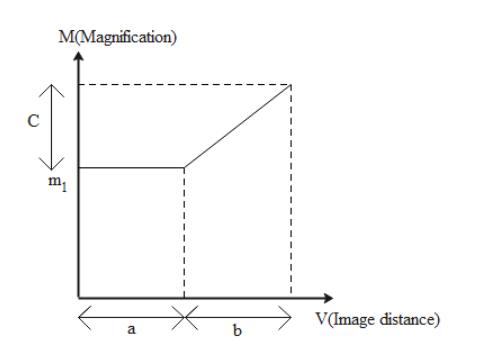
The graph of magnification v/s image distance of a thin lens is given its focal length will be-
\[\begin{align}
& A.~~~~~~~~~~~~~f=-\dfrac{a}{c} \\
& B.~~~~~~~~~~~~~f=\dfrac{b}{c} \\
& C.~~~~~~~~~~~~~f=-\dfrac{c}{b} \\
& D.~~~~~~~~~~~~None\text{ }of\text{ }these \\
\end{align}\]
Answer
 Verified
654.3k+ views
Hint: We are given magnification v/s image distance, as it is a straight line we can use it to find magnification as a function of image distance. We can also get the relation between magnification and image distance in terms of focal length and can use it to find Focal length in terms of a, b and c .
Formula Used:
Lens Formula
$\dfrac{1}{v}-\dfrac{1}{u}=\dfrac{1}{f}$ … (1)
$m=\dfrac{v}{u}$ … (2)
where v is image distance, u is object distance, m is magnification and f is focal length.
Complete step-by-step answer:
By lens formula we have,
$\dfrac{1}{v}-\dfrac{1}{u}=\dfrac{1}{f}$
$\dfrac{1}{u}=\dfrac{1}{v}-\dfrac{1}{f}$
Using the value of $\dfrac{1}{u}$ from above equation and putting it in equation 2,
$m=\dfrac{v}{u}=v\left[ \dfrac{1}{v}-\dfrac{1}{f} \right]$
$m=1-\dfrac{v}{f}$
From the above equation slope of graph must be;
$-\dfrac{1}{f}$
From the graph we can see that slope of $AB=\dfrac{BC}{AC}$
Now as BC=c and AC=b, So
AB = c/b
$-\dfrac{1}{f}=\dfrac{c}{b}$
$f=-\dfrac{c}{b}$
Hence the correct option is C.
Note:The formula of magnification changes to $m=\dfrac{v}{u}$ for lens. The formula $m=-\dfrac{v}{u}$ is applicable only in the mirror. All the formulas of a mirror can be applied in a lens by replacing u with –u. If both b and c will be positive or negative, focal length of lens will be negative meaning this is drawn for a concave lens but if only one of them is negative, the lens is convex. However this interpretation is true only when the lens is kept in the surrounding having refractive index less than the refractive index of the lens.
Formula Used:
Lens Formula
$\dfrac{1}{v}-\dfrac{1}{u}=\dfrac{1}{f}$ … (1)
$m=\dfrac{v}{u}$ … (2)
where v is image distance, u is object distance, m is magnification and f is focal length.
Complete step-by-step answer:
By lens formula we have,
$\dfrac{1}{v}-\dfrac{1}{u}=\dfrac{1}{f}$
$\dfrac{1}{u}=\dfrac{1}{v}-\dfrac{1}{f}$
Using the value of $\dfrac{1}{u}$ from above equation and putting it in equation 2,
$m=\dfrac{v}{u}=v\left[ \dfrac{1}{v}-\dfrac{1}{f} \right]$
$m=1-\dfrac{v}{f}$
From the above equation slope of graph must be;
$-\dfrac{1}{f}$
From the graph we can see that slope of $AB=\dfrac{BC}{AC}$
Now as BC=c and AC=b, So
AB = c/b
$-\dfrac{1}{f}=\dfrac{c}{b}$
$f=-\dfrac{c}{b}$
Hence the correct option is C.
Note:The formula of magnification changes to $m=\dfrac{v}{u}$ for lens. The formula $m=-\dfrac{v}{u}$ is applicable only in the mirror. All the formulas of a mirror can be applied in a lens by replacing u with –u. If both b and c will be positive or negative, focal length of lens will be negative meaning this is drawn for a concave lens but if only one of them is negative, the lens is convex. However this interpretation is true only when the lens is kept in the surrounding having refractive index less than the refractive index of the lens.
Recently Updated Pages
Master Class 11 Social Science: Engaging Questions & Answers for Success

Master Class 11 English: Engaging Questions & Answers for Success
Master Class 11 Accountancy: Engaging Questions & Answers for Success
Master Class 11 Physics: Engaging Questions & Answers for Success
Master Class 11 Computer Science: Engaging Questions & Answers for Success
Master Class 11 Business Studies: Engaging Questions & Answers for Success
Trending doubts
Find the value of the expression given below sin 30circ class 11 maths CBSE
Draw a diagram of nephron and explain its structur class 11 biology CBSE
Proton was discovered by A Thomson B Rutherford C Chadwick class 11 chemistry CBSE
The teeth used for biting and cutting food are called class 11 biology CBSE
Frogs heart when taken out of the body continues to class 11 biology CBSE
10 examples of diffusion in everyday life