




The graph of line $y = 6$ is a line that is:
A.Parallel to the $x$axis at a distance of 6 units from the origin.
B.Parallel to $y$axis at a distance of 6 units from the origin
C.Making an intercept of 6 units on the $x$axis
D.Making an intercept of 6 units on the both the axes
Answer
 Verified
649.5k+ views
Hint: Hint: The equation $y = 6$ can be written as $y = 0x + 6$. Find the value of $y$ for different values of $x$ such as \[ - 1,0,1,2..\]. Then draw the line in the $xy$ plane.
Complete step-by-step answer:
The equation given to us in the question $y = 6$ can be rewritten as $y = 0x + 6$.
We can then find different ordered pair that satisfies the equation $y = 0x + 6$ by finding the different values of $y$ for different integer values of $x$ such as \[ - 1,0,1,2..\]
For\[x = 0\], $y = 6$
\[x = 1\], $y = 6$
\[x = 2\], $y = 6$
\[x = 3\], $y = 6$
The different ordered pairs so formed are$\left( {0,6} \right),\left( {1,6} \right),\left( {2,6} \right),\left( {3,6} \right)$.
We can draw the line in the $xy$ plane by plotting different points and joining them to form the line.
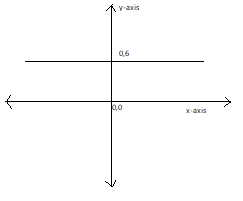
From the diagram we can observe that the line never touches the $x$ axis.
Therefore there is no intercept on the $x$ axis. Since there is no intercept on the $x$ axis the given line is parallel to the $x$ axis.
Also, we can observe that the distance between the $x$ axis and the given line is 6 units throughout.
Therefore we can conclude the given line is parallel to $x$ axis at a distance of 6 units from the origin.
Thus, option A is the correct answer.
Note: The graph of any equation of one variable can be plotted on the $xy$ plane. The $x$ axis is the horizontal axis and $y$ axis is the vertical axis. The intersection of $x$ and $y$ axis is called the origin
Complete step-by-step answer:
The equation given to us in the question $y = 6$ can be rewritten as $y = 0x + 6$.
We can then find different ordered pair that satisfies the equation $y = 0x + 6$ by finding the different values of $y$ for different integer values of $x$ such as \[ - 1,0,1,2..\]
For\[x = 0\], $y = 6$
\[x = 1\], $y = 6$
\[x = 2\], $y = 6$
\[x = 3\], $y = 6$
The different ordered pairs so formed are$\left( {0,6} \right),\left( {1,6} \right),\left( {2,6} \right),\left( {3,6} \right)$.
We can draw the line in the $xy$ plane by plotting different points and joining them to form the line.
From the diagram we can observe that the line never touches the $x$ axis.
Therefore there is no intercept on the $x$ axis. Since there is no intercept on the $x$ axis the given line is parallel to the $x$ axis.
Also, we can observe that the distance between the $x$ axis and the given line is 6 units throughout.
Therefore we can conclude the given line is parallel to $x$ axis at a distance of 6 units from the origin.
Thus, option A is the correct answer.
Note: The graph of any equation of one variable can be plotted on the $xy$ plane. The $x$ axis is the horizontal axis and $y$ axis is the vertical axis. The intersection of $x$ and $y$ axis is called the origin
Recently Updated Pages
Basicity of sulphurous acid and sulphuric acid are

Master Class 11 English: Engaging Questions & Answers for Success
Master Class 11 Physics: Engaging Questions & Answers for Success
Master Class 11 Computer Science: Engaging Questions & Answers for Success
Master Class 11 Chemistry: Engaging Questions & Answers for Success
Master Class 11 Social Science: Engaging Questions & Answers for Success
Trending doubts
Difference Between Prokaryotic Cells and Eukaryotic Cells
Two of the body parts which do not appear in MRI are class 11 biology CBSE
One Metric ton is equal to kg A 10000 B 1000 C 100 class 11 physics CBSE
10 examples of friction in our daily life
Draw a diagram of nephron and explain its structur class 11 biology CBSE
What will happen if the mucus is not secreted by the class 11 biology CBSE