




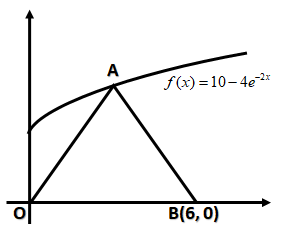
The graph of \[f(x) = 10 - 4{e^{ - 2x}}\] is shown. What is the area of triangle ABO if OA=OB.
A.25
B.60
C.45
D.50
E.30
Answer
 Verified
586.2k+ views
Hint: To find the area of a triangle we will apply the formula of the area of the triangle. For that we have to draw a line perpendicular on OB at point C and passes from A. First of all, find the coordinates of A from the given condition i.e. \[OA = AB\]. After we know the coordinates of A and C, we can calculate the value of AC. Then finally we can calculate area of $\vartriangle ABO$ and formula for area of triangle is given by:
$ \Rightarrow A = \dfrac{1}{2} \times b \times h$
Complete step-by-step answer:
In this question we have given with the graph of \[f(x) = 10 - 4{e^{ - 2x}}\]as shown below:
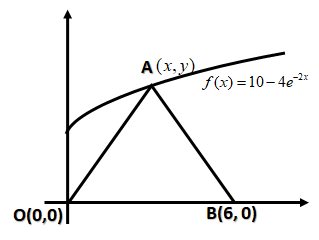
Let us assume the coordinates of A be $(x,y)$. We can find it by the following steps:
As, O is at origin. Therefore, the coordinate of O is $(0,0)$. B point lies on $(6,0)$.
The distance between two coordinates $O(0,0)$ and $A(x,y)$ i.e. OA can be calculated as:
$ \Rightarrow OA = \sqrt {{{(x - 0)}^2} + {{(y - 0)}^2}} $
While opening the bracket, we get,
$ \Rightarrow OA = \sqrt {{x^2} + {y^2}} $ ……(1)
And the distance between two coordinates $A(x,y)$and $B(6,0)$ i.e. AB can be calculated as:
$ \Rightarrow AB = \sqrt {{{(x - 6)}^2} + {{(y - 0)}^2}} $
While opening the bracket, we get,
$ \Rightarrow AB = \sqrt {{x^2} + 36 - 12x + {y^2}} $ ……(2)
As it is given that \[OA = AB\], therefore by putting the values of (1) and (2) in this we get,
\[ \Rightarrow OA = AB\]
$ \Rightarrow \sqrt {{x^2} + {y^2}} = \sqrt {{x^2} + 36 - 12x + {y^2}} $
By squaring both sides we get,
$ \Rightarrow {x^2} + {y^2} = {x^2} + 36 - 12x + {y^2}$
By cancelling same terms from both sides, we get,
$ \Rightarrow 0 = 36 - 12x$
Taking term of x on L.H.S we get,
$
\Rightarrow 12x = 36 \\
\Rightarrow x = 3 \\
$
To find y, put $x = 3$ in \[f(x) = 10 - 4{e^{ - 2x}}\] we get,
$ \Rightarrow y = 10 - 4{e^{ - 2(3)}}$
$ \Rightarrow y = 10 - 4{e^{ - 6}}$ ……..(3)
To find area of $\vartriangle ABO$, we have to find base i.e. OB and height. For height we will draw a line perpendicular on OB at point C and passes from A as shown below:
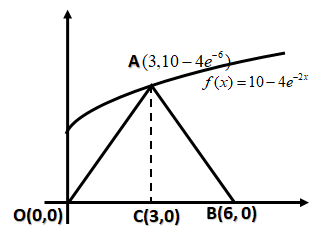
We can find the OB i.e.
$
\Rightarrow OB = \sqrt {{{(6 - 0)}^2} + {{(0 - 0)}^2}} \\
\Rightarrow OB = \sqrt {{6^2}} \\
$
By cancelling square root with square of 6 we get,
$ \Rightarrow OB = $6 ……(4)
We can calculate the AC as:
$ \Rightarrow AC = \sqrt {{{(3 - 3)}^2} + {{(10 - 4{e^{ - 6}} - 0)}^2}} $
By solving and opening the bracket, we get,
$ \Rightarrow AC = \sqrt {{{(10 - 4{e^{ - 6}})}^2}} $
By cancelling square root with square, we get,
$ \Rightarrow AC = 10 - 4{e^{ - 6}}$ ……(5)
The area of $\vartriangle ABO$ is given by
$ \Rightarrow A = \dfrac{1}{2} \times OB \times AC$
By putting the values of (4) and (5) in above equation we get,
$ \Rightarrow A = \dfrac{1}{2} \times 6 \times (10 - 4{e^{ - 6}})$
By dividing 6 with 2 we get,
$ \Rightarrow A = 3(10 - 4{e^{ - 6}})$
Put value of ${e^{ - 6}} = 0.00247$ in above equation we get,
$ \Rightarrow A = 3(10 - 4 \times 0.00247)$
$ \Rightarrow A = 3(10 - 0.00991)$
We will take approximation in this by ignoring decimal value as it is very small, hence
$ \Rightarrow A \approx 3 \times 10$
$ \Rightarrow A \approx 30$
Hence, option E is the correct answer.
Note: Here students get confused while finding the coordinates of A. They do mistake at this point as they take y coordinate as zero because while finding the A coordinates the answer will be left only with x value. But as A lies on the graph of \[f(x) = 10 - 4{e^{ - 2x}}\]. Hence y is defined as a function of x and we can find the y coordinate for A by putting the value of x i.e. 3 in the function \[f(x)\] and hence the value of y is \[10 - 4{e^{ - 6}}\].
$ \Rightarrow A = \dfrac{1}{2} \times b \times h$
Complete step-by-step answer:
In this question we have given with the graph of \[f(x) = 10 - 4{e^{ - 2x}}\]as shown below:
Let us assume the coordinates of A be $(x,y)$. We can find it by the following steps:
As, O is at origin. Therefore, the coordinate of O is $(0,0)$. B point lies on $(6,0)$.
The distance between two coordinates $O(0,0)$ and $A(x,y)$ i.e. OA can be calculated as:
$ \Rightarrow OA = \sqrt {{{(x - 0)}^2} + {{(y - 0)}^2}} $
While opening the bracket, we get,
$ \Rightarrow OA = \sqrt {{x^2} + {y^2}} $ ……(1)
And the distance between two coordinates $A(x,y)$and $B(6,0)$ i.e. AB can be calculated as:
$ \Rightarrow AB = \sqrt {{{(x - 6)}^2} + {{(y - 0)}^2}} $
While opening the bracket, we get,
$ \Rightarrow AB = \sqrt {{x^2} + 36 - 12x + {y^2}} $ ……(2)
As it is given that \[OA = AB\], therefore by putting the values of (1) and (2) in this we get,
\[ \Rightarrow OA = AB\]
$ \Rightarrow \sqrt {{x^2} + {y^2}} = \sqrt {{x^2} + 36 - 12x + {y^2}} $
By squaring both sides we get,
$ \Rightarrow {x^2} + {y^2} = {x^2} + 36 - 12x + {y^2}$
By cancelling same terms from both sides, we get,
$ \Rightarrow 0 = 36 - 12x$
Taking term of x on L.H.S we get,
$
\Rightarrow 12x = 36 \\
\Rightarrow x = 3 \\
$
To find y, put $x = 3$ in \[f(x) = 10 - 4{e^{ - 2x}}\] we get,
$ \Rightarrow y = 10 - 4{e^{ - 2(3)}}$
$ \Rightarrow y = 10 - 4{e^{ - 6}}$ ……..(3)
To find area of $\vartriangle ABO$, we have to find base i.e. OB and height. For height we will draw a line perpendicular on OB at point C and passes from A as shown below:
We can find the OB i.e.
$
\Rightarrow OB = \sqrt {{{(6 - 0)}^2} + {{(0 - 0)}^2}} \\
\Rightarrow OB = \sqrt {{6^2}} \\
$
By cancelling square root with square of 6 we get,
$ \Rightarrow OB = $6 ……(4)
We can calculate the AC as:
$ \Rightarrow AC = \sqrt {{{(3 - 3)}^2} + {{(10 - 4{e^{ - 6}} - 0)}^2}} $
By solving and opening the bracket, we get,
$ \Rightarrow AC = \sqrt {{{(10 - 4{e^{ - 6}})}^2}} $
By cancelling square root with square, we get,
$ \Rightarrow AC = 10 - 4{e^{ - 6}}$ ……(5)
The area of $\vartriangle ABO$ is given by
$ \Rightarrow A = \dfrac{1}{2} \times OB \times AC$
By putting the values of (4) and (5) in above equation we get,
$ \Rightarrow A = \dfrac{1}{2} \times 6 \times (10 - 4{e^{ - 6}})$
By dividing 6 with 2 we get,
$ \Rightarrow A = 3(10 - 4{e^{ - 6}})$
Put value of ${e^{ - 6}} = 0.00247$ in above equation we get,
$ \Rightarrow A = 3(10 - 4 \times 0.00247)$
$ \Rightarrow A = 3(10 - 0.00991)$
We will take approximation in this by ignoring decimal value as it is very small, hence
$ \Rightarrow A \approx 3 \times 10$
$ \Rightarrow A \approx 30$
Hence, option E is the correct answer.
Note: Here students get confused while finding the coordinates of A. They do mistake at this point as they take y coordinate as zero because while finding the A coordinates the answer will be left only with x value. But as A lies on the graph of \[f(x) = 10 - 4{e^{ - 2x}}\]. Hence y is defined as a function of x and we can find the y coordinate for A by putting the value of x i.e. 3 in the function \[f(x)\] and hence the value of y is \[10 - 4{e^{ - 6}}\].
Recently Updated Pages
Master Class 12 Economics: Engaging Questions & Answers for Success

Master Class 12 Physics: Engaging Questions & Answers for Success
Master Class 12 English: Engaging Questions & Answers for Success
Master Class 12 Social Science: Engaging Questions & Answers for Success
Master Class 12 Maths: Engaging Questions & Answers for Success
Master Class 12 Business Studies: Engaging Questions & Answers for Success
Trending doubts
What are the major means of transport Explain each class 12 social science CBSE
India is a sovereign socialist secular democratic republic class 12 social science CBSE
How many states of matter are there in total class 12 chemistry CBSE
What are the advantages of vegetative propagation class 12 biology CBSE
Suicide bags of cells are aEndoplasmic reticulum bLysosome class 12 biology CBSE
What is the Full Form of PVC, PET, HDPE, LDPE, PP and PS ?