




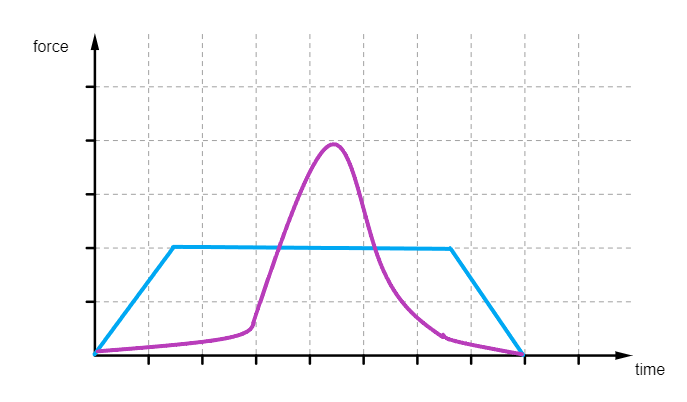
The graph below shows the net force applied to two different objects (one blue and one purple) along a straight line over a same time period. How do the changes in momentum compare for these two objects?
(A) The purple object’s momentum changes slightly more than blue object’s momentum
(B) The purple object’s momentum changes about twice as much as the blue object’s momentum.
(C) The blue object’s momentum changes slightly more than the purple object’s momentum.
(D) The blue object’s momentum changes about twice as much as the purple object’s momentum.
(E) we cannot determine how much the momentum of either changes without knowing the masses of the objects and their velocity changes.
Answer
 Verified
614.7k+ views
Hint
We will find the change in momentum using Newton's second law of motion. After then we will compare the momentum change in the two graphs using area under both the graphs.
Complete step by step answer
Newton’s second law of motion states $F= m.a$,
Where, m= mass of the body, a= acceleration
It can be rewrite as $ F = \dfrac {m(v_2-v_1)}{(t_2-t_1)} $
v= velocity and t= time
$ F = \dfrac{{dP}}{{dt}} $
Where, dP = change in momentum
dt = change in time.
$ dP = \int {F.dt} $
This equation can be interpreted as the area under the Force-Time graph.
So, change in momentum is the area under the F-t curve.
Now in the Graph Time period is the same for both the lines.
Blue line’s force has a peak value of 2units but it is for around 6 sec and it covers more area in first 1sec and last 1 sec.
Whereas Purple’s line force has peak value of 4 but only for 2 sec. and area covered in the first 3 sec and last 3 sec is not much as compared to blue.
So approximately blue’s momentum changes twice as compared to purple’s momentum change.
Hence the correct option is Option (D) i.e. The blue object’s momentum changes about twice as much as the purple object’s momentum.
Note
Here you do not have to consider the mass and velocities of both the objects because it all depends on the area of the graph. Also, you cannot calculate the exact area of both graphs so you have to do the approximation and use your analytical abilities to answer your question.
We will find the change in momentum using Newton's second law of motion. After then we will compare the momentum change in the two graphs using area under both the graphs.
Complete step by step answer
Newton’s second law of motion states $F= m.a$,
Where, m= mass of the body, a= acceleration
It can be rewrite as $ F = \dfrac {m(v_2-v_1)}{(t_2-t_1)} $
v= velocity and t= time
$ F = \dfrac{{dP}}{{dt}} $
Where, dP = change in momentum
dt = change in time.
$ dP = \int {F.dt} $
This equation can be interpreted as the area under the Force-Time graph.
So, change in momentum is the area under the F-t curve.
Now in the Graph Time period is the same for both the lines.
Blue line’s force has a peak value of 2units but it is for around 6 sec and it covers more area in first 1sec and last 1 sec.
Whereas Purple’s line force has peak value of 4 but only for 2 sec. and area covered in the first 3 sec and last 3 sec is not much as compared to blue.
So approximately blue’s momentum changes twice as compared to purple’s momentum change.
Hence the correct option is Option (D) i.e. The blue object’s momentum changes about twice as much as the purple object’s momentum.
Note
Here you do not have to consider the mass and velocities of both the objects because it all depends on the area of the graph. Also, you cannot calculate the exact area of both graphs so you have to do the approximation and use your analytical abilities to answer your question.
Recently Updated Pages
Master Class 12 Economics: Engaging Questions & Answers for Success

Master Class 12 English: Engaging Questions & Answers for Success
Master Class 12 Social Science: Engaging Questions & Answers for Success
Master Class 12 Maths: Engaging Questions & Answers for Success
Master Class 12 Physics: Engaging Questions & Answers for Success
Master Class 9 General Knowledge: Engaging Questions & Answers for Success
Trending doubts
One Metric ton is equal to kg A 10000 B 1000 C 100 class 11 physics CBSE
Difference Between Prokaryotic Cells and Eukaryotic Cells
Two of the body parts which do not appear in MRI are class 11 biology CBSE
1 ton equals to A 100 kg B 1000 kg C 10 kg D 10000 class 11 physics CBSE
Draw a diagram of nephron and explain its structur class 11 biology CBSE
10 examples of friction in our daily life