



The given table shows the number of chapattis Ms. Sharma makes on each day in a week.
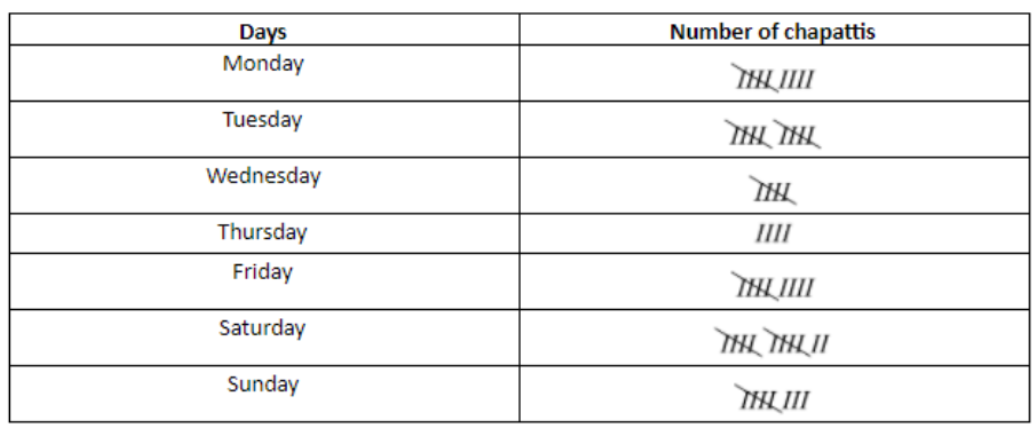
How many chapatis did she make in the whole week?
(a) 42
(b) 67
(c) 57
Answer
 Verified
610.5k+ views
Hint: First, before proceeding with this, we must know that the representation used in the above table is roman number representation as below,

Then we can conclude from the above representation that four sticks show the number 4 and the stick vertically cutting the four sticks shows the total of 5 and so on. Then, to get the total number of chapatis made by her in the entire week is given by the sum of all the chapatis made on each day.
Complete step-by-step solution
In this question, we are supposed to find the number of chapatis made by Ms. Sharma in the entire week if the table is given for the count of chapattis on each day as:
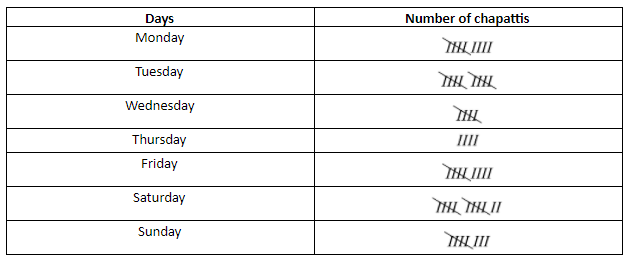
So, before proceeding with this, we must know that the representation used in the above table is the roman number representation.
Now, we must know some of the basic representations of the roman numbers are:
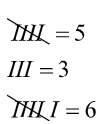
So, we can conclude from the above representation that four sticks show the number 4 and the stick vertically cutting the four sticks shows the total of 5 and so on.
So, we get the number of chapattis of each day from the given table as:
Monday=9
Tuesday=10
Wednesday=5
Thursday=4
Friday=9
Saturday=12
Sunday=8
Now, to get the total number of chapatis made by her in the entire week is given by the sum of all the chapatis made on each day.
So, by using the above condition, we get:
$\begin{align}
& 9+10+5+4+9+12+8 \\
& \Rightarrow 57 \\
\end{align}$
So, we get a total of 57 chapatis made by her in the entire week.
Hence, the option (c) is correct.
Note:Now, to solve these types of questions we need to be careful while understanding the way used to denote the number of chapatis in the question as it is the only tricky part of the question otherwise the question is straight forward. Moreover, we must also know that there is also one more representation of roman numbers as:
$\begin{align}
& V=5 \\
& III=3 \\
& VI=6 \\
\end{align}$
Then we can conclude from the above representation that four sticks show the number 4 and the stick vertically cutting the four sticks shows the total of 5 and so on. Then, to get the total number of chapatis made by her in the entire week is given by the sum of all the chapatis made on each day.
Complete step-by-step solution
In this question, we are supposed to find the number of chapatis made by Ms. Sharma in the entire week if the table is given for the count of chapattis on each day as:
So, before proceeding with this, we must know that the representation used in the above table is the roman number representation.
Now, we must know some of the basic representations of the roman numbers are:
So, we can conclude from the above representation that four sticks show the number 4 and the stick vertically cutting the four sticks shows the total of 5 and so on.
So, we get the number of chapattis of each day from the given table as:
Monday=9
Tuesday=10
Wednesday=5
Thursday=4
Friday=9
Saturday=12
Sunday=8
Now, to get the total number of chapatis made by her in the entire week is given by the sum of all the chapatis made on each day.
So, by using the above condition, we get:
$\begin{align}
& 9+10+5+4+9+12+8 \\
& \Rightarrow 57 \\
\end{align}$
So, we get a total of 57 chapatis made by her in the entire week.
Hence, the option (c) is correct.
Note:Now, to solve these types of questions we need to be careful while understanding the way used to denote the number of chapatis in the question as it is the only tricky part of the question otherwise the question is straight forward. Moreover, we must also know that there is also one more representation of roman numbers as:
$\begin{align}
& V=5 \\
& III=3 \\
& VI=6 \\
\end{align}$
Recently Updated Pages
Master Class 11 English: Engaging Questions & Answers for Success

Master Class 11 Social Science: Engaging Questions & Answers for Success
Master Class 11 Maths: Engaging Questions & Answers for Success
Master Class 11 Biology: Engaging Questions & Answers for Success
Master Class 11 Physics: Engaging Questions & Answers for Success
Master Class 11 Chemistry: Engaging Questions & Answers for Success
Trending doubts
What is the Full Form of ICSE / ISC ?
The president of the constituent assembly was A Dr class 9 social science CBSE
What comes after 10 crore in Indian system class 9 maths CBSE
Write all prime numbers between 1 to 50 class 9 maths CBSE
The Indo Gangetic Plains of India are fertile due to class 9 social science CBSE
What is the importance of natural resources? Why is it necessary to conserve them?