




The given relation is cotAcotBcotC$ \leqslant $0 in a triangle ABC
A. true
B. false
Answer
 Verified
638.7k+ views
HINT- The concept used in this question is that we have to understand the difference between right angle, acute angle and obtuse angle triangle.
Complete step by step solution:
Right angled triangle- a triangle is said to be right angled if one of its three angles is ${90^0}$
Acute angled triangle – a triangle is said to be acute angled triangle if all the three angles of triangle is less than ${90^0}$
Obtuse angled triangle – a triangle is said to be obtuse angled if its one angle is greater than ${90^0}$
Now, moving on to the question,
Given, cotAcotBcotC$ \leqslant $0
Since ABC is a triangle we have three possible cases
i) Right angled triangle
Let A = ${90^0}$
cotAcotBcotC = 0
ii) Acute angled triangle
A, B, C are in Ist quadrant
cotAcotBcotC > 0
iii) Obtuse angled triangle
Let angle A > ${90^0}$, but angle B and C < ${90^0}$
cotA < 0 but cotBcotC > 0
cotAcotBcotC < 0
Therefore, cotAcotBcotC$ \leqslant $0 is only possible for right angles and obtuse angled triangles, but it is false for acute angled triangles.
Therefore, the statement
cotAcotBcotC $ \leqslant $ 0 is false for A, B, C are angles in triangle ABC.
NOTE- The trigonometric functions are real functions which relate an angle of a right angled triangles to ratios of two side lengths. The most widely used trigonometric functions are the sine, the cosine, and the tangent. Their reciprocals are respectively the cosecant, the secant and the cotangent.
In a right triangle ABC right angled at B, we have hypotenuse = AC, base = BC and perpendicular = AB
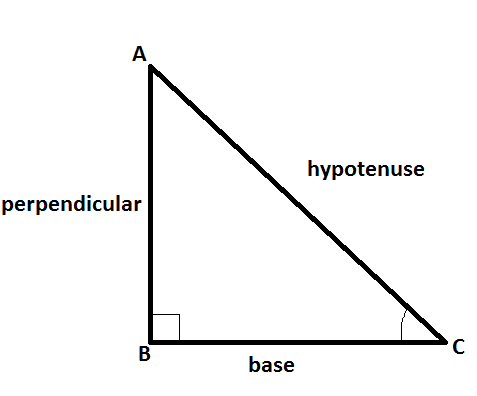
$\sin C = \dfrac{{perpendicular}}{{hypotenuse}}$
$\cos C = \dfrac{{base}}{{hypotenuse}}$
$\tan C = \dfrac{{perpendicular}}{{base}}$
Complete step by step solution:
Right angled triangle- a triangle is said to be right angled if one of its three angles is ${90^0}$
Acute angled triangle – a triangle is said to be acute angled triangle if all the three angles of triangle is less than ${90^0}$
Obtuse angled triangle – a triangle is said to be obtuse angled if its one angle is greater than ${90^0}$
Now, moving on to the question,
Given, cotAcotBcotC$ \leqslant $0
Since ABC is a triangle we have three possible cases
i) Right angled triangle
Let A = ${90^0}$
cotAcotBcotC = 0
ii) Acute angled triangle
A, B, C are in Ist quadrant
cotAcotBcotC > 0
iii) Obtuse angled triangle
Let angle A > ${90^0}$, but angle B and C < ${90^0}$
cotA < 0 but cotBcotC > 0
cotAcotBcotC < 0
Therefore, cotAcotBcotC$ \leqslant $0 is only possible for right angles and obtuse angled triangles, but it is false for acute angled triangles.
Therefore, the statement
cotAcotBcotC $ \leqslant $ 0 is false for A, B, C are angles in triangle ABC.
NOTE- The trigonometric functions are real functions which relate an angle of a right angled triangles to ratios of two side lengths. The most widely used trigonometric functions are the sine, the cosine, and the tangent. Their reciprocals are respectively the cosecant, the secant and the cotangent.
In a right triangle ABC right angled at B, we have hypotenuse = AC, base = BC and perpendicular = AB
$\sin C = \dfrac{{perpendicular}}{{hypotenuse}}$
$\cos C = \dfrac{{base}}{{hypotenuse}}$
$\tan C = \dfrac{{perpendicular}}{{base}}$
Recently Updated Pages
Master Class 11 English: Engaging Questions & Answers for Success

Master Class 11 Social Science: Engaging Questions & Answers for Success
Master Class 11 Maths: Engaging Questions & Answers for Success
Master Class 11 Biology: Engaging Questions & Answers for Success
Master Class 11 Physics: Engaging Questions & Answers for Success
Master Class 11 Chemistry: Engaging Questions & Answers for Success
Trending doubts
Explain the Treaty of Vienna of 1815 class 10 social science CBSE
What is the Total Duration of Football Match?
First Cotton Mill of India
In which year voting age was reduced from 21 to 18?
10 examples of evaporation in daily life with explanations
What planets have no moons Which one has only one moon class 10 physics CBSE