




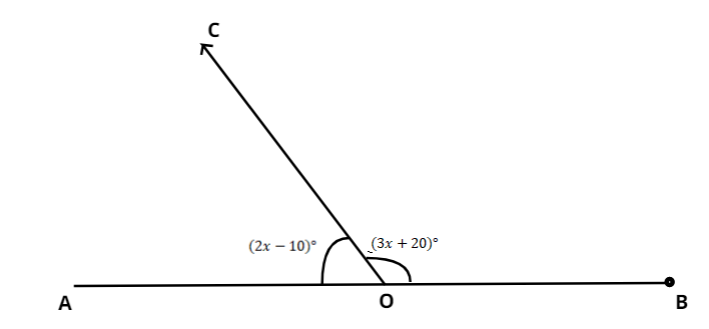
The given problem \[AOB\] is a straight line. The ray \[OC\] stands on \[AOB\] at the point \[O\]. Also if $\angle AOC = {(2x - 10)^0}$ and $\angle BOC = {(3x + 20)^0}$. Then find the value of $x$ and also to find the angles $\angle AOC$ and $\angle BOC$.
Answer
 Verified
624.9k+ views
Hint: In this problem we have to find the value of $x$ and to find the angles of $\angle AOC$ and $\angle BOC$. Here the given is angles of $\angle AOC$ and $\angle BOC$ in $x$ relation. When a line stands on another line then the sum of the two angles on both sides of the standing line is ${180^ \circ }$ . It is called straight angle. By using the concept first we find the value of $x$ then substituting the $x$ to get the required angles.
Complete step-by-step answer:
To solve the problem we have to draw the figure. Here \[AOB\] is a straight line. The ray \[OC\] stands on \[AOB\] at \[O\]. Then two angles $\angle AOC$ and $\angle BOC$ are created. These are adjacent angles. The sum of these two angles is always ${180^ \circ }$.
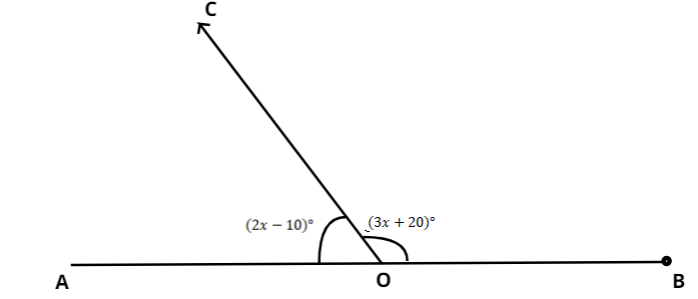
It is given that $\angle AOC = {(2x - 10)^ \circ }$ and $\angle BOC = {(3x + 20)^ \circ }$ .
Applying the property of straight angle, we have,
$\angle AOC + \angle BOC = {180^0}$ .
Putting the value of $\angle AOC = {(2x - 10)^ \circ }$ and $\angle BOC = {(3x + 20)^ \circ }$, we obtain,
${(2x - 10)^ \circ } + {(3x + 20)^ \circ } = {180^ \circ }$
Cancelling the degree sign from both sides,
$(2x - 10) + (3x + 20) = 180$
After simplification, we obtain,
$5x + 10 = 180$
$5x = 180 - 10 = 170$
Solving for $x$ ,
$x = \dfrac{{170}}{5} = 34$
So $2x - 10 = 2 \times 34 - 10 = 58$ and $3x + 20 = 3 \times 34 + 20 = 102 + 20 = 122$
Hence $x = 34,\;\angle AOC = {58^ \circ }$ and $\angle BOC = {122^ \circ }$
Additional information: After finding the value of $x$ we need not to calculate $(2x - 10)$ and $(3x + 20)$ both. After calculating $(2x - 10)$ we could find the value of $(3x + 20)$ by subtracting the value of $(2x - 10)$ from \[{180^ \circ }\] as the sum of $(2x - 10)$ and $(3x + 20)$ is always \[{180^ \circ }\].
Note: When one straight stands on another line it produces two adjacent angles. The sum of the two adjacent angles is always ${180^ \circ }$. If the adjacent angles are the same and since the sum of two angles is ${180^ \circ }$ , so each angle is equal to ${90^ \circ }$. In this case we say that the lines are perpendicular to each other and each angle is the right angle.
Complete step-by-step answer:
To solve the problem we have to draw the figure. Here \[AOB\] is a straight line. The ray \[OC\] stands on \[AOB\] at \[O\]. Then two angles $\angle AOC$ and $\angle BOC$ are created. These are adjacent angles. The sum of these two angles is always ${180^ \circ }$.
It is given that $\angle AOC = {(2x - 10)^ \circ }$ and $\angle BOC = {(3x + 20)^ \circ }$ .
Applying the property of straight angle, we have,
$\angle AOC + \angle BOC = {180^0}$ .
Putting the value of $\angle AOC = {(2x - 10)^ \circ }$ and $\angle BOC = {(3x + 20)^ \circ }$, we obtain,
${(2x - 10)^ \circ } + {(3x + 20)^ \circ } = {180^ \circ }$
Cancelling the degree sign from both sides,
$(2x - 10) + (3x + 20) = 180$
After simplification, we obtain,
$5x + 10 = 180$
$5x = 180 - 10 = 170$
Solving for $x$ ,
$x = \dfrac{{170}}{5} = 34$
So $2x - 10 = 2 \times 34 - 10 = 58$ and $3x + 20 = 3 \times 34 + 20 = 102 + 20 = 122$
Hence $x = 34,\;\angle AOC = {58^ \circ }$ and $\angle BOC = {122^ \circ }$
Additional information: After finding the value of $x$ we need not to calculate $(2x - 10)$ and $(3x + 20)$ both. After calculating $(2x - 10)$ we could find the value of $(3x + 20)$ by subtracting the value of $(2x - 10)$ from \[{180^ \circ }\] as the sum of $(2x - 10)$ and $(3x + 20)$ is always \[{180^ \circ }\].
Note: When one straight stands on another line it produces two adjacent angles. The sum of the two adjacent angles is always ${180^ \circ }$. If the adjacent angles are the same and since the sum of two angles is ${180^ \circ }$ , so each angle is equal to ${90^ \circ }$. In this case we say that the lines are perpendicular to each other and each angle is the right angle.
Recently Updated Pages
Master Class 9 General Knowledge: Engaging Questions & Answers for Success

Master Class 9 Maths: Engaging Questions & Answers for Success
Master Class 9 Science: Engaging Questions & Answers for Success
Master Class 9 English: Engaging Questions & Answers for Success
Master Class 9 Social Science: Engaging Questions & Answers for Success
Class 9 Question and Answer - Your Ultimate Solutions Guide
Trending doubts
Find the sum of series 1 + 2 + 3 + 4 + 5 + + 100 class 9 maths CBSE
Difference Between Plant Cell and Animal Cell
Fill the blanks with the suitable prepositions 1 The class 9 english CBSE
What is pollution? How many types of pollution? Define it
Name 10 Living and Non living things class 9 biology CBSE
What is the full form of pH?