




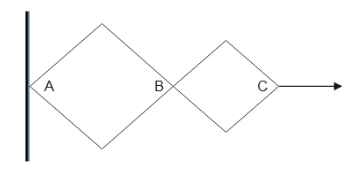
The given hinge construction consists of two rhombus with the ratio of sides $3:2$. The vertex $C$ moves in the horizontal direction with a velocity $v$. The velocity of $B$ is then
A. $0.3v$
B. $0.6v$
C. $2v$
D. $3v$
Answer
 Verified
503.7k+ views
Hint: We are given a hinge construction consisting of two rhombi of sides of a certain ratio and the vertex of the later rhombus moves with the given velocity and we need to find the velocity of the second vertex. We need to use the properties of two rhombi and compare the ratio of the corresponding sides with the velocities of the vertices.
Complete step by step answer:
We will redraw the given diagram to get a clear understanding of the given situation.
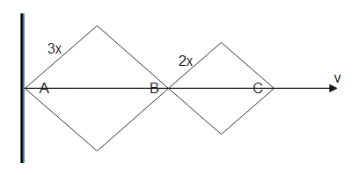
We joined the segments AB and BC and since the ratio of the sides of the two rhombi is $3:2$ hence by the geometry of two rhombi we get
$\dfrac{{3x}}{{2x}} = \dfrac{{AB}}{{BC}} = \dfrac{3}{2}$
Hinge $B$ pulls the segment AB and the hinge $C$ pulls the segment AC.Hence
$\dfrac{{AB}}{{BC + AB}} = \dfrac{3}{{2 + 3}} = \dfrac{3}{5}$
Now it is given that the vertex C moves with velocity $v$ , the vertex B will also move with similar velocity along the segment, therefore
$\dfrac{{{V_B}}}{{{V_C}}} = \dfrac{3}{5}$
$ \Rightarrow {V_B} = \dfrac{3}{5}{V_C} \\
\Rightarrow {V_B}= \dfrac{3}{5}V \\
\therefore {V_B}= 0.6v$
Hence option B is the correct answer.
Note: Note that in a rhombus, all the sides are equal. Like squares, rhombuses satisfy the condition of the ratio of corresponding sides being equal. In a rhombus, the opposite sides are parallel and hence the opposite angles are equal. But the value of the angles can be anything except right angles otherwise it will be a square. Therefore all rhombuses are not similar and we cannot compare the corresponding sides of two random rhombi. We use the geometry of two rhombi because the ratio of the sides was given in the question.
Complete step by step answer:
We will redraw the given diagram to get a clear understanding of the given situation.
We joined the segments AB and BC and since the ratio of the sides of the two rhombi is $3:2$ hence by the geometry of two rhombi we get
$\dfrac{{3x}}{{2x}} = \dfrac{{AB}}{{BC}} = \dfrac{3}{2}$
Hinge $B$ pulls the segment AB and the hinge $C$ pulls the segment AC.Hence
$\dfrac{{AB}}{{BC + AB}} = \dfrac{3}{{2 + 3}} = \dfrac{3}{5}$
Now it is given that the vertex C moves with velocity $v$ , the vertex B will also move with similar velocity along the segment, therefore
$\dfrac{{{V_B}}}{{{V_C}}} = \dfrac{3}{5}$
$ \Rightarrow {V_B} = \dfrac{3}{5}{V_C} \\
\Rightarrow {V_B}= \dfrac{3}{5}V \\
\therefore {V_B}= 0.6v$
Hence option B is the correct answer.
Note: Note that in a rhombus, all the sides are equal. Like squares, rhombuses satisfy the condition of the ratio of corresponding sides being equal. In a rhombus, the opposite sides are parallel and hence the opposite angles are equal. But the value of the angles can be anything except right angles otherwise it will be a square. Therefore all rhombuses are not similar and we cannot compare the corresponding sides of two random rhombi. We use the geometry of two rhombi because the ratio of the sides was given in the question.
Recently Updated Pages
Master Class 11 Business Studies: Engaging Questions & Answers for Success

Master Class 11 Economics: Engaging Questions & Answers for Success
Master Class 11 Computer Science: Engaging Questions & Answers for Success
Master Class 11 English: Engaging Questions & Answers for Success
Master Class 11 Maths: Engaging Questions & Answers for Success
Master Class 11 Biology: Engaging Questions & Answers for Success
Trending doubts
One Metric ton is equal to kg A 10000 B 1000 C 100 class 11 physics CBSE
Discuss the various forms of bacteria class 11 biology CBSE
Draw a diagram of a plant cell and label at least eight class 11 biology CBSE
State the laws of reflection of light
Explain zero factorial class 11 maths CBSE
10 examples of friction in our daily life