




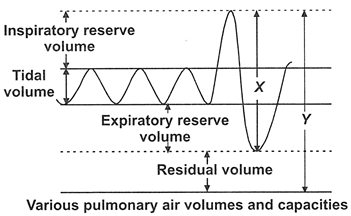
The given graph shows various pulmonary air volumes and capacities. What is depicted by X and Y in the graph?
A.Functional residual capacity and vital capacity
B.Total lung capacity and inspiratory capacity
C.Vital capacity and total lung capacity
D.Inspiratory capacity and functional residual capacity
Answer
 Verified
538.8k+ views
Hint: Respiratory starts when start to take in the air via our nostrils to the nasal cavity. After passing through the nasal cavity the air passes through the trachea. The air then reaches the lungs. Lung volume refers to the total volume of air that is present in the lung during different phases of the respiratory cycle. There are four standard volumes of the lung that include inspiratory reserve volume, tidal volume, expiratory reserve volume, and residual volume. We can look into these definitions and see what X and Y represent in the given graph.
Complete answer:
Similar to the four standard lung volumes there are four lung capacities : inspiratory capacity, functional residual capacity, vital capacity, and total lung capacity.
Tidal volume is defined as the volume that enters and leaves during each normal breath that we take. Inspiratory reserve volume can be defined as the extra amount of volume that we can intake during each inspiration. This inspiratory reserve above the tidal volume is from normal quiet inspiration to maximum inspiration. Similarly, expiratory reserve volume is the extra amount of volume that we release during each expiration. Residual volume is defined as the volume of air that remains in the lungs after maximum expiration.
Lung capacities consist of two or more lung volumes. We can see how each of the four vital lung capacities is calculated.
Vital capacity is defined as the volume that can be exhaled after maximum inspiration to that of the maximum expiration. It can be calculated as Vital capacity \[ = \] Expiratory reserve volume \[ + \]Inspiratory reserve volume\[ + \] Tidal volume
Inspiratory capacity is defined as the volume breathed in from normal expiration to maximum inspiration. It can be calculated as,
Inspiratory capacity \[ = \]Tidal volume \[ + \] Inspiratory reserve volume
Functional residual capacity can be defined as the total volume remaining in the lungs after normal expiration. It can be calculated as Functional residual capacity\[ = \]Expiratory reserve volume\[ + \]Residual volume
Total lung capacity can be defined as the total volume of the air that is present in the lungs after maximum inspiration. It can be calculated as, Total lung capacity\[ = \]sum of all the volumes.
In the graph the area that is comprised by X\[ = \] Inspiratory reserve volume \[ + \]Tidal volume \[ + \]expiratory reserve volume
Therefore from the above-discussed capacities, we know that this is equal to vital capacity.
Now the area is covered by the Y\[ = \] sum of all the volumes. That is,
Y\[ = \]Inspiratory reserve volume \[ + \]Tidal volume \[ + \]expiratory reserve volume\[ + \] residual volume.
Therefore Y represents total lung capacity.
Therefore the correct option is C.
Note:
Human lung capacities are usually determined by many factors including genetics, gender, and height. On average, the maximum capacity of air that the lung can hold is almost six liters. However, they do not always work on this maximal capacity. Lung volume only measures any one function and lung capacity comprises any two or more volumes.
Complete answer:
Similar to the four standard lung volumes there are four lung capacities : inspiratory capacity, functional residual capacity, vital capacity, and total lung capacity.
Tidal volume is defined as the volume that enters and leaves during each normal breath that we take. Inspiratory reserve volume can be defined as the extra amount of volume that we can intake during each inspiration. This inspiratory reserve above the tidal volume is from normal quiet inspiration to maximum inspiration. Similarly, expiratory reserve volume is the extra amount of volume that we release during each expiration. Residual volume is defined as the volume of air that remains in the lungs after maximum expiration.
Lung capacities consist of two or more lung volumes. We can see how each of the four vital lung capacities is calculated.
Vital capacity is defined as the volume that can be exhaled after maximum inspiration to that of the maximum expiration. It can be calculated as Vital capacity \[ = \] Expiratory reserve volume \[ + \]Inspiratory reserve volume\[ + \] Tidal volume
Inspiratory capacity is defined as the volume breathed in from normal expiration to maximum inspiration. It can be calculated as,
Inspiratory capacity \[ = \]Tidal volume \[ + \] Inspiratory reserve volume
Functional residual capacity can be defined as the total volume remaining in the lungs after normal expiration. It can be calculated as Functional residual capacity\[ = \]Expiratory reserve volume\[ + \]Residual volume
Total lung capacity can be defined as the total volume of the air that is present in the lungs after maximum inspiration. It can be calculated as, Total lung capacity\[ = \]sum of all the volumes.
In the graph the area that is comprised by X\[ = \] Inspiratory reserve volume \[ + \]Tidal volume \[ + \]expiratory reserve volume
Therefore from the above-discussed capacities, we know that this is equal to vital capacity.
Now the area is covered by the Y\[ = \] sum of all the volumes. That is,
Y\[ = \]Inspiratory reserve volume \[ + \]Tidal volume \[ + \]expiratory reserve volume\[ + \] residual volume.
Therefore Y represents total lung capacity.
Therefore the correct option is C.
Note:
Human lung capacities are usually determined by many factors including genetics, gender, and height. On average, the maximum capacity of air that the lung can hold is almost six liters. However, they do not always work on this maximal capacity. Lung volume only measures any one function and lung capacity comprises any two or more volumes.
Recently Updated Pages
If x a + bt + ct2 where x is in meters and t is in class 11 physics CBSE

A car covers the first half distance between two places class 11 physics CBSE
The resultant of two vectors overrightarrow P and overrightarrow class 11 physics CBSE
Find the value of cos 135 class 11 maths CBSE
A mass M is held in place by an applied force F and class 11 physics CBSE
A solution of glucose in water is labelled as 10 dfracwv class 11 chemistry CBSE
Trending doubts
What is the maximum height of a projectile class 11 physics CBSE
Describe various types of epithelial tissues with the class 11 biology CBSE
Lysosomes are known as suicidal bags of cell why class 11 biology CBSE
Simon Commission came to India in A 1927 B 1928 C 1929 class 11 social science CBSE
State and derive law of conservation of momentum class 11 physics CBSE
How are involuntary actions and reflex actions different class 11 biology CBSE