



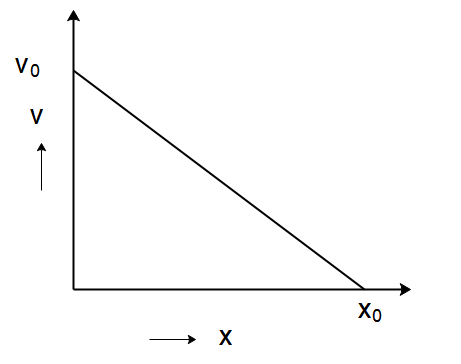
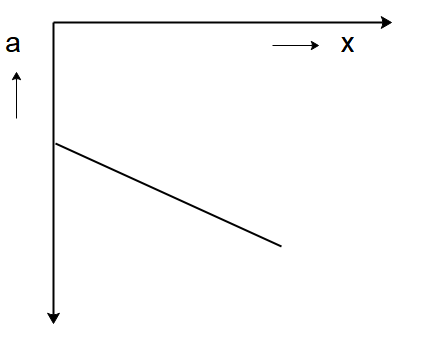
The given graph shows the variation of velocity with displacement. Which one of the graphs given below correctly represents the variation of acceleration with displacement?
A)
B)
C)
D)
Answer
 Verified
585.6k+ views
Hint: The velocity of the object is decreasing with increasing distance. We will determine the equation of motion for this motion and use the laws of motion to determine the variation of acceleration with displacement.
Complete step by step answer
In the graph given to us, we can see that the line intercepts the $ y $ -axis at $ {v_0} $. The slope of the line can be determined as the line passing through the points on the $ y $ -axis and the $ x $ -axis as
$\Rightarrow m = \dfrac{{{y_2} - {y_1}}}{{{x_2} - {x_1}}} $
The two points of concern will be $ ({x_1},{y_1}) = (0,{v_0}) $ The $ x $ -coordinate will be zero since the point is on the $ y $ -axis.
And $ ({x_2},{y_2}) = ({x_0},0) $ since the point is on the $ x $ -axis its $ y $ -coordinate is zero. So the slope of the line will be
$\Rightarrow m = - \dfrac{{{v_0}}}{{{x_0}}} $
Then the equation of the line can be determined as
$\Rightarrow y = mx + c $ where $ c $ is the $ y $ -intercept of the line. So, for the line in question, the equation will be
$\Rightarrow v = - \dfrac{{{v_0}}}{{{x_0}}}x + {v_0} $
Now the acceleration of the object will be
$\Rightarrow a = \dfrac{{dv}}{{dt}} $ and we can multiply the numerator and the denominator with $ dx $ and write
$\Rightarrow a = \dfrac{{dv}}{{dx}}\dfrac{{dx}}{{dt}} $
Substituting $ \dfrac{{dx}}{{dt}} = v $ and $ v = - \dfrac{{{v_0}}}{{{x_0}}}x + {v_0} $ in the above equation, we get
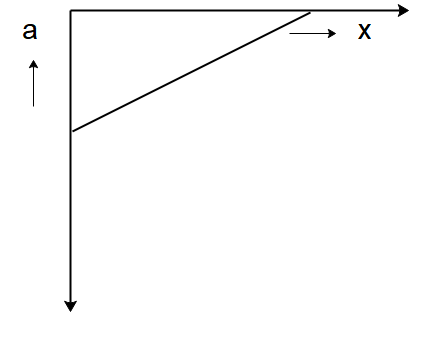
$\Rightarrow a = {\left( {\dfrac{{{v_0}}}{{{x_0}}}} \right)^2}x - \dfrac{{{v_0}^2}}{{{x_0}}} $
This equation of acceleration $ a $ is again of the form $ y = mx + c $ where
$\Rightarrow m = {\left( {\dfrac{{{v_0}}}{{{x_0}}}} \right)^2} $ and $ c = - \dfrac{{{v_0}^2}}{{{x_0}}} $.
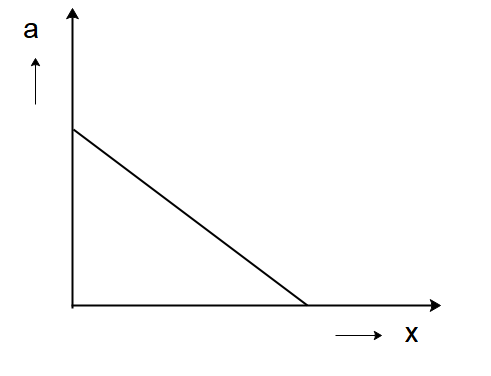
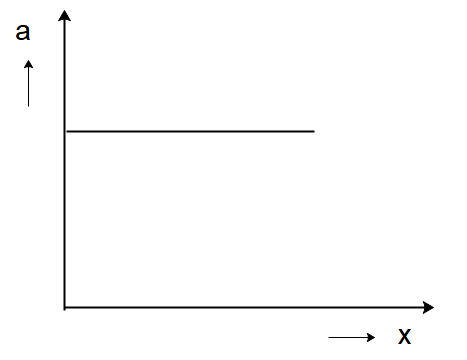
Since the $ y $ -intercept is negative and the slope of the line is positive the only option that matches this choice is option (A).
Note
We must be careful to derive the relation of acceleration with displacement as given in the option and not of acceleration with velocity. To do so, we must be familiar with the method to form the equation of a line from different points given to us.
Complete step by step answer
In the graph given to us, we can see that the line intercepts the $ y $ -axis at $ {v_0} $. The slope of the line can be determined as the line passing through the points on the $ y $ -axis and the $ x $ -axis as
$\Rightarrow m = \dfrac{{{y_2} - {y_1}}}{{{x_2} - {x_1}}} $
The two points of concern will be $ ({x_1},{y_1}) = (0,{v_0}) $ The $ x $ -coordinate will be zero since the point is on the $ y $ -axis.
And $ ({x_2},{y_2}) = ({x_0},0) $ since the point is on the $ x $ -axis its $ y $ -coordinate is zero. So the slope of the line will be
$\Rightarrow m = - \dfrac{{{v_0}}}{{{x_0}}} $
Then the equation of the line can be determined as
$\Rightarrow y = mx + c $ where $ c $ is the $ y $ -intercept of the line. So, for the line in question, the equation will be
$\Rightarrow v = - \dfrac{{{v_0}}}{{{x_0}}}x + {v_0} $
Now the acceleration of the object will be
$\Rightarrow a = \dfrac{{dv}}{{dt}} $ and we can multiply the numerator and the denominator with $ dx $ and write
$\Rightarrow a = \dfrac{{dv}}{{dx}}\dfrac{{dx}}{{dt}} $
Substituting $ \dfrac{{dx}}{{dt}} = v $ and $ v = - \dfrac{{{v_0}}}{{{x_0}}}x + {v_0} $ in the above equation, we get
$\Rightarrow a = {\left( {\dfrac{{{v_0}}}{{{x_0}}}} \right)^2}x - \dfrac{{{v_0}^2}}{{{x_0}}} $
This equation of acceleration $ a $ is again of the form $ y = mx + c $ where
$\Rightarrow m = {\left( {\dfrac{{{v_0}}}{{{x_0}}}} \right)^2} $ and $ c = - \dfrac{{{v_0}^2}}{{{x_0}}} $.
Since the $ y $ -intercept is negative and the slope of the line is positive the only option that matches this choice is option (A).
Note
We must be careful to derive the relation of acceleration with displacement as given in the option and not of acceleration with velocity. To do so, we must be familiar with the method to form the equation of a line from different points given to us.
Recently Updated Pages
Master Class 11 Social Science: Engaging Questions & Answers for Success

Master Class 11 Physics: Engaging Questions & Answers for Success
Master Class 11 Maths: Engaging Questions & Answers for Success
Master Class 11 Economics: Engaging Questions & Answers for Success
Master Class 11 Computer Science: Engaging Questions & Answers for Success
Master Class 11 Chemistry: Engaging Questions & Answers for Success
Trending doubts
One Metric ton is equal to kg A 10000 B 1000 C 100 class 11 physics CBSE
There are 720 permutations of the digits 1 2 3 4 5 class 11 maths CBSE
1 Quintal is equal to a 110 kg b 10 kg c 100kg d 1000 class 11 physics CBSE
State and prove Bernoullis theorem class 11 physics CBSE
Difference Between Prokaryotic Cells and Eukaryotic Cells
Which among the following are examples of coming together class 11 social science CBSE