




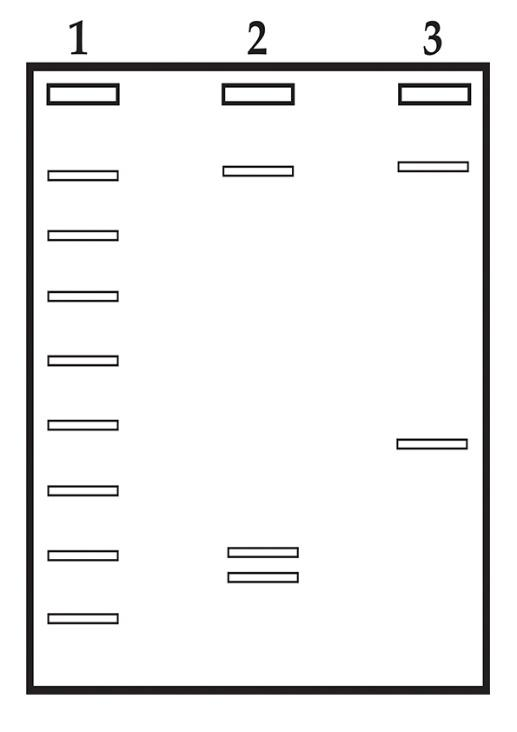
The given gel shows lanes 1, 2, and 3. Lane 1 shows the DNA ladder starting from 100 bp and so on. Lane 2 shows restriction enzyme digestion results of a plasmid containing a normal human beta-globin allele. Lane 3 shows restriction enzyme digestion of sickle cell anemia of a plasmid containing a diseased allele. Which of the following is true for the results shown?
A. Both lanes 1 and 2 contain 100 bp fragments
B. Only lane 2 contains a 175 bp fragment
C. Only lane 3 contains 375 bp fragment
D. Both lanes 2 and 3 contain two equal-sized fragments
E. Only lane 3 contains a 300 bp fragment
Answer
 Verified
601.5k+ views
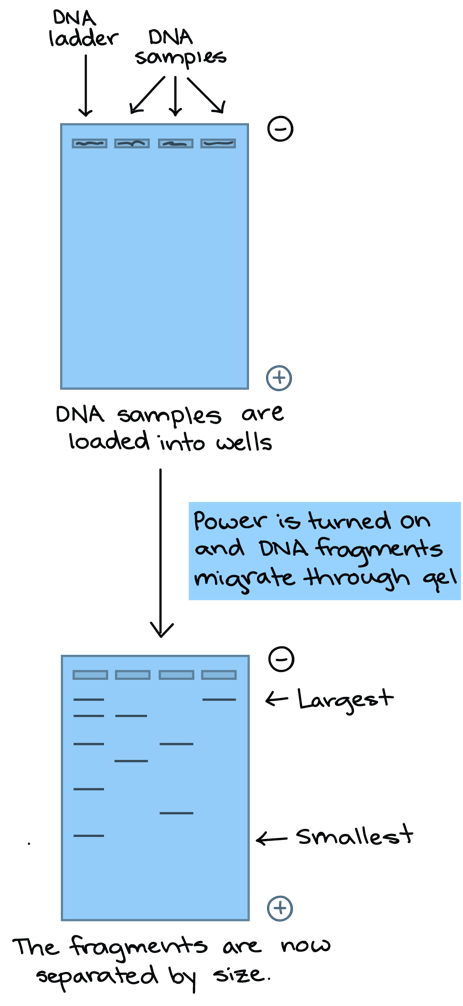
Hint: Gel electrophoresis is a technique that is used to separate DNA fragments according to their size. Samples are loaded into wells, which are known as the indentations. The wells are present at one end of a gel. Then an electric current is applied to pull them through the gel and as a result DNA fragments move towards the positive electrode (anode) as they are negatively charged. The process and result analysis process of Gel electrophoresis is described below by a diagram:
Complete answer:
According to the question,
Lane 1 is loaded with 100 bp markers. So, this means from the bottom to the top the size of the base pairs is 100, 200, 300, and so on.
In lane 2, there are a total of 3 fragments present. The first fragment, which is present at the bottom, lies between the first two markers of lane 1. Thus, the first fragment in lane 2 that is near to the 2nd fragment of lane 1 has a size of 175 bp. The second fragment of lane 2 is 200 bp in size. So, the total size of the fragment is 175 + 200 = 375.
Similarly, lane 3 has a 375 bp fragment.
Therefore, the correct answer is option B, C, and D.
Note: The most popular type of gel electrophoresis is SDS – PAGE. Agarose and polyacrylamide gels are used in this technique. The gel electrophoresis technique is used to identify different types and sizes of the analyte. Polyacrylamide gels are used for proteins and it has high resolving power to identify small fragments of DNA like 5-500 bp fragments. The overall process is as follows:
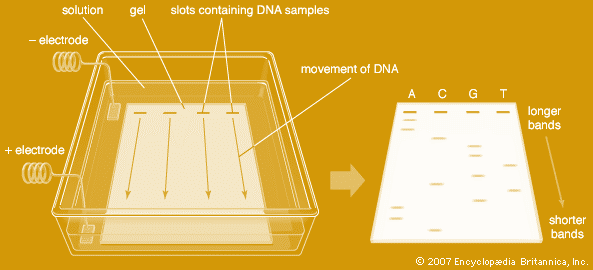
Fig: Gel Electrophoresis
Complete answer:
According to the question,
Lane 1 is loaded with 100 bp markers. So, this means from the bottom to the top the size of the base pairs is 100, 200, 300, and so on.
In lane 2, there are a total of 3 fragments present. The first fragment, which is present at the bottom, lies between the first two markers of lane 1. Thus, the first fragment in lane 2 that is near to the 2nd fragment of lane 1 has a size of 175 bp. The second fragment of lane 2 is 200 bp in size. So, the total size of the fragment is 175 + 200 = 375.
Similarly, lane 3 has a 375 bp fragment.
Therefore, the correct answer is option B, C, and D.
Note: The most popular type of gel electrophoresis is SDS – PAGE. Agarose and polyacrylamide gels are used in this technique. The gel electrophoresis technique is used to identify different types and sizes of the analyte. Polyacrylamide gels are used for proteins and it has high resolving power to identify small fragments of DNA like 5-500 bp fragments. The overall process is as follows:
Fig: Gel Electrophoresis
Recently Updated Pages
Master Class 12 Business Studies: Engaging Questions & Answers for Success

Master Class 12 Chemistry: Engaging Questions & Answers for Success
Master Class 12 Biology: Engaging Questions & Answers for Success
Class 12 Question and Answer - Your Ultimate Solutions Guide
Master Class 11 English: Engaging Questions & Answers for Success
Master Class 11 Social Science: Engaging Questions & Answers for Success
Trending doubts
Which are the Top 10 Largest Countries of the World?
Draw a labelled sketch of the human eye class 12 physics CBSE
Differentiate between homogeneous and heterogeneous class 12 chemistry CBSE
Differentiate between Pyramid of energy and pyramid class 12 biology CBSE
Why is the cell called the structural and functional class 12 biology CBSE
Draw the diagram of the pyramid of energy Explain In class 12 biology CBSE