




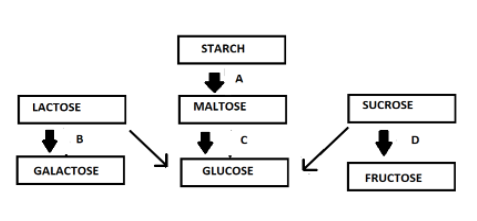
The given flowchart shows the fate of carbohydrates during digestion in the human alimentary canal. Identify the enzymes acting at stages indicated as A, B, C and D and select the correct option.
A) A = Amylase, B = Maltase C = Lactase D= Invertase
B) A = Amylase, B = Maltase C = Invertase D= Lactase
C) A = Amylase, B = Invertase C = Maltase D= Lactase
D) A = Amylase, B= Lactase C = Maltase D = Invertase
Answer
 Verified
517.2k+ views
Hint: Carbohydrates are called the energy giving food. They are present in almost every type of food we eat. Plants prepare the food in the form of carbohydrate and store it in the form of starch. The complex polysaccharides are broken down into simpler monosaccharides which are utilised by the living beings.
Complete answer:
The human alimentary canal comprises the mouth oesophagus, stomach, large intestine, small intestine and ends at anus. The food we eat moves in this pathway that is it is ingested through the mouth and eliminated through anus. At all the parts of the digestive system, carbohydrates and other nutrients present are broken down into simpler saccharides by the help of enzymes.
Let us discuss the different types of carbohydrates and their metabolism in the alimentary canal.
A) Starch- It is a complex polysaccharide which is present in plant-based food. The starch is broken down in the mouth by the help of enzyme salivary amylase. (A)
B) Lactose- The lactose is present in the milk. It is broken down into glucose and galactose by the help of enzyme lactase (B). It happens in the stomach.
C) Maltose is formed as a result of breakdown of starch. It is broken down into glucose by the action of maltase (C). This takes place in the intestines.
D) Sucrose is another disaccharide which breaks down into glucose and fructose. This takes place by the help of enzyme invertase(D). This takes place in the small intestine.
Thus the correct answer is option ‘D’.
Note: The protein present in the food is digested at the stomach by the help of pancreatic juices secreted by the stomach. The digestion of fat mostly takes place in the intestines by the help of bile which is secreted by the liver to the intestines.
Complete answer:
The human alimentary canal comprises the mouth oesophagus, stomach, large intestine, small intestine and ends at anus. The food we eat moves in this pathway that is it is ingested through the mouth and eliminated through anus. At all the parts of the digestive system, carbohydrates and other nutrients present are broken down into simpler saccharides by the help of enzymes.
Let us discuss the different types of carbohydrates and their metabolism in the alimentary canal.
A) Starch- It is a complex polysaccharide which is present in plant-based food. The starch is broken down in the mouth by the help of enzyme salivary amylase. (A)
B) Lactose- The lactose is present in the milk. It is broken down into glucose and galactose by the help of enzyme lactase (B). It happens in the stomach.
C) Maltose is formed as a result of breakdown of starch. It is broken down into glucose by the action of maltase (C). This takes place in the intestines.
D) Sucrose is another disaccharide which breaks down into glucose and fructose. This takes place by the help of enzyme invertase(D). This takes place in the small intestine.
Thus the correct answer is option ‘D’.
Note: The protein present in the food is digested at the stomach by the help of pancreatic juices secreted by the stomach. The digestion of fat mostly takes place in the intestines by the help of bile which is secreted by the liver to the intestines.
Recently Updated Pages
Master Class 11 Computer Science: Engaging Questions & Answers for Success

Master Class 11 Business Studies: Engaging Questions & Answers for Success
Master Class 11 Economics: Engaging Questions & Answers for Success
Master Class 11 English: Engaging Questions & Answers for Success
Master Class 11 Maths: Engaging Questions & Answers for Success
Master Class 11 Biology: Engaging Questions & Answers for Success
Trending doubts
One Metric ton is equal to kg A 10000 B 1000 C 100 class 11 physics CBSE
There are 720 permutations of the digits 1 2 3 4 5 class 11 maths CBSE
Discuss the various forms of bacteria class 11 biology CBSE
Draw a diagram of a plant cell and label at least eight class 11 biology CBSE
State the laws of reflection of light
Explain zero factorial class 11 maths CBSE