




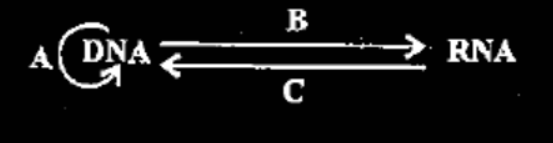
The given flow chart shows the central dogma reverse.
Enzymes used in processes A, b, and C are respectively
I. A- DNA dependent DNA polymerase, B- RNA dependent DNA polymerase, C-DNA dependent RNA polymerase
II. A- DNA dependent DNA polymerase, B- DNA dependent RNA polymerase, C- RNA dependent DNA polymerase
III. A- DNA dependent RNA polymerase, B- DNA dependent DNA polymerase, C-RNA dependent RNA polymerase
IV. A- RNA dependent DNA polymerase, B- DNA dependent RNA polymerase, C-RNA dependent RNA polymerase.
Answer
 Verified
601.2k+ views
Hint: In molecular biology, central dogma demonstrates the flow of genetic information from DNA to RNA to protein. It is elucidated as a process in which the information in DNA is converted into a functional product. It is suggested that the information present in DNA is very much important or essential to make up all proteins and RNA acts as a messenger that carries information through the ribosomes.
Complete answer: The process of replication/copying of DNA demands the action of a DNA Polymerase enzyme that utilizes a DNA template for the synthesis of another complementary DNA strand synthesis. Thus it is a DNA dependent DNA polymerase.
-The transcription process of the DNA code to make RNA includes another enzyme called RNA polymerase which uses DNA as a template to synthesize RNA and hence is a DNA-dependent RNA polymerase.
-The process of formation of DNA from RNA is very much rare and generally known as reverse transcription and is catalyzed by the enzyme Reverse transcriptase that utilizes RNA as the template to synthesize DNA and hence, it is an RNA dependent DNA polymerase.
Thus, the correct answer 'A - DNA dependent DNA polymerase, B - DNA dependent RNA polymerase, C - RNA dependent DNA polymerase'.
Hence, the correct answer is Option II.
Note: In central dogma, DNA codes for mRNA, which codes for a protein. One very popular exception to the central dogma is exhibited by retroviruses. These RNA-encoded viruses possess a phase in their life cycle in which their genomic RNA is converted back to DNA by an enzyme called reverse transcriptase. This is known to take place in the case of retroviruses, like HIV, as well as in eukaryotes.
Complete answer: The process of replication/copying of DNA demands the action of a DNA Polymerase enzyme that utilizes a DNA template for the synthesis of another complementary DNA strand synthesis. Thus it is a DNA dependent DNA polymerase.
-The transcription process of the DNA code to make RNA includes another enzyme called RNA polymerase which uses DNA as a template to synthesize RNA and hence is a DNA-dependent RNA polymerase.
-The process of formation of DNA from RNA is very much rare and generally known as reverse transcription and is catalyzed by the enzyme Reverse transcriptase that utilizes RNA as the template to synthesize DNA and hence, it is an RNA dependent DNA polymerase.
Thus, the correct answer 'A - DNA dependent DNA polymerase, B - DNA dependent RNA polymerase, C - RNA dependent DNA polymerase'.
Hence, the correct answer is Option II.
Note: In central dogma, DNA codes for mRNA, which codes for a protein. One very popular exception to the central dogma is exhibited by retroviruses. These RNA-encoded viruses possess a phase in their life cycle in which their genomic RNA is converted back to DNA by an enzyme called reverse transcriptase. This is known to take place in the case of retroviruses, like HIV, as well as in eukaryotes.
Recently Updated Pages
Master Class 12 Business Studies: Engaging Questions & Answers for Success

Master Class 12 Chemistry: Engaging Questions & Answers for Success
Master Class 12 Biology: Engaging Questions & Answers for Success
Class 12 Question and Answer - Your Ultimate Solutions Guide
Master Class 9 General Knowledge: Engaging Questions & Answers for Success
Master Class 9 Maths: Engaging Questions & Answers for Success
Trending doubts
Which are the Top 10 Largest Countries of the World?
Draw a labelled sketch of the human eye class 12 physics CBSE
Name the crygenes that control cotton bollworm and class 12 biology CBSE
Differentiate between homogeneous and heterogeneous class 12 chemistry CBSE
In a transcription unit the promoter is said to be class 12 biology CBSE
Sulphuric acid is known as the king of acids State class 12 chemistry CBSE