




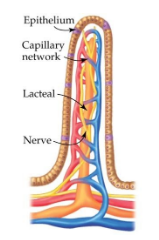
The given figure shows a part of the digestive system. Identify it and select its main function.
A) Gallbladder: Carries the digested food to all parts of the body.
B) Part of the pancreas: produces digestive juices to digest the food in the small intestine.
C) Villus: Makes a large surface area for the effective absorption of digested food.
D) Oesophagus: Helps the movement of undigested food into the large intestine.
Answer
 Verified
575.4k+ views
Hint: The gastrointestinal tract, as well as the digestive organs that support it, make up the human digestive system. Food is broken down into smaller and smaller components during digestion until it can be consumed and assimilated into the body.
Step by step explanation:
Option A: Gallbladder, Carries the digested food to all parts of the body. The gallbladder is a pear-shaped, hollow structure located under the liver and on the right side of the abdomen.
Option B: Part of pancreas, produces digestive juices to digest the food in the small intestine. The pancreas is formed like a “J” or a retort, and it is positioned obliquely.
Option C: villus, Creates a wide surface area for efficient digestion and absorption of food. Some villi are shaped like fingers, while others are more flattened. Villi vary in duration and shape throughout the length of the intestine, with shorter and more finger-like villi in the duodenum and longer and more finger-like villi in the jejunum.
Option D: esophagus: Helps the movement of undigested food into the large intestine.
The esophagus is a flattened muscular tube of \[18\]$ - $\[26{\text{ }}cm\] from the upper sphincter to the lower sphincter.
So the correct answer is option C.
Note:
Tiny finger-like projections in the small intestine walls are called villi. Their aim is to increase surface area in order to optimize digested food absorption.
Step by step explanation:
Option A: Gallbladder, Carries the digested food to all parts of the body. The gallbladder is a pear-shaped, hollow structure located under the liver and on the right side of the abdomen.
Option B: Part of pancreas, produces digestive juices to digest the food in the small intestine. The pancreas is formed like a “J” or a retort, and it is positioned obliquely.
Option C: villus, Creates a wide surface area for efficient digestion and absorption of food. Some villi are shaped like fingers, while others are more flattened. Villi vary in duration and shape throughout the length of the intestine, with shorter and more finger-like villi in the duodenum and longer and more finger-like villi in the jejunum.
Option D: esophagus: Helps the movement of undigested food into the large intestine.
The esophagus is a flattened muscular tube of \[18\]$ - $\[26{\text{ }}cm\] from the upper sphincter to the lower sphincter.
So the correct answer is option C.
Note:
Tiny finger-like projections in the small intestine walls are called villi. Their aim is to increase surface area in order to optimize digested food absorption.
Recently Updated Pages
Master Class 11 English: Engaging Questions & Answers for Success

Master Class 11 Physics: Engaging Questions & Answers for Success
Master Class 11 Computer Science: Engaging Questions & Answers for Success
Master Class 11 Chemistry: Engaging Questions & Answers for Success
Master Class 11 Social Science: Engaging Questions & Answers for Success
Master Class 11 Accountancy: Engaging Questions & Answers for Success
Trending doubts
Difference Between Prokaryotic Cells and Eukaryotic Cells
Two of the body parts which do not appear in MRI are class 11 biology CBSE
One Metric ton is equal to kg A 10000 B 1000 C 100 class 11 physics CBSE
10 examples of friction in our daily life
Draw a diagram of nephron and explain its structur class 11 biology CBSE
Draw a diagram of a plant cell and label at least eight class 11 biology CBSE