




The given figure represents the V.S of bulb of Allium cepa. Identify the different parts and select the correct option.
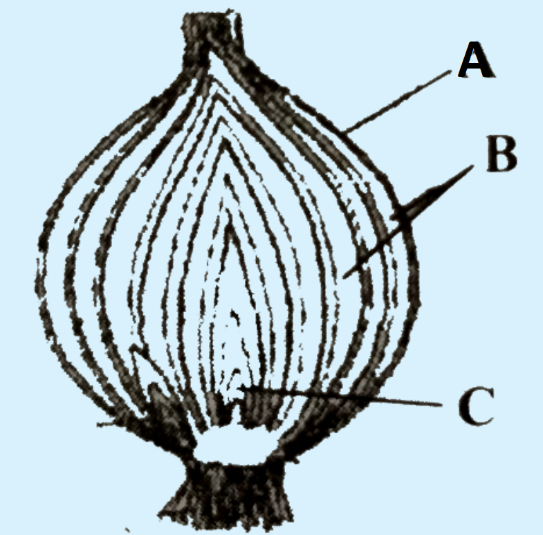
A: Fleshy scales B: Tunic C: Terminal bud
A: Tunic B: Terminal bud C: Fleshy scales
A: Tunic B: Fleshy scales C: Terminal bud
A: Terminal bud B: Fleshy scales C: Tunic
Answer
 Verified
518.1k+ views
Hint: Allium cepa is the scientific name of onion. Onion belongs to the family Liliaceae. The stem of the onion is bulb type & it has edible fleshy scales/leaves. When photosynthesis occurs in onion leaves with chloroplast, the glucose produced during the process is converted to starch and stored in the bulb. In the outer portion, the fleshy scales represent leaf bases, while in the middle, they represent scale leaves. They happen in a circular pattern. A whitish or pinkish tunic covers the bulb. The terminal bud is encased in fleshy scales.
Complete answer:
According to the given explanation in the hint section, this option does not give the proper labelling of the diagram. A is the outer pinkish covering tunic and B represents the scales.
So, option (a) is incorrect.
We now know that the fleshy scales enclose the terminal bud in onions and therefore B can not be terminal bud and C cannot be the scales, as given is this option.
Hence, option (b) is incorrect.
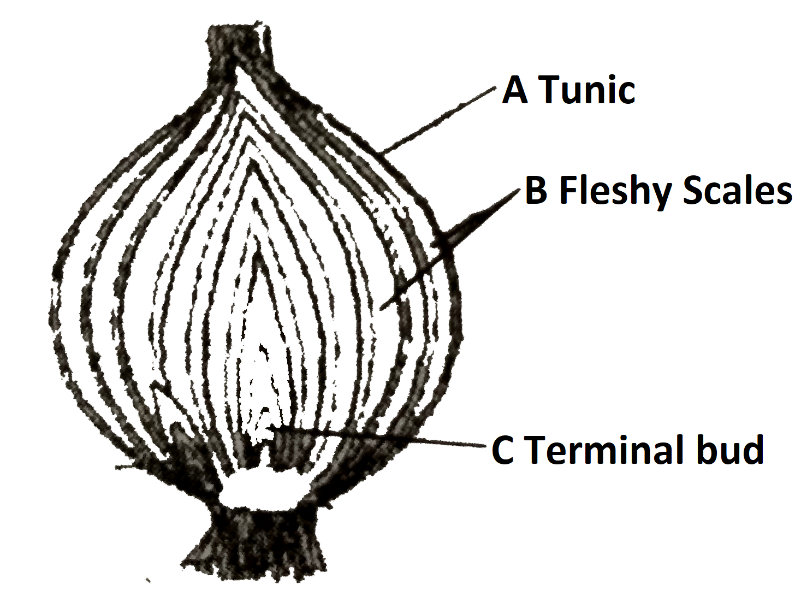
Tunic is the outer covering as represented by A in the given diagram and B, C also shows the correct labelling of the parts as fleshy scales and terminal bud respectively.
Option (c) is correct.
A is outer covering and does not represent the terminal bud. Also, C is the terminal bud, the primary growing part which is present at the shoot apex.
So, option (d) is incorrect.
Hence, the correct answer is option (c).
Additional Information:
Other characters of family Liliaceae:
These are monocots and have fibrous roots.
Their leaves have parallel venation and are exstipulated.
Shows cyamose (umbel) inflorescence.
The flower is bisexual and hypogynous.
These are tetramerous and have tepals (perianth), with valvate aestivation.
Androecium is polyandrous and epiphyllous.
Gynoecium is syncarpous and tricarpellary.
Note:
Different parts of plants show different modifications in different plants. Onions are an example of a modified underground stem, in which the stem is reduced and is present in the form of a disc, called a “bulb”. The fleshy leaves of a bulb functions as food reservoirs that enable a plant to lie dormant when water is unavailable and resume the growth when favorable conditions return.
Complete answer:
According to the given explanation in the hint section, this option does not give the proper labelling of the diagram. A is the outer pinkish covering tunic and B represents the scales.
So, option (a) is incorrect.
We now know that the fleshy scales enclose the terminal bud in onions and therefore B can not be terminal bud and C cannot be the scales, as given is this option.
Hence, option (b) is incorrect.
Tunic is the outer covering as represented by A in the given diagram and B, C also shows the correct labelling of the parts as fleshy scales and terminal bud respectively.
Option (c) is correct.
A is outer covering and does not represent the terminal bud. Also, C is the terminal bud, the primary growing part which is present at the shoot apex.
So, option (d) is incorrect.
Hence, the correct answer is option (c).
Additional Information:
Other characters of family Liliaceae:
These are monocots and have fibrous roots.
Their leaves have parallel venation and are exstipulated.
Shows cyamose (umbel) inflorescence.
The flower is bisexual and hypogynous.
These are tetramerous and have tepals (perianth), with valvate aestivation.
Androecium is polyandrous and epiphyllous.
Gynoecium is syncarpous and tricarpellary.
Note:
Different parts of plants show different modifications in different plants. Onions are an example of a modified underground stem, in which the stem is reduced and is present in the form of a disc, called a “bulb”. The fleshy leaves of a bulb functions as food reservoirs that enable a plant to lie dormant when water is unavailable and resume the growth when favorable conditions return.
Recently Updated Pages
Master Class 11 Social Science: Engaging Questions & Answers for Success

Master Class 11 English: Engaging Questions & Answers for Success
Master Class 11 Maths: Engaging Questions & Answers for Success
Master Class 11 Chemistry: Engaging Questions & Answers for Success
Master Class 11 Biology: Engaging Questions & Answers for Success
Master Class 11 Physics: Engaging Questions & Answers for Success
Trending doubts
Differentiate between an exothermic and an endothermic class 11 chemistry CBSE
There are 720 permutations of the digits 1 2 3 4 5 class 11 maths CBSE
Which gas is abundant in air class 11 chemistry CBSE
Draw a diagram of nephron and explain its structur class 11 biology CBSE
Explain zero factorial class 11 maths CBSE
Difference between unicellular and multicellular o class 11 biology CBSE