




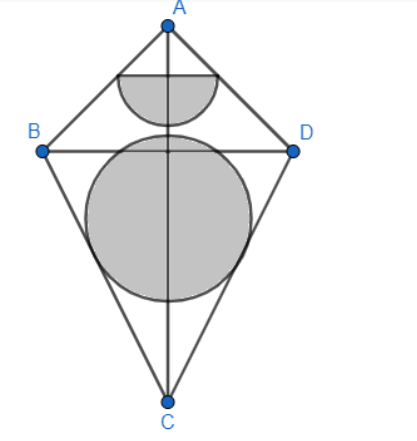
The given figure represents a kite with a circular and a semi-circular motif stuck on it. The radius of the circle is 2.5 cm and the semi-circle is 2 cm. If diagonals AC and BD are of the lengths 12 cm and 8 cm, respectively, find the area of the unshaded part.
Answer
 Verified
604.5k+ views
Hint: We know that the area of a kite is equal to the half of the product of its diagonals. Also, we can easily find the area of the circular and semicircular shaded region using the formula $\pi {{R}^{2}}\text{ and }\dfrac{\pi {{r}^{2}}}{2}$ , respectively. So, you just have to find the area of the kite and subtract the area of the shaded regions from it to get the area of the unshaded part.
Complete step-by-step answer:
Let us start the solution to the above question by drawing the diagram.
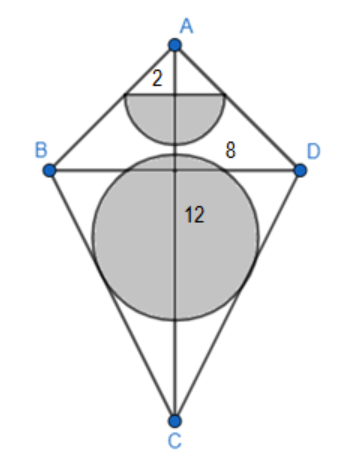
In the question, it is given in the question that AC=12 cm and BD=8 cm. Also, ABCD is a kite with AC and BD as diagonals. We know that the area of a kite is equal to the half of the product of its diagonals.
$ar\left( ABCD \right)=\dfrac{1}{2}\times AC\times BD=\dfrac{1}{2}\times 12\times 8=48\text{ c}{{\text{m}}^{2}}$
Now moving to find the area of the shaded region. As you can see in the figure that the area of the shaded region is an area of semi-circular added with the area of the circular part.
We know that the area of the semicircular arc is $\dfrac{\pi {{r}^{2}}}{2}$ , where r is the radius of the semi-circle and is equal to 2cm. Also, we know area of the circular part with radius R=2.5cm is given by $\pi {{R}^{2}}$ .Therefore, we get
Area of the shaded region= \[\dfrac{\pi \times {{\left( 2 \right)}^{2}}}{2}+\pi {{\left( 2.5 \right)}^{2}}=\pi \left( 2+6.25 \right)=8.25\pi \]
Now, if we put the value of $\pi $ as 3.14, we get
Area of the shaded region= \[8.25\times 3.14=25.90\text{ c}{{\text{m}}^{2}}\]
Now, if we subtract the area of the shaded region from the area of the kite, we get the area of the unshaded region.
Area of the unshaded region = Area of kite ABCD - Area of shaded region
Area of the unshaded region = 48 - 25.90 = 22.10 sq cm.
Therefore, we can conclude that the area of the unshaded region is 22.10 sq cm.
Note: Be careful in the calculation part and learn all the formulas related to different types of quadrilaterals like kite, parallelogram etc. and be sure that you don’t confuse the area of the kite with the formula $\dfrac{1}{2}\times \left( \text{sum of diagonals} \right)$ instead of the correct formula $\dfrac{1}{2}\times \left( \text{product of diagonals} \right)$ . Also, learn all the formulas related to the area and perimeter of the circle. The other possibilities of making a mistake includes misreading the question and finding the area of the shaded region instead of the unshaded region.
Complete step-by-step answer:
Let us start the solution to the above question by drawing the diagram.
In the question, it is given in the question that AC=12 cm and BD=8 cm. Also, ABCD is a kite with AC and BD as diagonals. We know that the area of a kite is equal to the half of the product of its diagonals.
$ar\left( ABCD \right)=\dfrac{1}{2}\times AC\times BD=\dfrac{1}{2}\times 12\times 8=48\text{ c}{{\text{m}}^{2}}$
Now moving to find the area of the shaded region. As you can see in the figure that the area of the shaded region is an area of semi-circular added with the area of the circular part.
We know that the area of the semicircular arc is $\dfrac{\pi {{r}^{2}}}{2}$ , where r is the radius of the semi-circle and is equal to 2cm. Also, we know area of the circular part with radius R=2.5cm is given by $\pi {{R}^{2}}$ .Therefore, we get
Area of the shaded region= \[\dfrac{\pi \times {{\left( 2 \right)}^{2}}}{2}+\pi {{\left( 2.5 \right)}^{2}}=\pi \left( 2+6.25 \right)=8.25\pi \]
Now, if we put the value of $\pi $ as 3.14, we get
Area of the shaded region= \[8.25\times 3.14=25.90\text{ c}{{\text{m}}^{2}}\]
Now, if we subtract the area of the shaded region from the area of the kite, we get the area of the unshaded region.
Area of the unshaded region = Area of kite ABCD - Area of shaded region
Area of the unshaded region = 48 - 25.90 = 22.10 sq cm.
Therefore, we can conclude that the area of the unshaded region is 22.10 sq cm.
Note: Be careful in the calculation part and learn all the formulas related to different types of quadrilaterals like kite, parallelogram etc. and be sure that you don’t confuse the area of the kite with the formula $\dfrac{1}{2}\times \left( \text{sum of diagonals} \right)$ instead of the correct formula $\dfrac{1}{2}\times \left( \text{product of diagonals} \right)$ . Also, learn all the formulas related to the area and perimeter of the circle. The other possibilities of making a mistake includes misreading the question and finding the area of the shaded region instead of the unshaded region.
Recently Updated Pages
Master Class 10 Computer Science: Engaging Questions & Answers for Success

Master Class 10 General Knowledge: Engaging Questions & Answers for Success
Master Class 10 English: Engaging Questions & Answers for Success
Master Class 10 Social Science: Engaging Questions & Answers for Success
Master Class 10 Maths: Engaging Questions & Answers for Success
Master Class 10 Science: Engaging Questions & Answers for Success
Trending doubts
What is the median of the first 10 natural numbers class 10 maths CBSE
Which women's tennis player has 24 Grand Slam singles titles?
Who is the Brand Ambassador of Incredible India?
Why is there a time difference of about 5 hours between class 10 social science CBSE
Write a letter to the principal requesting him to grant class 10 english CBSE
A moving boat is observed from the top of a 150 m high class 10 maths CBSE