




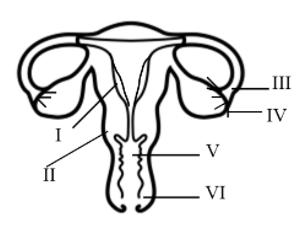
The given figure depicts a diagrammatic sectional view of the human female reproductive system. Which set of three parts is correctly identified?
A) (ii)Endometrium (iii) Infundibulum (iv) Fimbria
B) (iii) Infundibulum (iv)Fimbriae (v) Cervix
C) (iv)Oviduct funnel (iv)Uterus (v) Cervix
D) (i)Perimetrium (ii)Myometrium(iii)Fallopian tube
Answer
 Verified
534.3k+ views
Hint: The Fallopian tubes, also known as uterine tubes. These are are the female structures that transport the ova from the ovary to the uterus each month. Each oviduct is suspended by mesosalpinx and is differentiated into three parts.
Complete answer:
The part of the oviduct closer to the ovary in the funnel-shaped infundibulum. The edges of the infundibulum have certain finger-like projections called fimbriae. Fimbriae collect the ovum after ovulation.
Ampulla: as we see above, the infundibulum leads to a wider part of the oviduct called the ampulla.
Isthmus: It is the last and narrow part having a narrow lumen that links to the uterus.
Talking about the cervix: it is a lower, narrow part that opens in the body of the uterus by the internal os and in the vagina below by the external os. It is mainly composed of the most powerful sphincter muscles in the body. As we move down, The cavity of the cervix is called a cervical canal which along with the vagina forms the birth canal.
Walls of the uterus: the innermost muscle which is highly vascular and glandular and called the endometrium. During the menstrual cycle, every month this layer undergoes cyclic changes. while myometrium exhibits strong contractions during the delivery of the baby.
So the answer is option ‘B’ i.e, (iii) Infundibulum (iv)Fimbriae (v) Cervix.
Note: Implantation of foetus occurs in uterine fundus. It is the site of foetal growth during pregnancy. It also takes part in placenta formation and expulsion of the baby during parturition. The infundibulum opens into the abdominal cavity by an aperture called the ostium.
Complete answer:
The part of the oviduct closer to the ovary in the funnel-shaped infundibulum. The edges of the infundibulum have certain finger-like projections called fimbriae. Fimbriae collect the ovum after ovulation.
Ampulla: as we see above, the infundibulum leads to a wider part of the oviduct called the ampulla.
Isthmus: It is the last and narrow part having a narrow lumen that links to the uterus.
Talking about the cervix: it is a lower, narrow part that opens in the body of the uterus by the internal os and in the vagina below by the external os. It is mainly composed of the most powerful sphincter muscles in the body. As we move down, The cavity of the cervix is called a cervical canal which along with the vagina forms the birth canal.
Walls of the uterus: the innermost muscle which is highly vascular and glandular and called the endometrium. During the menstrual cycle, every month this layer undergoes cyclic changes. while myometrium exhibits strong contractions during the delivery of the baby.
So the answer is option ‘B’ i.e, (iii) Infundibulum (iv)Fimbriae (v) Cervix.
Note: Implantation of foetus occurs in uterine fundus. It is the site of foetal growth during pregnancy. It also takes part in placenta formation and expulsion of the baby during parturition. The infundibulum opens into the abdominal cavity by an aperture called the ostium.
Recently Updated Pages
Master Class 11 Economics: Engaging Questions & Answers for Success

Master Class 11 English: Engaging Questions & Answers for Success
Master Class 11 Maths: Engaging Questions & Answers for Success
Class 11 Question and Answer - Your Ultimate Solutions Guide
Master Class 11 Social Science: Engaging Questions & Answers for Success
Master Class 11 Business Studies: Engaging Questions & Answers for Success
Trending doubts
One Metric ton is equal to kg A 10000 B 1000 C 100 class 11 physics CBSE
There are 720 permutations of the digits 1 2 3 4 5 class 11 maths CBSE
Differentiate between an exothermic and an endothermic class 11 chemistry CBSE
In what year Guru Nanak Dev ji was born A15 April 1469 class 11 social science CBSE
Difference Between Prokaryotic Cells and Eukaryotic Cells
State and prove Bernoullis theorem class 11 physics CBSE