




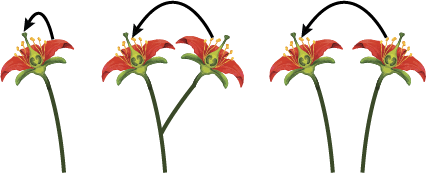
The given diagram shows two plants of the same species. Identify the types of pollination indicated \[P1\], \[P2\], and \[P3\] respectively.
A. \[P1\]-allogamy, \[P2\]- chasmogamy, \[P3\]-cleistogamy
B. \[P1\]-autogamy, \[P2\]-xenogamy, \[P3\]-geitonogamy
C. \[P1\]-autogamy, \[P2\]-geitonogamy, \[P3\]-xenogamy
D. \[P1\]-geitonogamy, \[P2\]-allogamy, \[P3\]-autogamy
Answer
 Verified
552.6k+ views
Hint: Flowering plants, often known as angiosperms, reproduce in a sexual manner. Plant reproduction is primarily centered on the flower, which contains both male and female gametes. Although some components of a bloom are sterile, they all help in the reproduction process. Pollen is delivered to the ovary through the pollen tube after pollination. One of the male gametes unites with the ovule, or female gamete, after reaching the ovary (fertilisation), and the other combines with the polar nuclei. When a gamete combines with eggs, it produces a zygote, which grows into an embryo over time.
Complete answer:
Option A: Allogamy, or cross pollination, is the transfer of pollen grains from one plant's anther to another plant's stigma. Out-breeding in this form is the most common.
The deposition of pollen grains from one flower's anther on the stigma of another flower, either in the same plant or in a separate plant of the same species, is known as allogamy.
So, option A is not correct.
Option B: Xenogamy is the transfer of pollen grains from one flower's anther to the stigma of another plant's blossom. It's a sort of cross-pollination in which the pollen grains and offspring generate differ genetically.
So, option B is not correct.
Option C: An intersexual or perfect bloom is pollinated by its own pollen in autogamy, a sort of self-pollination. Geitonogamy is a pollination method in which pollen grains from one flower are transported to the stigma of another flower from the same or genetically similar plant. Flowers in geitonogamy often have alterations comparable to those seen in xenogamy or cross-pollination. The transfer of pollen grains from one bloom's anther to the stigma of a genetically distinct flower is known as xenogamy or cross-pollination.
So, option C is correct.
Option D: The transport of pollen from one bloom's anther to the stigma of another blossom on the same plant is known as geitonogamy. Pollen is transferred from the anther of one bloom to the stigma of another flower of a different plant in a process known as xenogamy.
Hence this is an incorrect option
So, option C is the correct answer.
Note:
Pollination is the pre-fertilization occurrence or process in which pollen grains from an anther are transported to a flower's stigma.
Pollination can happen within a flower, between flowers from the same plant, or between blooms from different species. Pollinations can be classified into three categories based on this:
1. Autogamy- It is a sort of self-pollination in which pollen grains are transferred from the anther to the stigma within the same flower. Autogamy necessitates the opening and exposure of the anther and stigma.
2. Geitonogamy- Geitonogamy is a kind of self-pollination in which pollen grains are transferred from the anther to the stigma between flowers on the same plant. Despite the fact that it seems to be cross-pollination and occurs with the assistance of a pollinator, both gametes originate from the same plant.
3. Xenogamy- Xenogamy is a type of cross-pollination in which pollen grains are transferred between blooms from two distinct plants. To put it another way, pollen transfers from one plant's anther to another plant's stigma.
Complete answer:
Option A: Allogamy, or cross pollination, is the transfer of pollen grains from one plant's anther to another plant's stigma. Out-breeding in this form is the most common.
The deposition of pollen grains from one flower's anther on the stigma of another flower, either in the same plant or in a separate plant of the same species, is known as allogamy.
So, option A is not correct.
Option B: Xenogamy is the transfer of pollen grains from one flower's anther to the stigma of another plant's blossom. It's a sort of cross-pollination in which the pollen grains and offspring generate differ genetically.
So, option B is not correct.
Option C: An intersexual or perfect bloom is pollinated by its own pollen in autogamy, a sort of self-pollination. Geitonogamy is a pollination method in which pollen grains from one flower are transported to the stigma of another flower from the same or genetically similar plant. Flowers in geitonogamy often have alterations comparable to those seen in xenogamy or cross-pollination. The transfer of pollen grains from one bloom's anther to the stigma of a genetically distinct flower is known as xenogamy or cross-pollination.
So, option C is correct.
Option D: The transport of pollen from one bloom's anther to the stigma of another blossom on the same plant is known as geitonogamy. Pollen is transferred from the anther of one bloom to the stigma of another flower of a different plant in a process known as xenogamy.
Hence this is an incorrect option
So, option C is the correct answer.
Note:
Pollination is the pre-fertilization occurrence or process in which pollen grains from an anther are transported to a flower's stigma.
Pollination can happen within a flower, between flowers from the same plant, or between blooms from different species. Pollinations can be classified into three categories based on this:
1. Autogamy- It is a sort of self-pollination in which pollen grains are transferred from the anther to the stigma within the same flower. Autogamy necessitates the opening and exposure of the anther and stigma.
2. Geitonogamy- Geitonogamy is a kind of self-pollination in which pollen grains are transferred from the anther to the stigma between flowers on the same plant. Despite the fact that it seems to be cross-pollination and occurs with the assistance of a pollinator, both gametes originate from the same plant.
3. Xenogamy- Xenogamy is a type of cross-pollination in which pollen grains are transferred between blooms from two distinct plants. To put it another way, pollen transfers from one plant's anther to another plant's stigma.
Recently Updated Pages
Class 10 Question and Answer - Your Ultimate Solutions Guide

Master Class 12 Economics: Engaging Questions & Answers for Success
Master Class 12 Social Science: Engaging Questions & Answers for Success
Master Class 12 English: Engaging Questions & Answers for Success
Master Class 12 Maths: Engaging Questions & Answers for Success
Master Class 12 Physics: Engaging Questions & Answers for Success
Trending doubts
Explain the Treaty of Vienna of 1815 class 10 social science CBSE
The slogan Jai Hind was given by A Lal Bahadur Shastri class 10 social science CBSE
10 examples of evaporation in daily life with explanations
What is the full form of POSCO class 10 social science CBSE
Identify the feminine form of noun nephew a shenephew class 10 english CBSE
CSIR full form?