




The given diagram shows different parts of the human eye with one part labelled as X. Which the following statement is correct regarding label X?
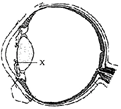
A) It is the opening in the lens that permits light into the inner chambers of the eye.
B) It is the coloured portion of the vascular tunic.
C) It is a biconcave structure that changes shape to bring objects into focus.
D) It is the thick, jelly-like substance in the posterior compartment of the eye.
Answer
 Verified
407.7k+ views
Hint:
Muscles of the X are regulated by the autonomic nervous system. Parasympathetic nerve fibers innervate the circular muscles (causing papillary constriction) and sympathetic fibers supply the radial muscle (causing papillary dilation).
Complete answer:
The cornea is a transparent coat that covers the colored iris. Because it is curved, the cornea helps to focus light onto the retina. The iris is the pigmented and colored portion of the eye. The round opening in the center of the iris through which light enters the interior portions of the eye is the pupil. The iris contains circular muscles that constrict and radial muscles dilate the pupil. The pupil acts like the diaphragm of a camera, dilating and constricting the pupil to allow more or less light into the eye.
Option ‘B’ is correct
Note:
The vitreous chamber is in the posterior segment of the eye. The vitreous humour fills the vitreous chamber and it is a gelatinous mass. Uvea is the iris, ciliary body, and choroid collectively. Iris comes under a vascular tunic made up of the ciliary body, iris, and choroid.
Muscles of the X are regulated by the autonomic nervous system. Parasympathetic nerve fibers innervate the circular muscles (causing papillary constriction) and sympathetic fibers supply the radial muscle (causing papillary dilation).
Complete answer:
The cornea is a transparent coat that covers the colored iris. Because it is curved, the cornea helps to focus light onto the retina. The iris is the pigmented and colored portion of the eye. The round opening in the center of the iris through which light enters the interior portions of the eye is the pupil. The iris contains circular muscles that constrict and radial muscles dilate the pupil. The pupil acts like the diaphragm of a camera, dilating and constricting the pupil to allow more or less light into the eye.
Option ‘B’ is correct
Note:
The vitreous chamber is in the posterior segment of the eye. The vitreous humour fills the vitreous chamber and it is a gelatinous mass. Uvea is the iris, ciliary body, and choroid collectively. Iris comes under a vascular tunic made up of the ciliary body, iris, and choroid.
Recently Updated Pages
Basicity of sulphurous acid and sulphuric acid are

Master Class 12 Economics: Engaging Questions & Answers for Success
Master Class 12 Biology: Engaging Questions & Answers for Success
Master Class 11 English: Engaging Questions & Answers for Success
Master Class 11 Physics: Engaging Questions & Answers for Success
Master Class 11 Computer Science: Engaging Questions & Answers for Success
Trending doubts
Hotspots are regions of high A Rarity B Endemism C class 11 biology NEET_UG
What is the Total Duration of Football Match?
What is BLO What is the full form of BLO class 8 social science CBSE
Explain the Treaty of Vienna of 1815 class 10 social science CBSE
Draw a labelled sketch of the human eye class 12 physics CBSE
In football, which nation is called "La Roja"?